Turlock’s November 2026 Voter Guide: Candidates, Propositions & What’s at Stake
On Tuesday, November 3, 2026, Turlock voters choose local leaders, California’s next governor and a member of Congress, while deciding 14 statewide propositions.
This guide draws on official ballot documents, candidates’ stated priorities and local reporting. Campaign promises and supporters’ opinions are identified as such.
- Start with your own ballot
- Mayor and City Council
- Schools and other local districts
- Congress and state lawmakers
- Governor and statewide offices
- Judicial retention votes
- All 14 propositions
- Dates, vote centers and drop boxes
First, check which ballot is yours
Two people living a few blocks apart can have different council, school and congressional contests. Turlock’s mayor is elected citywide; councilmembers are elected by district. Congressional boundaries changed for this election, and Turlock is now split between Districts 5 and 13. A Turlock mailing address also does not necessarily mean a home is inside the city limits.
Open the county’s personalized sample-ballot lookup and compare it with the ballot mailed to you. The state’s redistricting explanation and adopted congressional city-splits report confirm the new federal boundaries. New House members take office in January; the election map does not instantly change your current representative.
- City: everyone inside Turlock votes for mayor. Council Districts 1 and 3 have contests; Districts 2 and 4 do not this year.
- Schools: Turlock Unified’s contested race is in Trustee Area 4. Your school-district boundaries determine your ballot.
- Federal: one U.S. House race, in District 5 or 13. There is no presidential or California U.S. Senate election this November.
- State: governor, the other statewide offices, Senate District 4, Assembly District 22 and Board of Equalization District 1.
- Courts and measures: judicial retention questions and all 14 statewide propositions.
The candidate names below are checked against the city’s nomination list, the county’s current contest list and the Secretary of State’s certified candidate list. The county’s list covers the entire county; it is not one resident’s ballot.
City Hall: three candidates for mayor
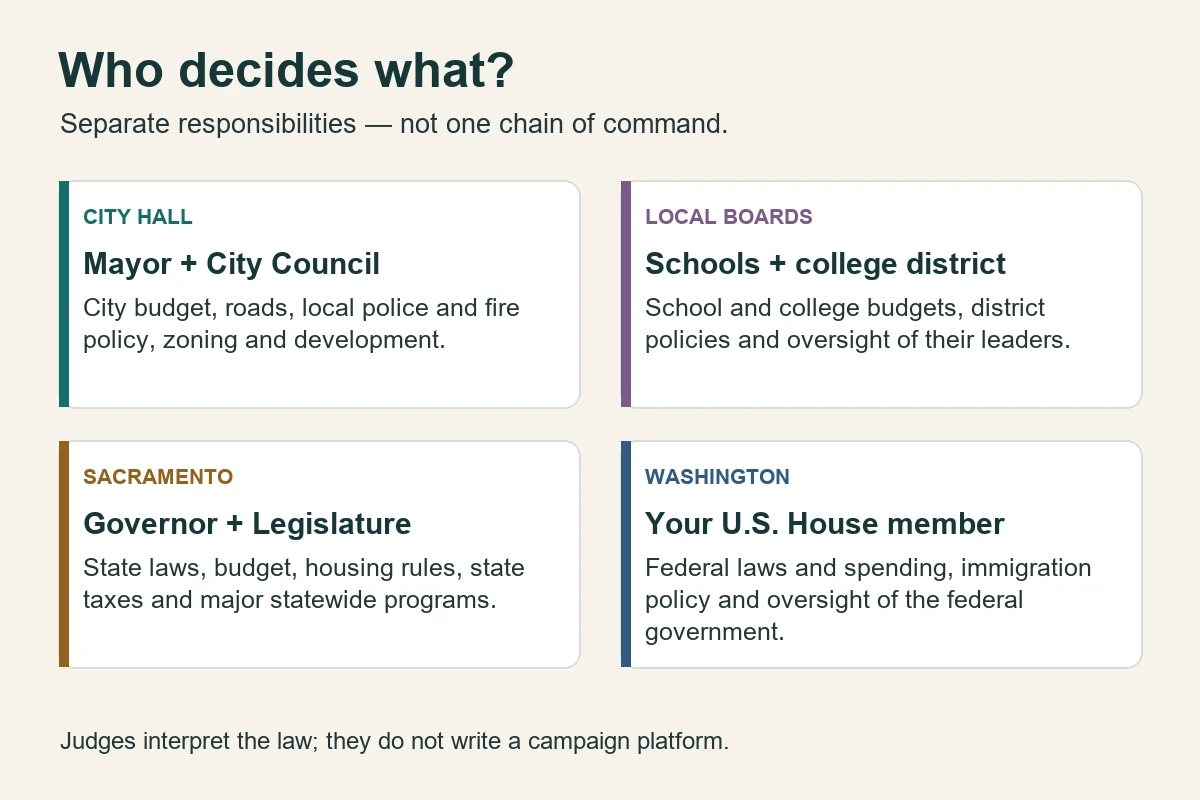
The mayor has one vote on a five-member City Council. Together, the council adopts the budget, sets city policy and makes major development and infrastructure decisions. The appointed city manager handles daily operations. A mayor can influence the direction of roads, police, fire services and housing, but does not run Turlock Unified or write federal immigration law. How Turlock’s council works.
Amy Bublak: continue the current direction
Bublak is the incumbent, first elected mayor in 2018 after serving on the council. Her case for another term centers on road work, finances and public-safety staffing. In the county voter guide, she argues that the city’s progress should continue. Her LocalTurlock profile follows her background and council record.
In the Modesto Bee’s candidate questionnaire, Bublak identifies sewer improvements as urgent and favors phasing work and seeking grants or partnerships before adding costs for residents. The useful follow-up is specific: which projects come first, what will households pay, and how will the city report progress?
Jim Reape: change the leadership style
Reape is a health-care professional, Air Force veteran and city planning commissioner. His candidate statement emphasizes collaboration, local businesses, housing affordability and steady professional leadership. In the Bee questionnaire, stabilizing leadership at City Hall is a leading priority.
He has a concrete policy difference with Bublak: the Journal reported that he supported restoring local fire administration rather than renewing the Modesto arrangement. His case is for a different working relationship at City Hall, with the practical test being how he would retain management, work with council colleagues and fund services. Read his background and public-service profile.
Kelley Coelho: stronger advocacy and accountability
Coelho is a private investigator, business owner and Army veteran. Her candidate statement stresses safety, infrastructure, responsible budgets, homelessness-spending accountability and accessible government. Her campaign argument is that residents need clearer answers and a more insistent advocate.
School safety is also a central concern in her Bee questionnaire. The distinction matters: the mayor can pursue city-school cooperation, while school policy belongs to the elected school board. Compare the specific changes she proposes, their cost and their timetable. Her LocalTurlock profile provides more background. The official nomination list spells her name Kelley.
What people are arguing about locally
Fire administration. In a reported 3–2 vote, Bublak backed renewing the agreement with Modesto; Bixel and Abram favored local administration. Reape spoke for local control. Firefighter-union members argued that the partnership hurt morale and wanted a separate local administration, while the interim deputy fire chief argued that the regional arrangement was the better option. The choice concerns management of Turlock’s fire service, not whether the city should have firefighters. Read the Journal’s report on the fire agreement.
Roads. All three mayoral candidates say repairs matter. At an earlier forum, Reape called for main-corridor priorities, preventive maintenance and future maintenance funding. Coelho favored prioritizing access to public-safety facilities and fixing underlying problems. Bublak defended the city’s comprehensive approach, including drainage and sidewalks, as a reason projects take longer. That leaves a useful comparison: which roads, which repair standard and which long-term funding plan? Their reported road answers.
Development incentives. The council approved fee reductions for qualifying commercial and industrial development. Bublak and Bixel supported them; Abram opposed the program, questioning its fairness and value. Supporters say lower upfront costs help attract investment and jobs. Critics want proof that the public benefit justifies the incentive and that infrastructure remains funded. This was a council decision, not a proposition on the November ballot. Read the development-fee debate.
The October 7 mayoral debate also showed a difference in temperament. The Journal interviewed eight attendees afterward: several praised Reape’s calm answers, while one favored Bublak’s experience. Those interviews describe those people’s reactions; they do not establish how the city will vote. Read the debate coverage.
A contrasting voice appears in Richard Clark’s letter supporting Bublak: he argues that successful implementation of road funding supports keeping the incumbent. That is an individual voter’s argument. Put it alongside the challengers’ case for a change in leadership and the candidates’ documented votes and proposals.
City Council: vote only in your district
District 1 — Kevin Bixel and Jeremy Rocha. Bixel, elected in 2022, emphasizes roads, safety, finances and setting policy without micromanaging employees. His voting record includes supporting local fire administration and development-fee incentives. Rocha’s campaign platform proposes simpler permits, jobs, parks and youth programs, police staffing and a road-maintenance reserve. Both talk about better services; compare what they would fund first. See Bixel’s profile and the candidate questionnaire.
District 3 — Cassandra Abram and Ryan Taylor. Abram, elected in 2022, emphasizes fiscal responsibility, safe streets and sidewalks, infrastructure and public participation. Her votes on fire administration and development incentives offer a record to examine. Taylor, a business owner with mosquito-abatement board experience, emphasizes road maintenance, safety, homelessness prevention and housing affordability. Compare Abram’s record, Taylor’s platform and their candidate statements. Ask both for a repair schedule and a budget, rather than stopping at the shared promise of public safety.
Schools and the other local districts
Turlock Unified Trustee Area 4 — Mary Jackson and Jayden Betbabanta. Jackson’s statement emphasizes stable finances, campus safety and additional academic support. Betbabanta told the Bee he wants earlier help for struggling students, less chronic absenteeism, more after-school opportunities and planning for enrollment changes. Both discuss safety and academics. Compare which students they would help first, what the intervention costs and how the district would measure results. Read the school-board questionnaire.
Areas 2 and 6 are also in this year’s school-board election cycle, with Sal Loera and Patrick Shields reported unopposed. The county’s current November contest list does not include those as contested races. Your address-specific sample ballot shows what you can actually mark; being in an election cycle does not guarantee a two-candidate contest.
Community colleges. Turlock city is in Yosemite Community College District Trustee Area 3. Milton Richards’ term runs to 2028. Nearby Hilmar and westside readers in Area 4 have a separate race between Jenny Nicolau and Ryan Segoviano. Nicolau emphasizes job-ready credentials and a West Side MJC site; Segoviano emphasizes rural access, completion and transparent leadership. Check the district’s map and regional trustee interviews if that is your district.
Turlock Irrigation District. There is no competitive TID contest on the county’s current November list. For Divisions 2, 3 and 5, the registrar certified that there was no more than one nominee and no qualifying petition for an election. An October 13 county agenda item requests appointments in lieu of an election. As of this guide’s October 12 update, that action is pending. Registrar certificate and appointment request.
Important officials who are not on this November ballot
Turlock-area County Supervisor Vito Chiesa, Sheriff Jeff Dirkse and District Attorney Jeff Laugero are on the 2028 election cycle. Councilmembers Rebecka Monez and Erika Phillips also have terms continuing to 2028. California’s U.S. senators are not on this ballot: Alex Padilla’s seat next comes up in 2028 and Adam Schiff’s in 2030. The president and vice president are not elected this year.
Appointed officials, including the city manager and police chief, are not elected on your November ballot. Our local representatives directory explains who currently holds these jobs. For election timing, see the county’s office-and-term list and U.S. Senate roster.
Congress: which federal race is on your ballot?
Your House member votes on federal laws, spending and taxes, and helps constituents deal with federal agencies. This office touches immigration law, Medicare, farm policy and federal water projects. House terms last two years. What the House does.
District 5: Tom McClintock and Michael Masuda
Republican incumbent Tom McClintock emphasizes limited government, lower spending, a balanced-budget amendment, water storage and less restrictive permitting. Democrat Michael Masuda, a foreign affairs officer, proposes federal investment in rural hospitals, wildfire prevention, housing and job training. His immigration platform combines enforcement focused on public-safety threats with legal pathways for long-term residents and agricultural workers.
The disagreement is over how much government should spend and regulate to address rural problems. Both discuss water and fire protection; compare the funding and environmental rules behind those promises. These are their published campaign positions: McClintock on spending, McClintock on water and Masuda’s priorities.
District 13: Adam Gray and Kevin Lincoln
Democratic incumbent Adam Gray emphasizes health coverage, tariff-related costs and water storage. He supports immigration legislation combining border security with legal status for qualifying farmworkers and other residents. Republican Kevin Lincoln, a former Stockton mayor and Marine veteran, emphasizes stronger border enforcement, lower taxes, less government waste, police support and water access. He has welcomed President Trump’s endorsement.
Both present themselves as Valley problem-solvers. The sharper differences involve health-care funding, taxes, immigration and their approach to the Trump administration. Read Gray’s proposals and Lincoln’s proposals alongside Stocktonia’s reporting. This is Gray versus Lincoln, not a repeat of the Gray–John Duarte race.
The state lawmakers: Senate 4 and Assembly 22
State Senate District 4 — Jaron Brandon and Alexandra Duarte. Democrat Brandon, a Tuolumne County supervisor, proposes faster housing permits, support for rural hospitals, fire-hardening grants and insurance discounts tied to risk reduction. Republican Duarte, a farmer, emphasizes lower taxes and fuel costs, water storage, stronger sentencing and police funding, and firefighting support.
Both stress agriculture, rural communities and insurance affordability. Their disagreement is over the mix of public investment, taxes, regulation and enforcement. Compare Brandon’s platform and Duarte’s platform, or watch their answers to the same questions in The Modesto Focus’ October debate.
Assembly District 22 — Juan Alanis. The Republican incumbent is the only candidate on the certified November list. There is no second finalist to compare. The Senate and Assembly write state laws and approve the budget; neither office can independently enact a promise. Certified candidate list; Alanis’ Assembly page.
Governor and the other statewide offices
Governor: Xavier Becerra and Steve Hilton
The governor proposes California’s budget, signs or vetoes laws, directs state agencies and appoints judges. Gavin Newsom is not seeking another term. Democrat Xavier Becerra is a former California attorney general and U.S. health secretary. Republican Steve Hilton is a former political adviser and television commentator.
Becerra emphasizes health-care access, consumer protections, housing-permit reform and opposition to Trump administration policies. Hilton proposes no state income tax on the first $150,000 of income, an 8% flat rate above it, fewer housing and business restrictions, and more oil production and water infrastructure. These are proposals, not changes already in law.
Their September debate exposed the argument plainly: Becerra criticized Hilton’s tax plan for benefiting wealthy earners; Hilton criticized Becerra for blaming Trump instead of explaining how he would fix state problems. Compare those arguments with the costs and implementation details. CalMatters’ debate report; Hilton’s agenda; Becerra’s agenda.
Water deserves a closer look. Hilton proposes more storage and fewer environmental restrictions. Becerra defends California’s authority to manage water, but CalMatters’ October comparison found he had not supplied a detailed water plan. More storage can appeal to farm-water advocates; environmental, fishing and tribal groups raise concerns about river flows and salmon. New infrastructure also has to be paid for. Read the water-policy comparison.
Lieutenant governor: Fiona Ma and Gloria Romero
This office succeeds the governor if the job becomes vacant and has important votes on higher-education and public-land boards. Democrat Fiona Ma, the current treasurer, emphasizes college affordability, paid internships, career pathways and financing experience. Republican Gloria Romero, a former Democratic Senate majority leader, emphasizes school choice, educational standards and less bureaucracy, along with her positions on women’s sports and campus policy. Office duties and both candidates’ statements.
Secretary of state: Shirley Weber and Don Wagner
This office oversees statewide elections, business filings and campaign-finance disclosure. Democratic incumbent Shirley Weber emphasizes voter access and voting rights. Republican Don Wagner emphasizes faster counting, voter ID and voter-roll maintenance. The disagreement is which checks improve trust and which add obstacles for eligible voters. Many rule changes need legislation or voter approval; the secretary cannot rewrite every rule alone. Their statements and office duties.
Controller: Malia Cohen and Herb Morgan
Think state accountant and financial auditor. Democratic incumbent Malia Cohen emphasizes transparency, returning unclaimed property and modernizing payroll. Republican Herb Morgan proposes a detailed, near-real-time public spending database and stronger audits. Both promise accountability; the useful distinction is what reporting and oversight they would change. Read both controller statements.
Treasurer: Eleni Kounalakis and Jennifer Hawks
Think state banker: investments, bonds and public financing. Democrat Eleni Kounalakis, the current lieutenant governor, emphasizes financing housing, protecting pensions and investing in families. Republican Jennifer Hawks emphasizes management experience, investment oversight and exposing waste. The treasurer manages financing but does not set the entire state budget alone. Read both treasurer statements.
Attorney general: Rob Bonta and Michael Gates
California’s top lawyer leads the Department of Justice and pursues major criminal, consumer and civil-rights cases. Democratic incumbent Rob Bonta emphasizes consumer protection, civil rights, gun-safety laws, reproductive rights and legal challenges to Trump administration policies. Republican Michael Gates emphasizes theft and drug-trafficking prosecutions, enforcing Proposition 36 and a stronger law-and-order approach. They disagree about enforcement priorities and several existing state policies. Bonta’s campaign priorities; Gates’ statement and office duties.
Insurance commissioner: Ben Allen and Jane Kim
Both candidates are Democrats. This regulator oversees insurance-company conduct and rates, affecting homeowners, drivers, renters and businesses. Ben Allen emphasizes fire-risk reduction, competition and consumer enforcement within the current market. Jane Kim favors a larger change, including public disaster insurance and tighter limits on insurer profits.
Allen’s supporters argue reform can improve coverage without the risks of a new public system. Kim’s supporters argue private-market fixes have not produced affordable, reliable coverage. Compare who would fund each approach, who carries disaster losses and which changes require lawmakers’ approval. CalMatters’ comparison; Official statements.
State schools superintendent: Richard Barrera and Sonja Shaw
This is a nonpartisan office. Richard Barrera, a San Diego school-board veteran, has Democratic Party support; Sonja Shaw, Chino Valley’s school-board president, has Republican Party support. Both promise stronger academics. Barrera emphasizes community cooperation and protections for students. Shaw emphasizes parental authority, reading and math, and restrictions on transgender students’ use of facilities and participation in girls’ sports. Those are substantive policy differences. KALW’s debate coverage; Candidate statements.
The job is changing. Starting in January 2027, a governor-appointed, Senate-confirmed education commissioner takes over day-to-day management of the California Department of Education. The elected superintendent remains an independent advocate and evaluator, with voting roles on education governing boards. It would be misleading to describe the winner as simply taking charge of the department. The Legislative Analyst explains the enacted change.
Board of Equalization District 1: Nelson Esparza and Shannon Grove
This tax-oversight office deals especially with property assessments. Democrat Nelson Esparza emphasizes consistent assessments, closing loopholes and fair treatment for households and small businesses. Republican Shannon Grove emphasizes taxpayer protection, Proposition 13 and preventing overtaxation. They emphasize different risks in the tax system; this board does not set every California tax. Statements and office duties.
Judges: a separate Yes or No for each person
California Supreme Court justices Kelli M. Evans and Joshua Groban have retention questions. The Fifth District Court of Appeal names are Arlan L. Harrell, Sonny S. Sandhu, Amy K. Guerra, Kathleen A. Meehan, Mark W. Snauffer and Thomas DeSantos.
These are nonpartisan retention votes, with no opposing candidate beside each name. Yes keeps that justice in office; No rejects retention. Professional qualifications and judicial work are the relevant record to examine. Read the Supreme Court biographies and explanation and Fifth District biographies.
All 14 statewide propositions, in plain English
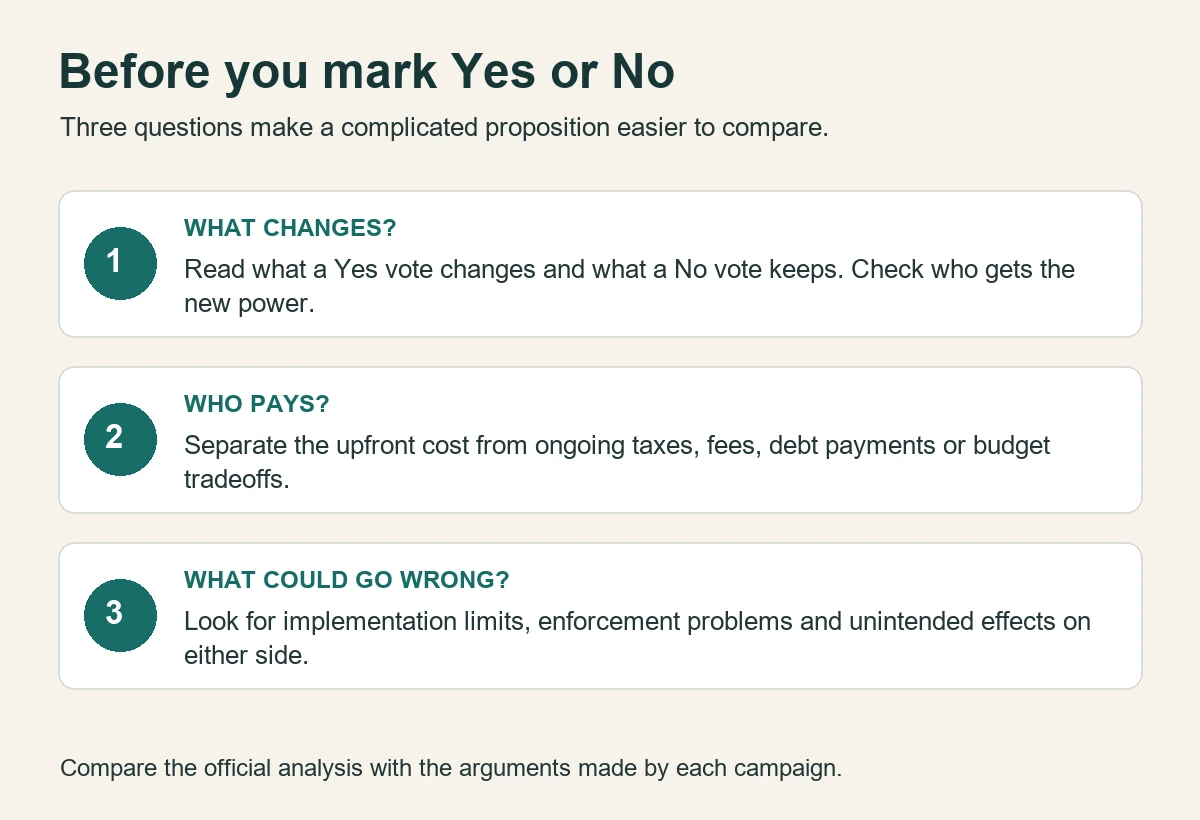
The numbering jumps from 5 to 37. That is the actual November ballot sequence, not a missing section. Below, the legal effect and fiscal estimates come from the Legislative Analyst’s official analyses. The arguments describe what supporters and opponents say. A missing formal opposition argument does not mean a measure has no tradeoffs.
There is no countywide, City of Turlock or Turlock Unified local measure on the county’s current November list. Measures K through P belong to other cities or school districts. Older Turlock measures mentioned in campaign discussions are not new propositions on this ballot. Check the county’s local-measure list.
Proposition 1: Borrow for affordable housing
- Yes: Let California borrow $11.25 billion for affordable rentals, housing preservation, homebuyer help and veterans’ mortgages.
- No: Reject this borrowing.
Supporters, including Habitat for Humanity California and veterans’ groups, say the state needs money to build and preserve homes for people priced out of the market. Republican legislators quoted by CalMatters question adding debt without tackling why construction costs so much. The Legislative Analyst estimates $500 million to $600 million in annual state repayments for about 25 years. The official guide received no formal opposition argument; that does not erase the budget tradeoff or the legislative criticism. This is statewide funding, not a promised allocation to Turlock.
Official analysis and costs · Supporters’ and opponents’ arguments · Independent reporting.
Proposition 2: Save more for bad budget years
- Yes: Raise the rainy day fund’s target ceiling from 10% to 20% of General Fund tax revenue, extend extra debt payments through 2040, and change how reserve deposits count against the state’s spending limit.
- No: Keep current rules.
Supporters say bigger savings will soften cuts to schools, health care and public safety when tax revenue falls. Opponents argue excluding deposits from the spending limit makes taxpayer rebates less likely. The Legislative Analyst expects higher reserves and possibly more debt payments. The choice is about budget rules, not an automatic new tax or guaranteed extra school spending.
Official analysis and costs · Supporters’ and opponents’ arguments.
Proposition 3: Keep the higher tax on high incomes
- Yes: Make the higher income-tax rates adopted in 2012 permanent.
- No: Let those higher rates expire in 2031 under current law.
Teachers’ and health groups supporting it say losing this money would damage education and other public services. Taxpayer and business groups opposing it argue the state should fix spending rather than make a temporary tax permanent. The Legislative Analyst estimates preserving $5 billion to $15 billion in annual revenue, depending heavily on the economy and investment gains. This does not immediately raise existing rates; it prevents their scheduled expiration. It is an income tax, distinct from Proposition 40’s wealth tax.
Official analysis and costs · Supporters’ and opponents’ arguments.
Proposition 4: Allow public campaign financing
- Yes: Allow the state and local governments to create optional public campaign-financing programs.
- No: Keep the ban for the state and most local governments.
Supporters, including the League of Women Voters, say small-donor/public programs could make candidates less dependent on wealthy contributors. Taxpayer groups opposing it say residents should not have to pay for politicians’ campaigns. Approval does not itself launch a Turlock program. Funds earmarked for education, transportation and public safety could not be diverted to campaigns. The state’s guidance costs are estimated at a few hundred thousand dollars yearly; any future financing program’s costs depend on decisions made later.
Official analysis and costs · Supporters’ and opponents’ arguments.
Proposition 5: Separate recall from replacement
- Yes: Remove the replacement-candidate question from state recall ballots. Fill the resulting vacancy through the office’s appointment or election process, with special rules for governor.
- No: Keep choosing whether to recall and who replaces the official on the same ballot.
Supporters say this avoids a replacement winning with a small share of votes. Opponents say voters lose an immediate say over the successor and sometimes face a second, costly election. For a recalled governor, the lieutenant governor would take over, with another election depending on timing. The Legislative Analyst says costs or savings could run into millions per recall; there is no fixed statewide saving.
Official analysis and costs · Supporters’ and opponents’ arguments.
Proposition 37: Help with a new home’s down payment, using another loan
- Yes: Create a homebuying assistance program financed by up to $25 billion in revenue bonds.
- No: Do not require this program.
Eligible buyers of qualifying newly built homes could borrow up to 17% of the price and provide at least 3% themselves. Supporters say this puts homeownership within reach without charging taxpayers. Critics described by CalMatters worry about deeper buyer debt, government involvement in lending, and leaving construction costs untouched. Buyers must repay the assistance: it is not free down-payment money. The Legislative Analyst finds no direct state/local cost because homeowner payments repay the bonds. The official guide has no submitted opposition argument, but independent reporting describes opposition.
Official analysis and costs · Supporters’ and opponents’ arguments · Independent reporting.
Proposition 38: Borrow for immune-system research
- Yes: Authorize $8.4 billion in state bonds for immunology and immunotherapy research.
- No: Reject this borrowing.
Supporters, including disease-research advocates, hope for treatments for cancer, Alzheimer’s and other illnesses. Opponent Robert Kaplan argues long-term debt locks in priorities better decided through ordinary budgets. About half the money would go to a qualifying research institute and half to competitive grants. The Legislative Analyst estimates $500 million to $600 million in yearly repayments for about 20 years. Discoveries might produce revenue that offsets debt, but that is uncertain and could take decades. A promised potential cure or no taxpayer cost is a campaign claim, not a guaranteed outcome.
Official analysis and costs · Supporters’ and opponents’ arguments.
Proposition 39: Add identification requirements when voting
- Yes: Require government-issued ID for in-person voting and the last four digits of a designated ID number on mail-ballot envelopes; add citizenship-verification efforts and election audits.
- No: Keep current identification procedures.
Supporters say the extra check builds confidence in elections. Civil-rights and voting groups opposing it say it adds unnecessary barriers for eligible voters who lack documents, alongside privacy and cost concerns. The state would provide a free voter ID on request. The Legislative Analyst estimates yearly implementation costs from tens of millions to the low hundreds of millions. This is a proposal for future rules; it is not an instruction to change how you complete this November’s envelope.
Official analysis and costs · Supporters’ and opponents’ arguments · Independent reporting.
Proposition 40: One-time tax on billionaire wealth
- Yes: Levy a one-time 5% wealth tax on qualifying billionaires who were California residents January 1, 2026.
- No: Reject it.
Ninety percent of proceeds would go to health care. Supporters such as SEIU-UHW say wealthy residents should help cover federal health-care cuts. Opponents include business interests and some medical, education and labor organizations; they worry about departures, lost future income-tax revenue and a temporary fix for ongoing costs. The Legislative Analyst estimates tens of billions in temporary revenue, with a possible continuing income-tax loss below $1 billion annually. The tax is due in 2027, with a costlier five-year payment option. Wealth and yearly income are different.
Official analysis and costs · Supporters’ and opponents’ arguments · Independent reporting.
A campaign ad says lawmakers could expand the billionaire tax to everyone. CalMatters’ fact-check finds that claim only partially true: amendment authority is limited by the measure’s purpose and constitutional text. The legal outcome is not settled. Another wrinkle: if Proposition 41 or 42 receives more Yes votes, it could block Proposition 40 if a court finds a conflict. The official analysis describes a possibility, not automatic cancellation.
Proposition 41: Audit programs funded by new special taxes
- Yes: Require new audits before certain voter-proposed state special taxes reach the ballot and recurring reviews of programs funded by new special taxes; restrict exemptions from the state spending limit.
- No: Keep current audit/spending-limit rules.
Supporters, including taxpayer groups and accountants, argue new taxes should come with a closer look at waste and results. SEIU-UHW and other opponents say it is also designed to undercut the billionaire tax. The Legislative Analyst estimates audit costs in the low millions annually, growing over time; broader fiscal effects depend on future decisions. It is more than an audit-only measure: the spending-limit provision matters too.
Official analysis and costs · Supporters’ and opponents’ arguments.
Proposition 42: Ban new state taxes on owned assets
- Yes: Prohibit new state taxes on the ownership of financial assets and other personal property, and limit certain retroactive taxes.
- No: Leave those future taxation options available.
Supporters describe protection for retirement savings and already-taxed assets. Opponents argue the measure also blocks the billionaire wealth tax and constrains future health-care funding. California currently taxes some personal property, such as through vehicle fees, but does not tax ownership of financial assets generally. The Legislative Analyst says future tax revenue could be lower; the amount is unknown. This proposal is not a repeal of your home’s property tax or of existing vehicle charges.
Official analysis and costs · Supporters’ and opponents’ arguments.
Proposition 43: Raise the threshold for certain local taxes
- Yes: Starting January 1, 2027, require two-thirds approval for new, increased or extended local special taxes proposed by voters.
- No: Keep majority approval for those voter-proposed taxes.
Taxpayer groups supporting it say earmarked taxes should have broad support and the same threshold as government-proposed special taxes. Firefighter, teacher and nursing groups opposing it say a minority could block funding the majority wants for local services. The Legislative Analyst expects possible lower future local revenue, with no fixed amount. It does not cut an existing tax, and it is not a blanket two-thirds rule for every local ballot question or school bond.
Official analysis and costs · Supporters’ and opponents’ arguments.
Proposition 44: Make certain clinics spend 90% on their mission
- Yes: Require covered private nonprofit community clinics to spend at least 90% of revenue on health-care/program services, with penalties for falling short.
- No: Do not add that rule.
Supporters say more money should reach patient care instead of administration and executive spending. Medical and clinic groups opposing it say the tight limit ignores necessary operating costs and could close clinics or reduce access. The Attorney General would define eligible spending, and some temporary waivers would be possible. The Legislative Analyst estimates state enforcement costs in the low tens of millions yearly, covered by clinic fees; wider service and public-cost effects are uncertain.
Official analysis and costs · Supporters’ and opponents’ arguments.
Proposition 45: Put faster deadlines on environmental reviews
- Yes: Let eligible housing and infrastructure projects use faster environmental-review, permitting and court-challenge procedures.
- No: Keep current procedures.
Business and building groups say unpredictable delays make homes and essential infrastructure more expensive. Environmental and some labor groups say tighter reviews weaken residents’ ability to challenge harmful projects. The Legislative Analyst says agencies would face initial annual costs in the high tens of millions, potentially above $100 million, partly paid through fees; longer-term gains or losses are uncertain. The choice is about review procedures, not approval of a particular Turlock development. High-speed rail and Delta conveyance projects are excluded from the eligible categories.
Official analysis and costs · Supporters’ and opponents’ arguments · Independent reporting.
How to vote in Turlock
Stanislaus County mails a ballot to registered voters, and in-person voting is also available. Sign the return envelope. At a vote center you can get a replacement ballot, language assistance, registration help and accessible voting equipment. County voters can use any open vote center in Stanislaus County. County voting options.
Dates worth putting on the fridge
- October 19: regular registration deadline. Check your registration or register or update it.
- October 20–November 3: eligible voters who miss that deadline can conditionally register and vote at the county office or an open vote center. The ballot counts after verification. Same-day registration rules.
- October 24: the Hampton Inn vote center opens in Turlock.
- October 27: the county recommends mailing at least seven days before Election Day because postal processing can delay postmarks. This is advice, not the legal deadline. County mail-early advisory.
- October 31: three more Turlock vote centers open.
- Tuesday, November 3: vote centers open 7 a.m.–8 p.m. Ballots must reach an official drop box by 8 p.m.; an indoor box may close earlier with its host. A mailed ballot must be postmarked by November 3 and received by November 10. Near the deadline, use an official drop box or request a manual postmark from a postal employee at the counter. Mail-ballot rules.
Where to vote in person
Before Election Day, these Turlock centers are open 8 a.m.–5 p.m. On November 3, they are open 7 a.m.–8 p.m. The dates and rooms below come from the county’s current voting-location list.
- Hampton Inn by Hilton–Turlock, meeting room: 1821 Lander Avenue. October 24–November 3, including weekends.
- Assyrian American Civic Club: 2618 N. Golden State Boulevard. October 31–November 3.
- Calvary Baptist Church, chapel: 700 E. Monte Vista Avenue. October 31–November 3.
- Turlock Library, Hilmar Cheese Company Community Room: 550 N. Minaret Avenue. October 31–November 3.
Where to return a completed ballot
Outdoor, 24-hour box: CSU Stanislaus, 1 University Circle, available through November 3 at 8 p.m. The outdoor box is a ballot-return location; CSU is not listed as a staffed in-person vote center. There is also staffed drive-up ballot return on campus November 2, 8 a.m.–5 p.m., and November 3, 7 a.m.–8 p.m. Use the county’s Voter Services Map for the campus location.
Indoor boxes operate during host opening hours. The county lists these Turlock locations:
- FoodMaxx, 1845 Countryside Drive.
- Save Mart, 2595 Geer Road.
- Save Mart, 1631 Lander Avenue.
- City Hall, 156 S. Broadway. The listed weekday hours end at 5 p.m.; choose another official location if returning a ballot later.
- Turlock Library, 550 N. Minaret Avenue.
Check the current county list for host hours, and track your ballot to confirm it was received and accepted. If a ballot is missing or you need help, contact the Registrar of Voters at 209-525-5200. The county office is at 1021 I Street, Suite 101.
Have a factual correction or a useful public source? Send it to LocalTurlock. For more background, explore the representatives directory and our mayoral-race coverage.
You might be interested in