Category archive

Government & Elections

Local government, public officials, elections, ballot measures and civic decisions.

Turlock Election Results: Amy Bublak Leads by 651 Votes
in Government & Elections/Education
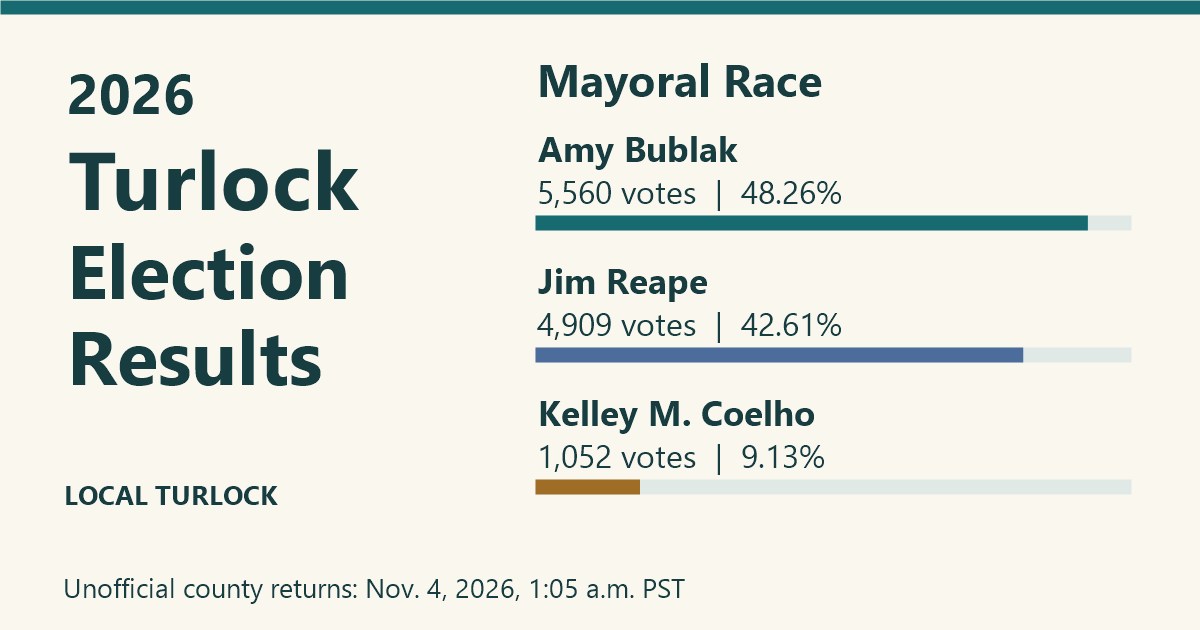
Unofficial Turlock mayoral vote: Amy Bublak 5,560; Jim Reape 4,909; Kelley M. Coelho 1,052.
Unofficial mayoral returns in the county's November 4, 1:05 a.m. report. Graphic by Local Turlock.

Turlock woke up Wednesday with Amy Bublak leading the mayoral race by 651 votes and a City Council contest separated by just 31 votes. The overnight returns favor three City Hall incumbents, but the local races remain unofficial as more ballots are processed.

The figures below use the Stanislaus County report issued November 4 at 1:05 a.m. for local contests and the California Secretary of State’s 6:27 a.m. statewide and districtwide returns for the larger races. A news organization’s race call is identified separately from an official certification.

Amy Bublak Leads Jim Reape in the Mayoral Count

CandidateVotesShare
Amy Bublak5,56048.26%
Jim Reape4,90942.61%
Kelley M. Coelho1,0529.13%

The county has recorded 11,521 votes for the three listed mayoral candidates. Amy leads Jim by 651 votes, or 5.65 percentage points. Kelley is third. These are the numbers in the overnight report, rather than a declaration that the contest has been decided.

The two methods of voting tell slightly different parts of the story. Among counted vote-by-mail ballots, Amy has 4,748 votes to Jim’s 4,297, a 451-vote advantage. At vote centers, Amy has 812 to Jim’s 612, adding another 200 votes to her lead. Kelley has 814 mail votes and 238 vote-center votes.

Those categories describe ballots already included in this report. They do not tell us how the uncounted ballots will break, and they do not establish why a particular neighborhood or group supported a candidate.

For Amy Bublak, the campaign is a bid for a third term. She became Turlock’s first woman mayor in 2018 after serving on the council. Her campaign emphasized public safety, city finances, street reconstruction and continuing projects begun during her tenure.

Jim Reape, a Planning Commission member since 2017 and longtime local healthcare professional, argued for steadier staffing, collaboration at City Hall and long-term road maintenance. Kelley Coelho, an investigator and Army veteran, emphasized accountability, responsiveness and school safety. Those were campaign priorities, rather than explanations the vote totals themselves can prove.

The Turlock Journal’s election-night report pictured Amy meeting supporters at Jura’s Pizza while holding an earlier lead. The county’s later report is the source for this article’s vote totals. For the candidates’ positions before Election Day, see our local representatives directory and the individual profiles linked above.

Cassandra Abram and Ryan Taylor Are Just 31 Votes Apart

District 3 is the closest of Turlock’s three contested City Hall races in this report. Incumbent Cassandra Abram has 1,670 votes, or 50.47%, against Ryan Taylor’s 1,639, or 49.53%. The difference is less than one percentage point.

Here, the voting-method breakdown makes the narrow margin especially clear. Cassandra leads the counted mail ballots 1,490 to 1,390. Ryan leads vote-center ballots 249 to 180. Subtracting Ryan’s 69-vote vote-center advantage from Cassandra’s 100-vote mail advantage leaves 31 votes.

In District 1, incumbent Kevin Bixel leads Jeremy Rocha 1,927 to 1,314. Kevin has 59.46% of the counted candidate vote, compared with Jeremy’s 40.54%, a 613-vote margin. The two district races should not be treated as equally close simply because both incumbents are ahead.
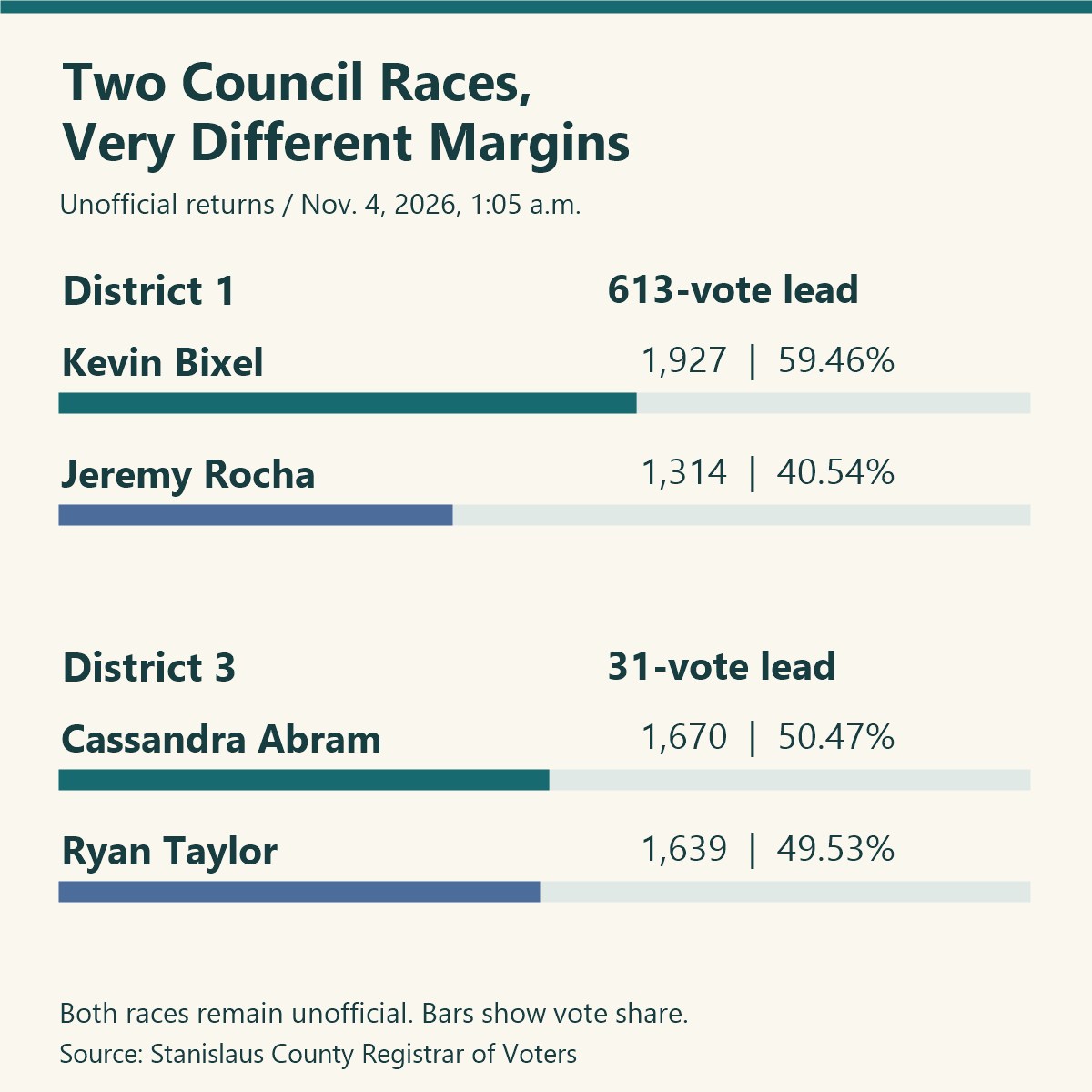
Kevin Bixel leads Jeremy Rocha by 613 votes. Cassandra Abram leads Ryan Taylor by 31 votes.
Unofficial council returns from the November 4, 1:05 a.m. county report. Graphic by Local Turlock.

If the current leaders ultimately prevail, voters will have retained Amy, Kevin and Cassandra in the offices on this year’s ballot. That is a conditional description of the present count. Turlock’s council still makes decisions collectively; an individual mayor or councilmember cannot approve a city budget or contract alone.

Mary Jackson Leads for Turlock Unified Area 4

In Turlock Unified School District Area 4, Mary Jackson has 1,914 votes, or 71.82%, against Jayden Betbabanta’s 751 votes, or 28.18%. The recorded margin is 1,163 votes. School-board boundaries are separate from City Council districts, so an Area 4 school result is not a District 4 council result.

Denair Unified voters were choosing up to two board members. Mike Baker has 769 votes and Kathi Dunham-Filson has 595, followed by Gaby Cortes with 483 and Billy Ray Myers with 434. Mike and Kathi occupy the two leading positions in this report. Because voters could select two candidates, those totals should not be read as if everyone cast one vote in a two-person race.

Congress and the Legislature: Use the Entire District

The county report includes only the Stanislaus County portion of congressional and state legislative contests. The full district can have a different margin, and sometimes a different leader. The Secretary of State combines the participating counties.

RaceFull-District CountStatus
U.S. House District 5Tom McClintock: 102,646 (56.2%)
Michael Masuda: 79,957 (43.8%)
AP race call for Tom McClintock
U.S. House District 13Adam Gray: 58,217 (61.3%)
Kevin Lincoln: 36,724 (38.7%)
Adam leads in the official tally
State Senate District 4Alexandra Duarte: 123,606 (52.2%)
Jaron Brandon: 113,160 (47.8%)
Alexandra leads districtwide
State Assembly District 22Juan Alanis: 45,013 (100%)Juan was the only listed candidate

Sources: official House District 5, House District 13, Senate District 4 and Assembly District 22 returns, all carrying the 6:27 a.m. report time. Fox News lists the AP call for Tom McClintock. A race call precedes certification.

Senate District 4 is the clearest example of the county-versus-district difference. Jaron leads in Stanislaus County with 44,170 votes, or 52.25%, to Alexandra’s 40,367, or 47.75%. Across the whole district, Alexandra leads by 10,446 votes. The county-only numbers would give readers the wrong impression of who is ahead for the seat.

For Juan, the 100% figure refers to the counted votes for the single candidate listed in that Assembly contest. It does not mean every registered voter voted for him.

Xavier Becerra Wins the Governor’s Race in the AP Call

KQED’s AP-powered results page identifies Xavier Becerra as the winner of the governor’s race against Steve Hilton. The official statewide tally at 6:27 a.m. has Xavier at 4,991,891 votes, or 63.9%, and Steve at 2,814,373, or 36.1%. The vote count continues after the news call.

Stanislaus County is considerably closer in that contest: Xavier has 52.92% here and Steve has 47.08%. The statewide electorate, rather than the county electorate, chooses the governor.

The same AP results page calls five other statewide offices. The percentages below come from the Secretary of State’s 6:27 a.m. returns; remaining contests are labeled as leads.

OfficeStatewide ReturnsStatus
Lieutenant GovernorFiona Ma 63.8%; Gloria Romero 36.2%AP called for Fiona
Secretary of StateShirley N. Weber 64.7%; Donald P. (Don) Wagner 35.3%AP called for Shirley
ControllerMalia M. Cohen 63.8%; Herb W. Morgan 36.2%AP called for Malia
TreasurerEleni Kounalakis 64.0%; Jennifer Hawks 36.0%AP called for Eleni
Attorney GeneralRob Bonta 63.8%; Michael E. Gates 36.2%AP called for Rob
Insurance CommissionerJane Kim 52.0%; Ben Allen 48.0%Jane leads
Superintendent of Public InstructionRichard Barrera 57.1%; Sonja Shaw 42.9%Richard leads
Board of Equalization, District 1Nelson Esparza 53.9%; Shannon Grove 46.1%Nelson leads districtwide

Use the official statewide results menu for the continuing count in each office. The Board of Equalization result covers its full district, rather than all of California.
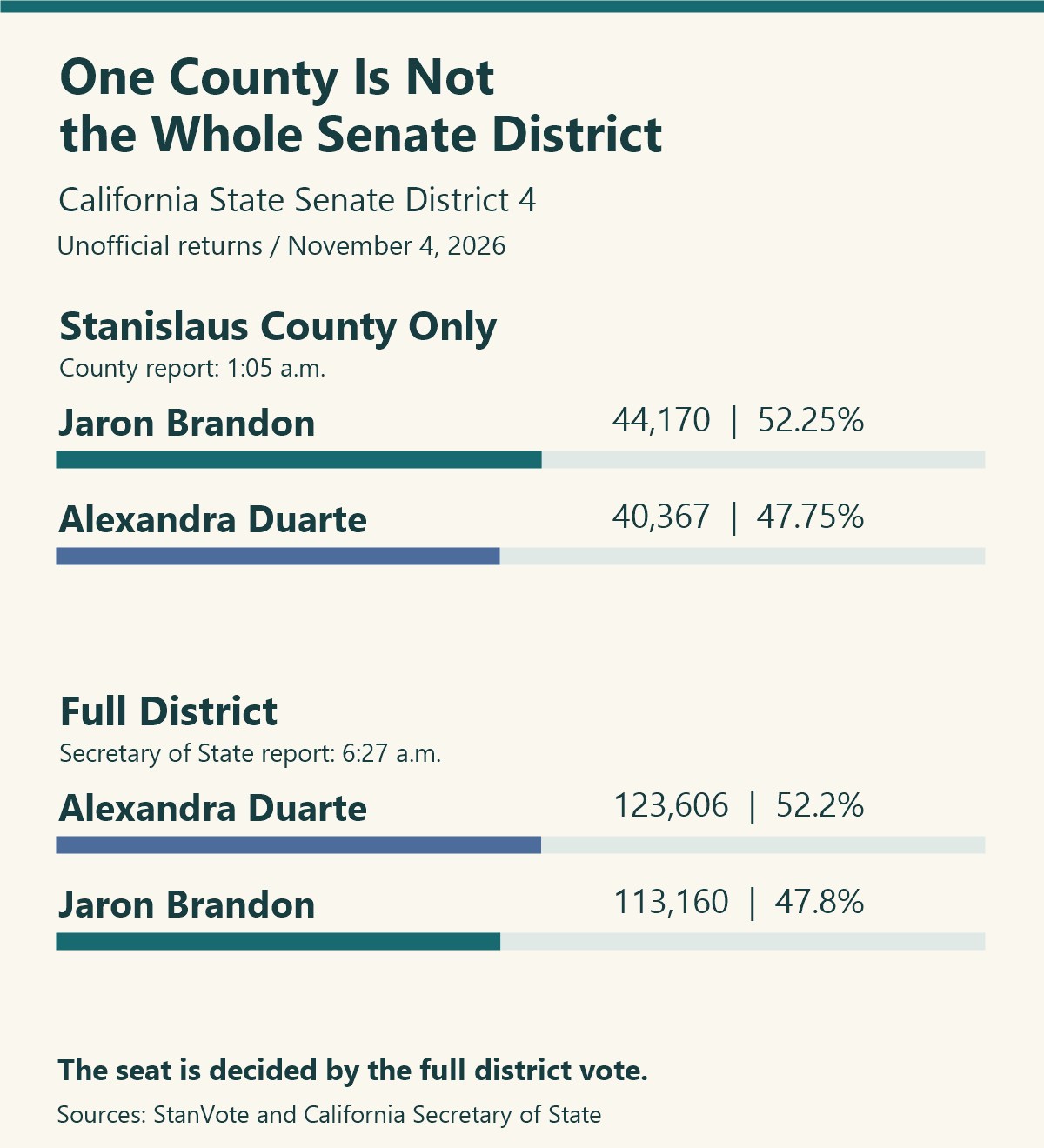
Jaron Brandon leads Stanislaus County, while Alexandra Duarte leads across the full Senate District 4.
County returns at 1:05 a.m. and full-district returns at 6:27 a.m. on November 4 show different leaders. Graphic by Local Turlock.

Where the State Propositions Stand

California’s propositions are also decided statewide. This table summarizes the Secretary of State’s 6:27 a.m. statewide returns. “Leading side” describes the current count; it is not a certified outcome.

Prop.SubjectLeading Side
1Housing affordability bondsYes, 59.4%
2Larger state rainy-day fundYes, 59.6%
3Extending the high-income tax for schools and healthcareYes, 58.7%
4Allowing public funding of election campaignsNo, 52.0%
5Changing statewide recall electionsYes, 50.3%
37Loans for middle-income buyers of qualifying new homesYes, 61.0%
38Immunology research bondsYes, 55.7%
39Government-issued identification requirement for votingNo, 58.6%
40One-time tax on certain taxpayersNo, 55.6%
41Spending-limit and audit rules for new state taxesNo, 52.4%
42Restrictions on new personal-property and certain retroactive taxesYes, 54.3%
43Limits on raising revenue for local government servicesNo, 54.9%
44Community health-clinic spending requirementsNo, 81.8%
45Environmental-review changes for certain projectsNo, 54.1%

Proposition 5 is especially close in the morning report: 3,706,564 yes votes to 3,657,452 no votes, a 49,112-vote difference. Its 50.3% yes share deserves a different description from a measure with a large margin. The official results page links the full legal title and voter-guide explanation for each proposal.

Why 100% of Precincts Does Not Mean Every Ballot

The county report lists all 206 precincts as reporting. It also labels the results unofficial. Those statements can both be true: precinct reporting is not a guarantee that every eligible mail, provisional or conditional-registration ballot has finished verification and counting.

The Secretary of State explains the ballots processed after Election Day, including mail ballots postmarked by Election Day and received within seven days, provisional ballots and ballots needing additional processing. Signature and registration checks take place before eligible ballots enter the count.

The county’s report shows 86,913 ballots against 301,333 registered voters, or 28.84%, countywide. For the citywide Turlock contest it shows 12,306 ballots against 40,481 registered voters, or 30.40%. Those are reported turnout figures at this stage, not final turnout and not the same thing as the number of votes cast for mayor.

For the next numbers, return to StanVote’s election-results page and check the report’s run date and time before comparing totals. Voters can also use California’s My Voter Status to check their own ballot status. The count still matters most in the close local races, especially the 31-vote District 3 contest.

What Should the Next Council Tackle First?

Road repairs, public safety, city services or another local priority? Tell us which project you want the next Turlock council to address.

Bowling, Soccer and Saunas: Inside Turlock’s $200,000 Opioid Plan

in Government & Elections/Health
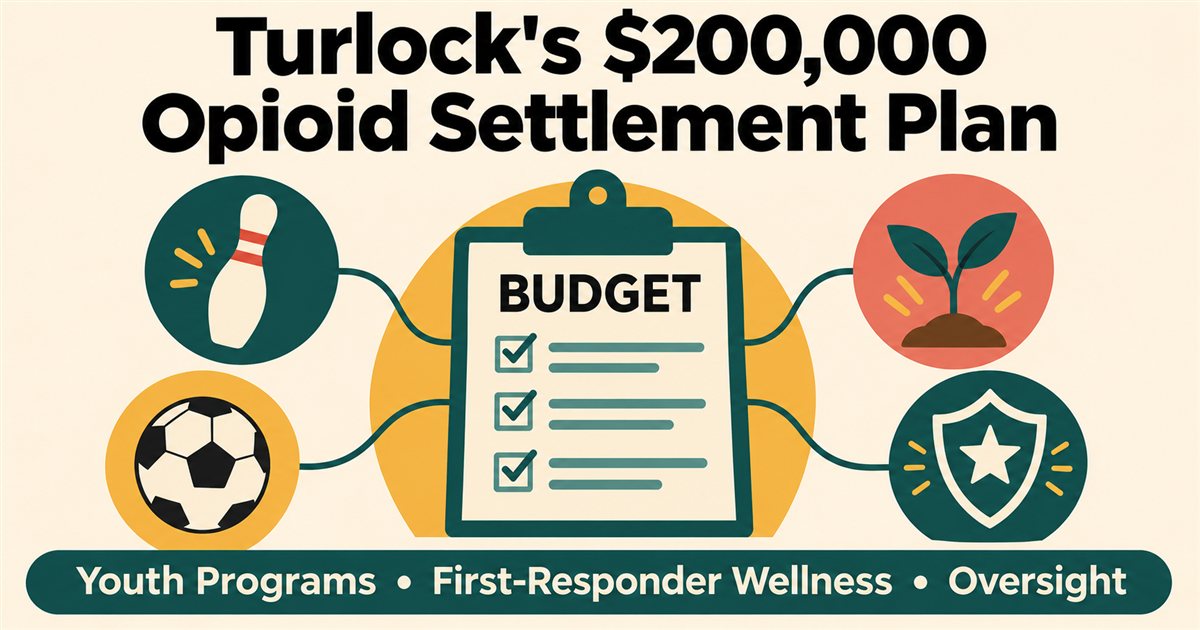
Illustrated budget document with bowling, soccer, gardening and public-service icons for Turlock's $200,000 opioid settlement plan.
Editorial illustration by Local Turlock.

Bowling, youth soccer, gardening programs and fire-station saunas are all part of Turlock’s latest opioid-settlement spending plan. The City Council approved a $200,000 package on October 27, with payment conditions and reporting requirements for the youth programs.

The Turlock Journal reported a unanimous vote. The city’s five-page staff report supplies a more detailed breakdown: $142,000 in maximum agreements with three youth-program providers, $50,000 for the fire-station sauna project and an $8,000 contingency.

The $142,000 Includes Insurance

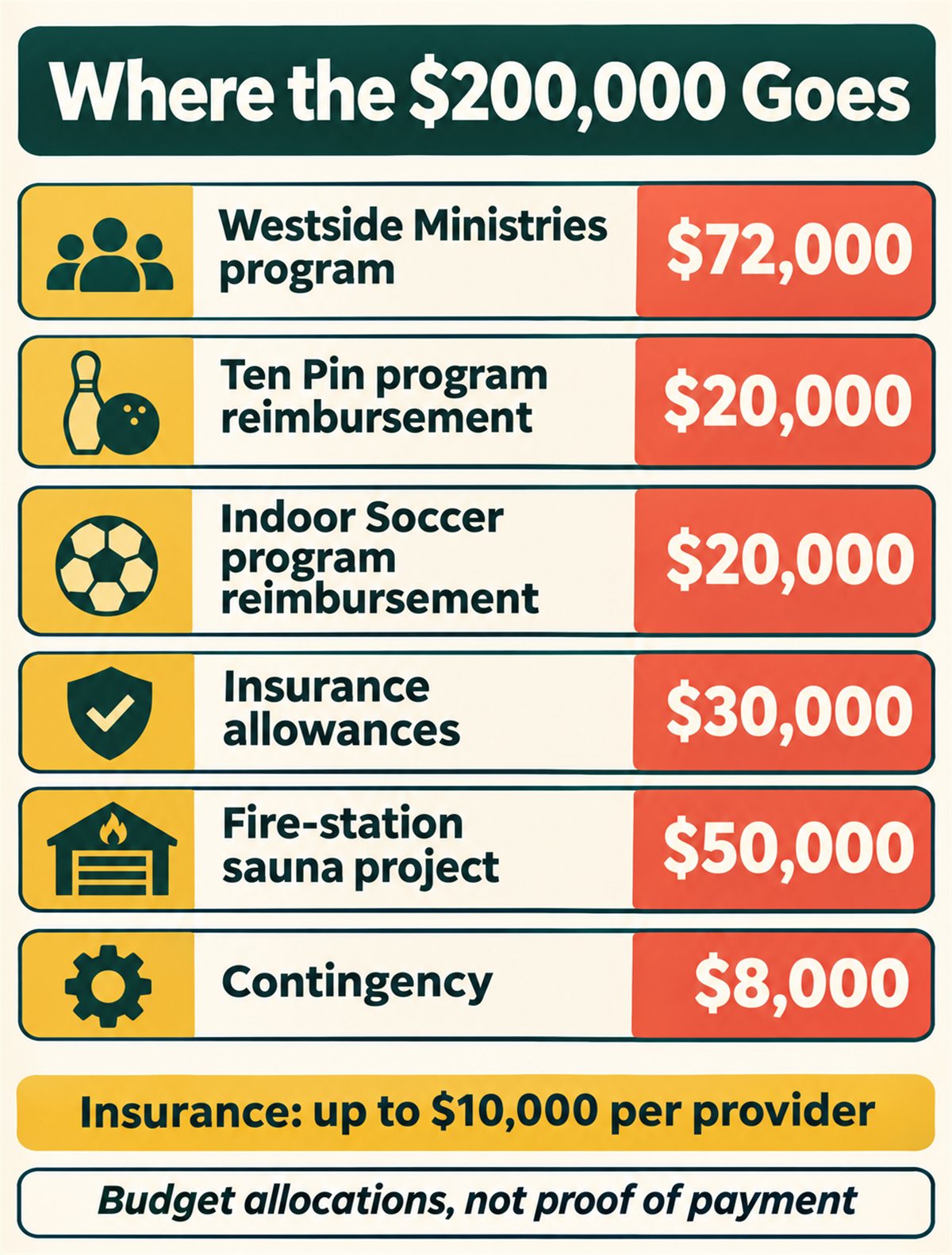
Westside Ministries’ agreement allows up to $82,000. Ten Pin Fun Center and Turlock Indoor Soccer each have a $30,000 maximum. Those are agreement ceilings, with conditions attached.

Across the three providers, the program portions total $112,000. Another $30,000 provides insurance allowances of up to $10,000 per organization. The staff report requires advance written approval from both the city manager and city attorney for insurance reimbursement, supported by actual additional premium costs attributable to the program.

The separate $8,000 contingency does not automatically raise the three agreement limits. Using it would require an authorized amendment. That distinction matters when comparing a council appropriation with a check, a reimbursement or a completed service.

What the Youth Programs Would Provide

Ten Pin Fun Center: The staff report describes two eight-week bowling sessions, each anticipated to serve 50 young people, combining instruction with age-appropriate substance-misuse education. Its sample agreement provides reimbursement for approved, documented costs rather than an advance payment. Registration fees and other program revenue reduce the reimbursable program expenses. Participation is to be handled discreetly, without requiring children to publicly disclose personal or family circumstances.

Turlock Indoor Soccer: The proposed approach pairs organized soccer with prevention information and supportive relationships. The staff report describes the same $20,000 program-expense ceiling and separate $10,000 insurance allowance. Outreach for both sports programs would emphasize young people affected by opioid misuse or facing increased risk, while allowing other participants as well.

The $200,000 allocation: Westside program $72,000, Ten Pin program $20,000, Indoor Soccer program $20,000, insurance $30,000, sauna project $50,000 and contingency $8,000.
The six budget lines in the October 27 staff report. Insurance allowances are separate from program allocations. Graphic by Local Turlock.

Westside Ministries: Its sample agreement supports year-round youth and family activities, mentoring, prevention and connections to services. The program allocation is $72,000. Of that, $64,800 is payable after the agreement takes effect and required insurance is approved. The final $7,200 cannot be paid earlier than nine months after the effective date and depends on reporting, documentation and compliance.

Westside’s monthly reports are due by the tenth of the following month. They must account for activities, attendance, spending and the remaining balance. Regular reports use aggregate information, without children’s names or unnecessary identifying details. The agreement also requires a final accounting and the return of unspent or ineligible funds.

Why Saunas Are in the Same Package

The staff report identifies $50,000 for the Public Safety Fire Stations Sauna Project. It says three saunas had been purchased for stations 31, 33 and 34, with further installation efforts involving Station 32 and the Public Safety Facility.

Staff’s explanation is first-responder wellness: police and fire personnel repeatedly encounter traumatic opioid-related emergencies. The report cites settlement language allowing wellness and support services for people experiencing secondary trauma from those events. The purchase and installation costs are included in the appropriation.

The Questions Raised Before the Vote

Approval followed public questions. According to the Journal, mayoral candidate Kelley Coelho asked how the organizations were selected and requested that the item be tabled for more information. Frank Aiello questioned the specificity of the education plans and who would develop them. The council proceeded with the allocation rather than postponing it.

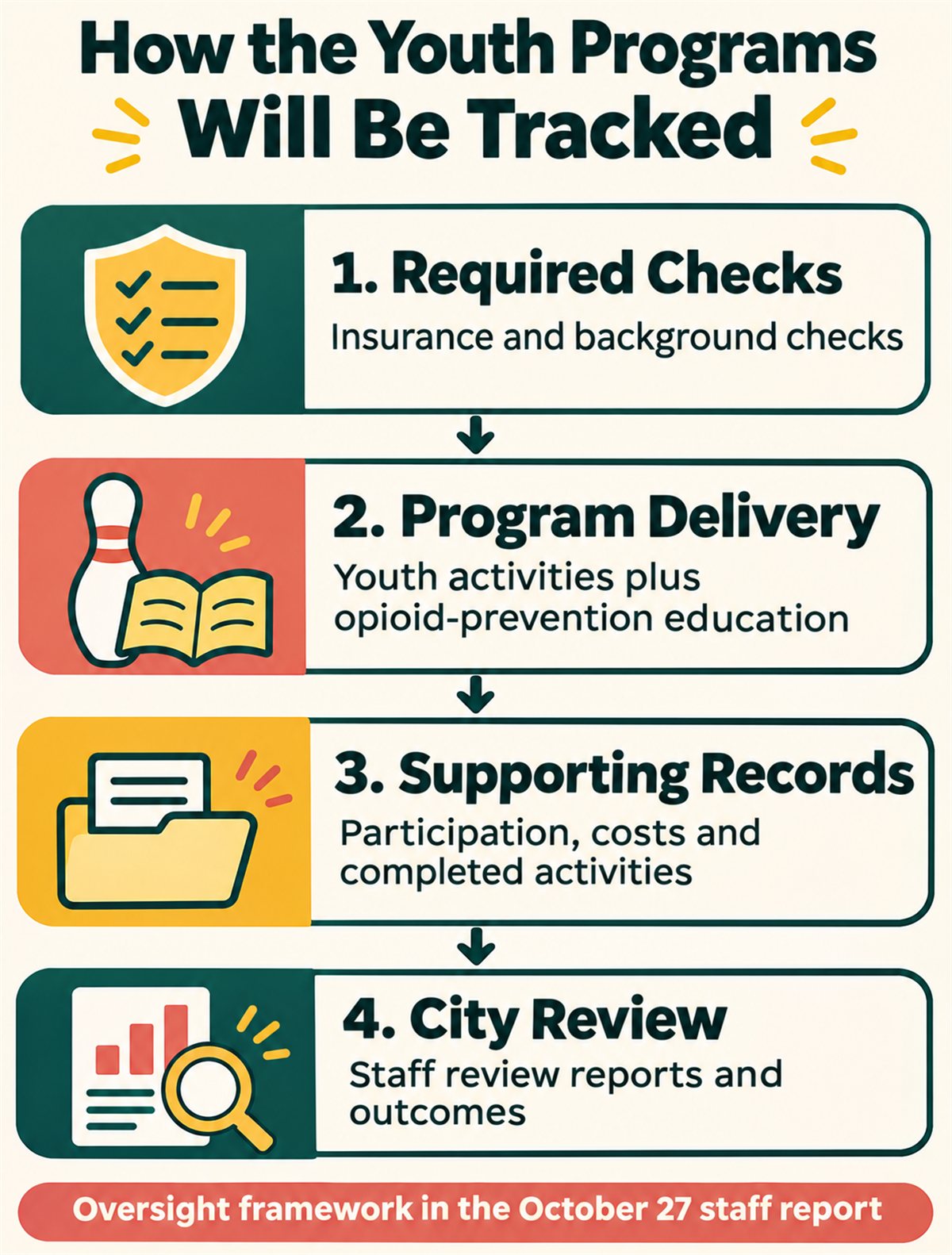
The written proposal gives residents concrete things to follow: which activities take place, what prevention education accompanies them, how many young people participate and what costs are reimbursed. It requires background checks for personnel supervising minors, insurance and supporting records. Staff would review participation, educational activities, expenses and outcomes when considering whether to continue or change the initial programs.

Four parts of the proposed oversight framework: insurance and background checks, activities with prevention education, participation and cost records, and city staff review.
The oversight framework described in the staff report and sample agreements. Explanatory graphic by Local Turlock.

What Residents Can Check Next

Turlock began receiving settlement payments in fiscal year 2022-23 and had received more than $750,000 by the staff report’s date. This package uses restricted settlement resources, without additional General Fund revenue.

The California Department of Health Care Services explains that settlement spending has opioid-remediation restrictions. For California Abatement Accounts Fund receipts, at least half must support designated high-impact activities. A council vote authorizes a local plan; the spending still has to meet the applicable requirements.

DHCS also requires annual expenditure reports, generally covering July through June and due September 30. Those reports and the providers’ activity records are the places to look for actual spending and delivery, rather than treating the approved budget as a result.

For parents, the council packet describes the partnerships rather than an enrollment schedule. Ask the provider for the funded program’s dates, age range, referral process, fees and supervision arrangements. Our Ten Pin guide covers the venue’s regular activities; those bookings are separate from this pilot. To follow future reports or speak at a meeting, use our public-meeting guide and the city’s October 27 council packet.

Discuss Turlock’s Opioid Funding

What would you want to see in the city’s first progress report? Add your priorities to our Facebook discussion.

Missed the Registration Deadline? Turlock Voters Still Have Options

in Government & Elections
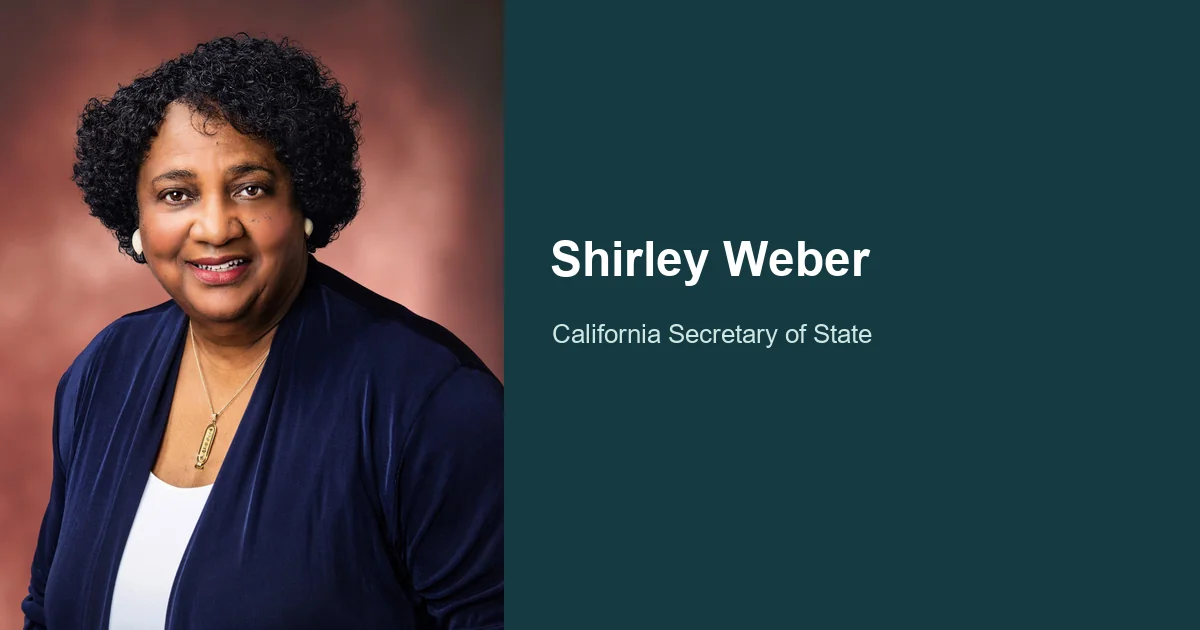
Official photograph of Shirley Weber beside her name and California Secretary of State title.
Shirley Weber’s official portrait, circa 2021. Photo: California Secretary of State’s Office; Public domain in the United States. Resized and paired with a name panel.

Missing Monday’s voter-registration deadline does not mean missing the November election. Eligible Turlock residents can still register and vote through California’s same-day voter registration process, available from October 20 through Election Day, Tuesday, November 3, 2026.

The next step is an in-person visit to an open voting location. For anyone planning that visit this week, the dates matter: Turlock’s first vote center opens Saturday, October 24. The county elections office in Modesto is available before then.

California Secretary of State Shirley Weber explained the remaining option in her October 19 registration reminder.

How Same-Day Voter Registration Works

If you think you are already registered, start with My Voter Status. Check the address as well as your name. A missing ballot and an unregistered voter are different problems, and election workers can help you find the right solution.

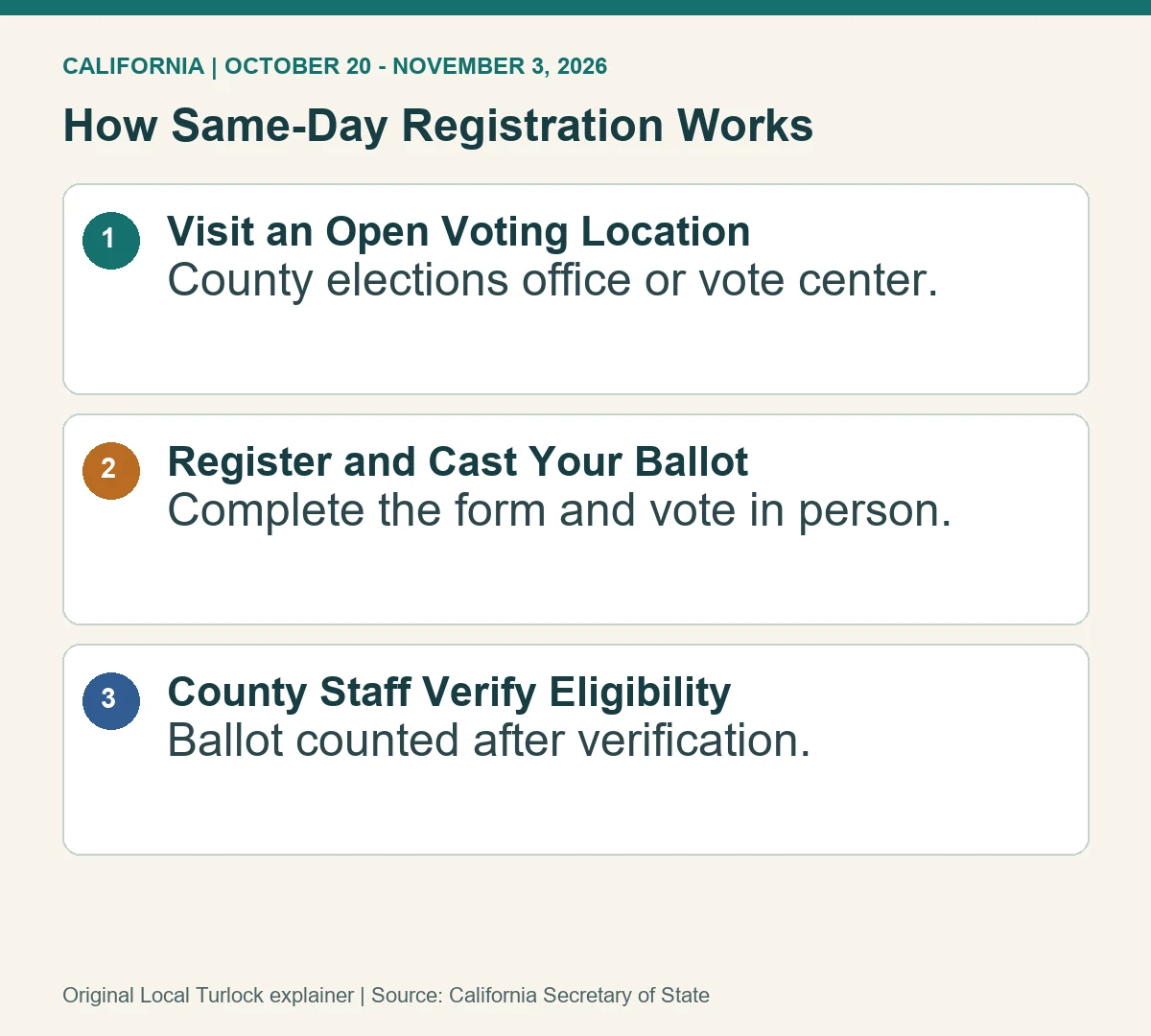
The state’s same-day registration instructions cover eligible citizens who need to register or re-register during the final 14 days. You complete a registration form and cast a ballot. The county verifies your registration before counting a conditional ballot. Simply missing the ordinary deadline does not disqualify an otherwise eligible voter.

You do not need to wait until November 3 to use this process. Choosing an earlier open location also leaves time to ask questions and deal with an address or registration problem before the last evening.

Three steps: visit an open voting location, register and cast a ballot, then county staff verify eligibility.
How conditional registration works. Original Local Turlock explainer, based on the California Secretary of State’s instructions.

Where to Go This Week

Before Saturday: the Stanislaus County Registrar of Voters is at 1021 I Street, Suite 101, Modesto, CA. The current November election flyer lists weekday voter services from 8 a.m. to 4 p.m. Its indoor ballot box is available until 5 p.m. Those are different closing times; arrive before 4 p.m. if you need registration or ballot assistance.

Starting Saturday, October 24: the Hampton Inn by Hilton meeting room at 1821 Lander Avenue, Turlock, CA becomes a vote center. It is listed for 8 a.m. to 5 p.m. daily before Election Day, including weekends, and 7 a.m. to 8 p.m. on November 3.

The county’s November voting-locations flyer lists the later-opening Turlock centers, including the library, Assyrian American Civic Club and Calvary Baptist Church, beginning October 31. You may use any open vote center in Stanislaus County; you are not restricted to the one closest to home.

What a Conditional Ballot Means

The extra envelope is part of checking eligibility. It is not an instruction to discard your vote. Under the state’s provisional-ballot rules, election officials confirm registration and check that a voter has not already voted before counting the ballot.

Ask the election worker how to check your ballot’s status and keep the information you receive. California voters who cast a provisional ballot have the right to learn whether it was counted and, if it was not, the reason. That follow-up is more useful than trying to infer the status from an election-night result.

A Drop Box Is for Returning a Ballot

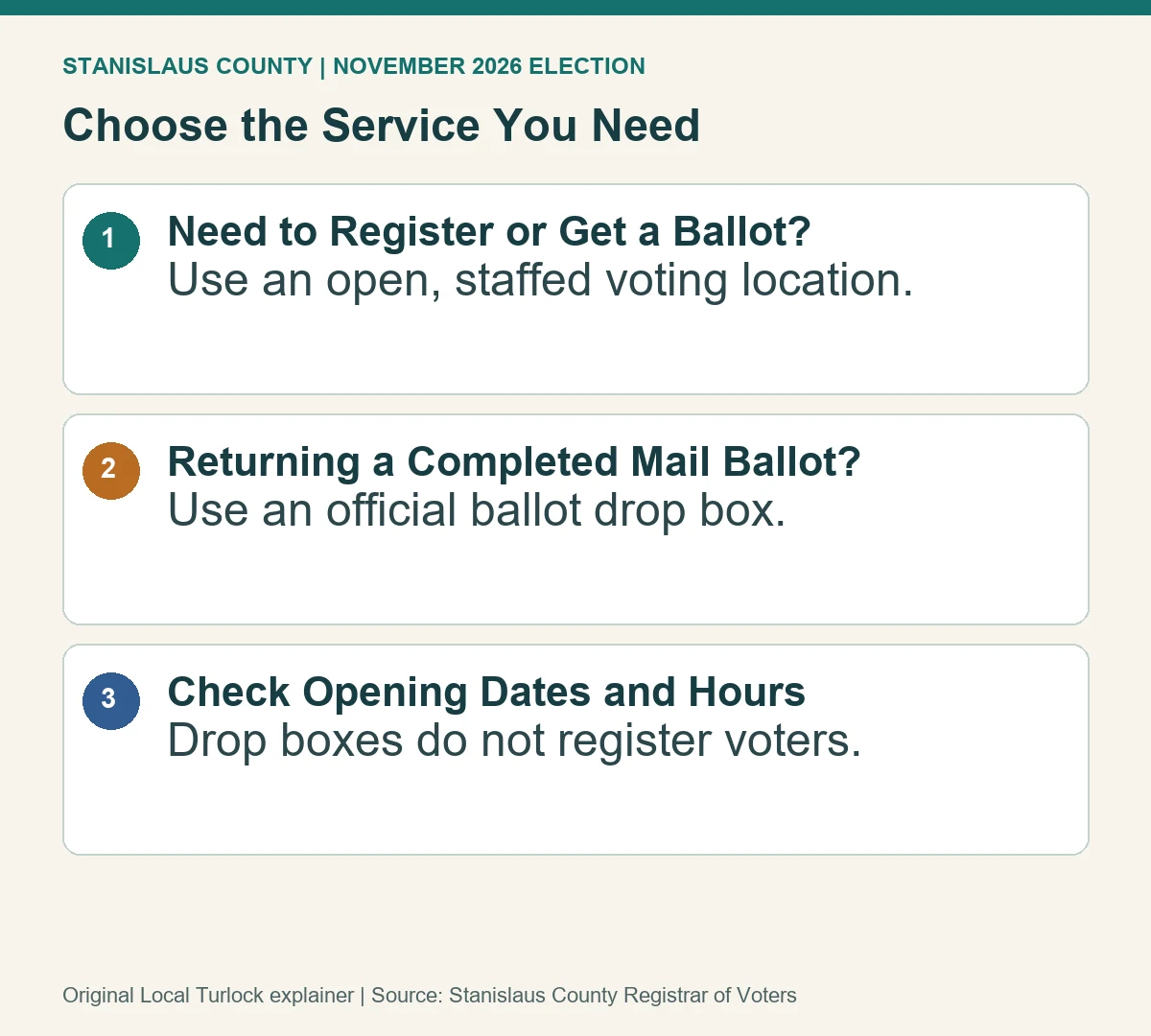
If you already have your correct mail ballot, follow the return-envelope instructions, including the signature requirement. You can return it to an official drop box or an open voting location. A drop box cannot register you, update your record or issue a replacement ballot.

One Turlock outdoor option is at CSU Stanislaus, 1 University Circle, Turlock, CA. The county lists that box as available around the clock until 8 p.m. on Election Day. Indoor boxes have their own building hours. Check the official location list before making a special trip.

Registration and replacement ballots require an open staffed voting location; completed mail ballots can go to an official drop box.
Choose a staffed voting location when you need help. Original Local Turlock explainer.

What to Bring and Who to Call

Most California voters do not have to show identification before casting a ballot. There is a first-time-voter exception when required identifying information was not provided during mail registration. The state’s what-to-bring page explains that exception and acceptable documents. If you are unsure how it applies to you, ask the elections office before your visit.

For local help, call 209-525-5200, or 209-525-5230 for Spanish assistance. Voters with disabilities and military or overseas voters should contact the county for the options available to them. Do not put your registration details or ballot choices in a public comment.

For the contests and candidates, use our November voter guide. If you are arranging a bus trip, our Turlock Transit guide explains the local system; confirm your route and return trip before leaving. For registration help this week, check your status, choose an open location and use its voter-service hours.

Share a Practical Voting Tip

Have a parking or accessibility tip for a local vote center? Join the discussion on our Facebook post. Keep registration details and ballot choices private.

Turlock Approves $100,000 for Highway 99 Welcome Signs

in Government & Elections/Business & Economy
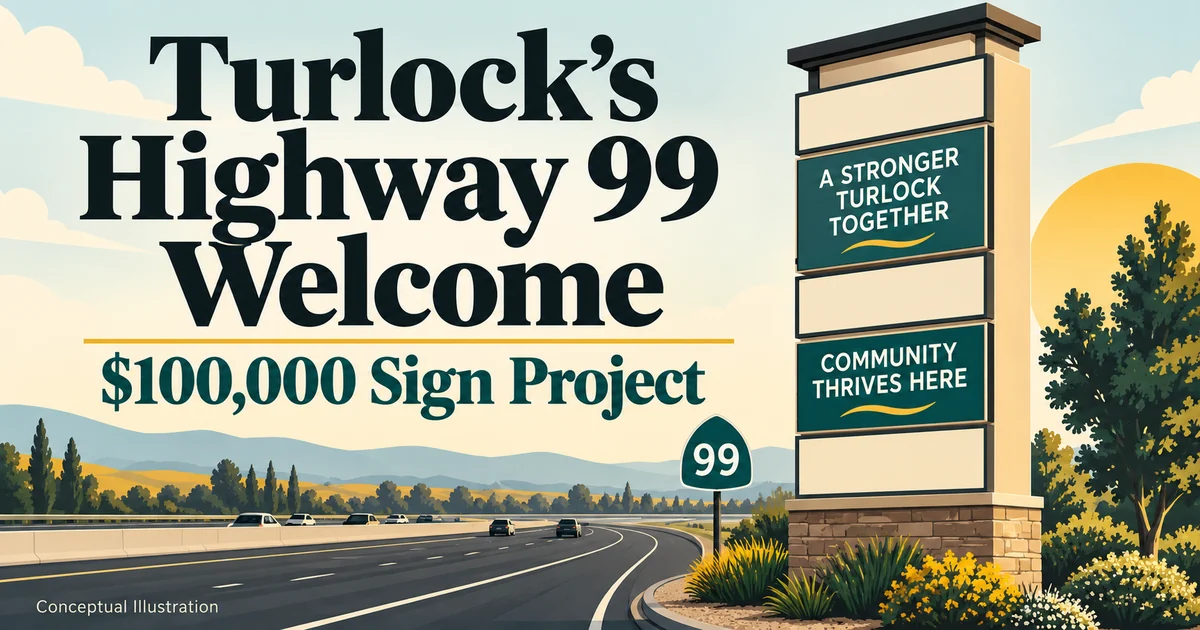
Conceptual illustration of community-message panels on a roadside sign beside Highway 99.
Conceptual illustration, not an installed sign or an approved city design.

Those empty spaces on tall shopping-center signs beside Highway 99 could soon carry a welcome from Turlock. The City Council has approved $100,000 for community-message panels, using tourism reserves to put existing sign space to work.

The Turlock Journal reports that the council approved the funding Tuesday, October 13. The city’s staff report explains what the money could buy, how private property owners would participate and what still needs to happen before installation.

What the $100,000 Would Buy

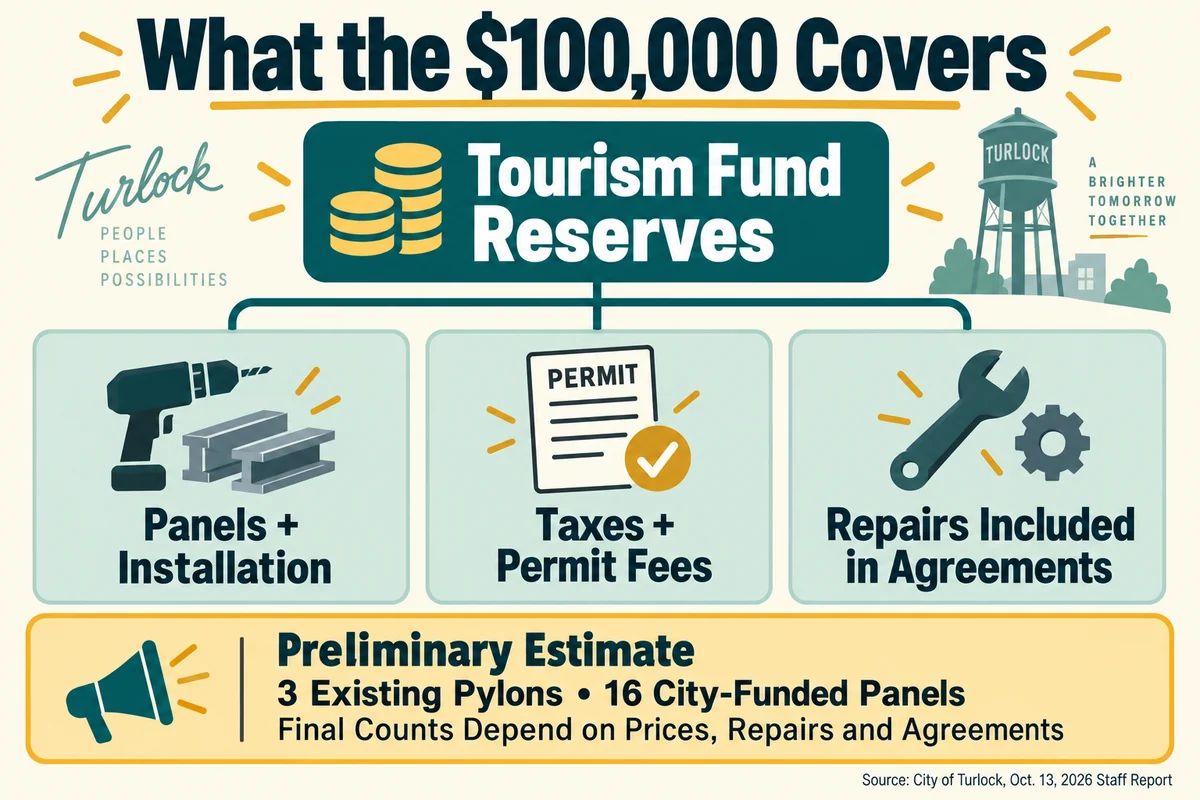
The Highway 99 Community Promotion Project would fill vacant panels on existing pylon signs visible from the freeway. Staff estimated that $100,000 could cover roughly three pylons, using both faces, with 16 city-funded panels in total. Those are preliminary estimates. Actual prices, repair needs and signed property agreements will determine the final count.

The budget comes from unallocated reserves in Fund 120, the city’s tourism fund. It can pay for:

  • Making and installing the city’s panels.
  • Applicable taxes and permit fees.
  • Repairs or repair contributions included in approved property-owner agreements, along with other necessary project costs.
The $100,000 tourism-funded budget covers panels and installation, taxes and permits, and agreed repairs. Preliminary scope: three existing pylons and 16 city-funded panels.
The staff estimate is three existing pylons and 16 city-funded panels. Prices, repairs and property agreements will determine the final scope. Graphic: Local Turlock, based on the city’s October 13 staff report.

A Welcome in Space That Is Already There

The city wants the panels to improve the appearance of empty signs while making Turlock more visible to visitors, prospective businesses and developers. The Journal quoted public information officer Joseph Spangler offering examples such as “Welcome to Turlock,” “Shop Turlock” and “Come Back Soon.” Those examples describe the idea; the staff report leaves city-panel design to coordination between the city manager and the corresponding property owner.

The location matters. A freeway driver can pass Turlock without seeing its older business district. Our Highway 99 history follows the change from the old route through town to the bypass. Today, the freeway also serves the shopping areas around Monte Vista Avenue and Countryside Drive. Our shopping and dining guide connects those centers with businesses elsewhere in town.

How the Private Signs Would Be Used

Each participating property owner would have an individual memorandum of understanding with the city. The proposed arrangement allows city-funded panels to remain without ongoing rental charges. Agreements would spell out minimum display periods, access, maintenance, replacement and removal conditions, and protections for the city’s investment.

The community messages could move or come down as businesses occupy the developments and need their own signs, subject to the agreement for that property. That makes the display terms an important part of the purchase: the city needs to know how long its panels can stay and what happens when a tenant needs the space.

Repairs are another variable. Staff identified at least one damaged sign and expected its owner to request city-funded repairs in exchange for use of the sign without rent. The report describes an anticipated request, rather than a completed repair agreement.

Community Partners Would Pay Separately

Stanislaus State and other community partners have expressed interest in buying panels too, according to the staff report. Participating organizations would contract with or pay the city-selected vendor directly for their own panels. Their payments would sit outside the city’s $100,000 expenditure limit. Spending more city money would require further authorization.

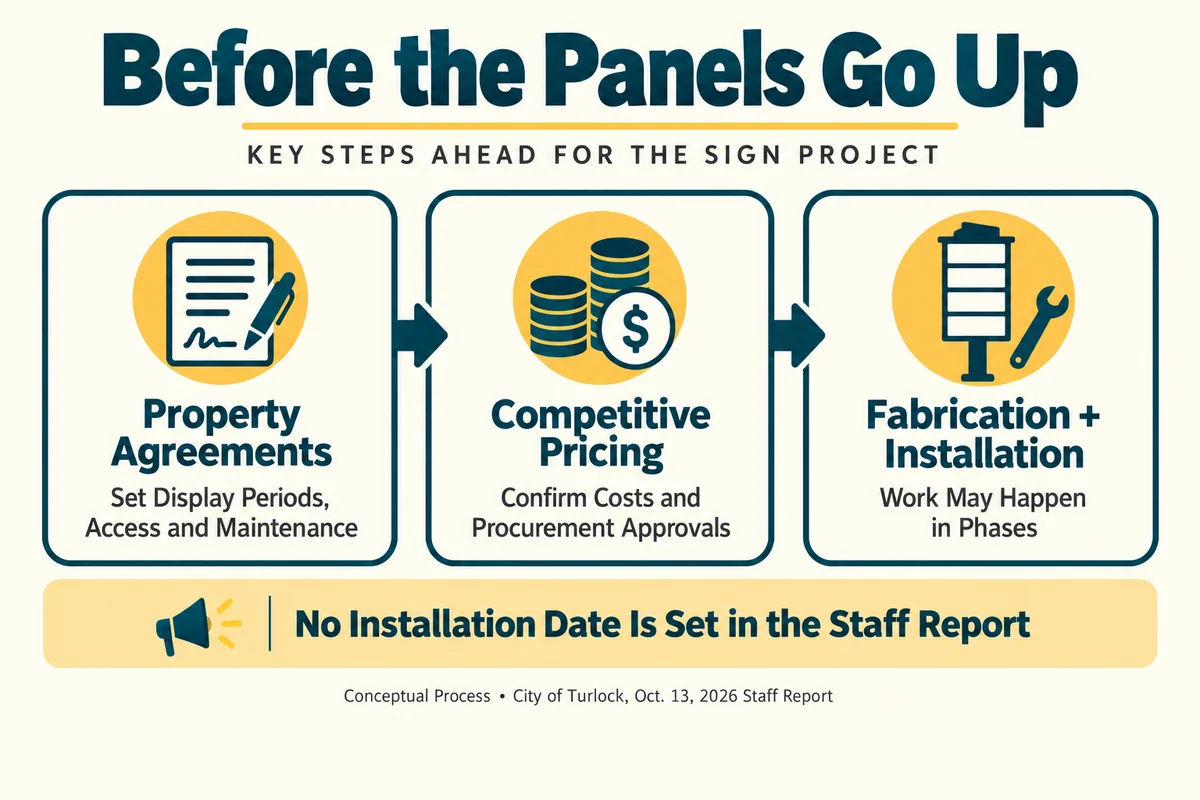
Tasks ahead include property agreements, competitive pricing, fabrication and installation. Work may happen in phases, and the staff report sets no installation date.
A conceptual outline of the work ahead. The staff report sets no installation date. Graphic: Local Turlock, based on the city’s October 13 staff report.

What Happens Before Installation

Staff’s early pricing put the anticipated work above the city’s $25,000 formal bidding threshold. The report proposes combining participating locations into a coordinated purchase where practical, to seek competitive prices and consistent fabrication and installation. Contract awards must follow the applicable approval rules, including another council decision if required.

The work may happen in phases as prices and participation become clear. The staff report supplies no installation date. The details to watch next are the participating locations, executed agreements, final panel count and procurement approvals.

You can read the proposal under Action Item 9B in the October 13 council record, which links the staff report, proposed resolution and sample property agreement.

What Should Turlock’s Welcome Signs Say?

Share an idea for the panels in the Facebook discussion.

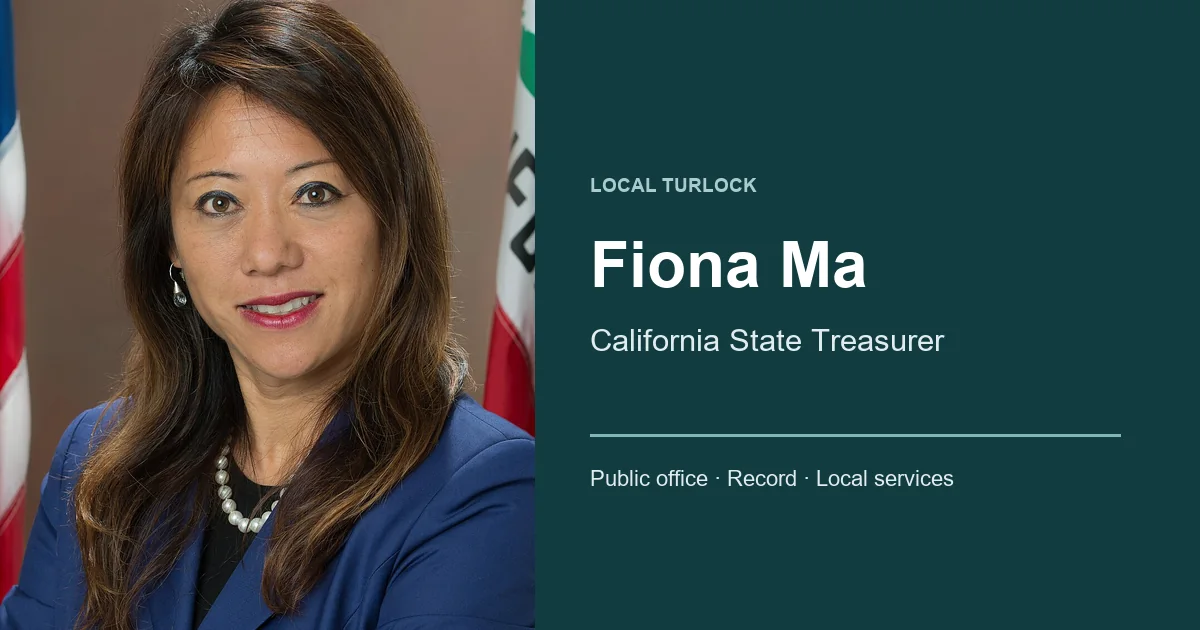
Fiona Ma: California’s State Treasurer

Fiona Ma in a real historical portrait beside her current California office title.
Fiona Ma’s official Board of Equalization portrait, December 2014. Photo: Florence Low / California Department of Water Resources · Public domain. Cropped; text added.

More than 109,000 CalKIDS scholarship accounts had been created for Stanislaus County children by June 2025. Families may have money for college waiting in an account they have never claimed. That program is one of the most useful local connections to Fiona Ma’s work as California treasurer. She also manages state borrowing and investments—and in November 2026, she is running for a different office: lieutenant governor. Current office: California state treasurer; Democrat and certified public… Keep Reading

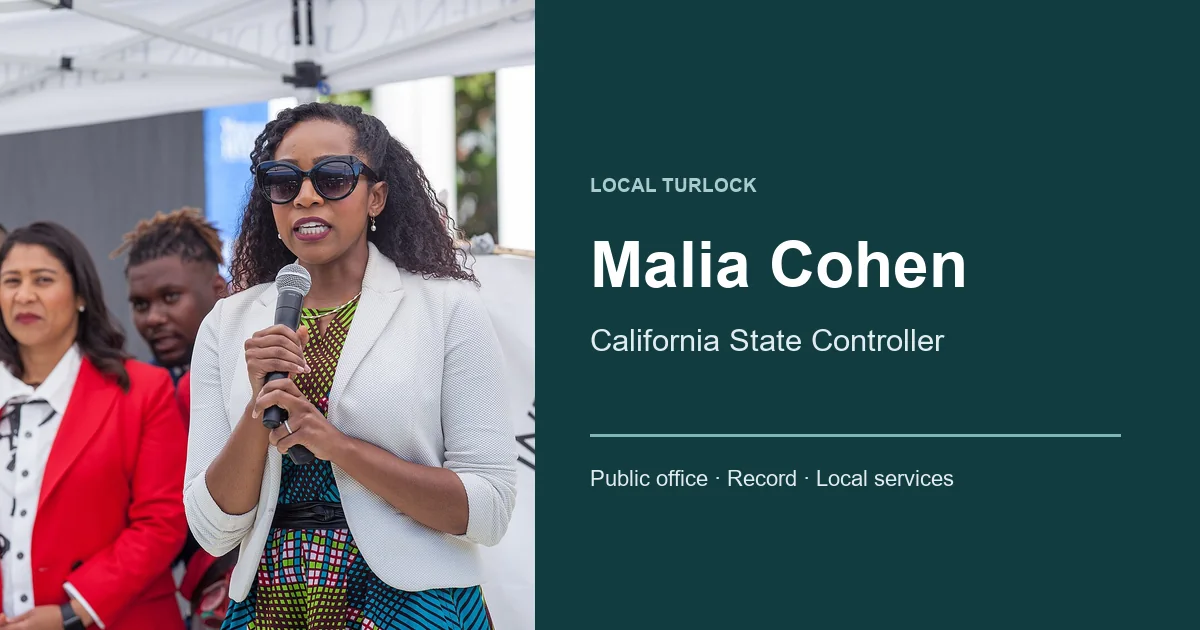
Malia Cohen: California’s State Controller

Malia Cohen speaking at Indigenous Peoples’ Day in 2018 beside a panel naming her current state-controller office.
Malia Cohen at Indigenous Peoples’ Day in San Francisco, October 2018, while serving as president of the city’s Board of Supervisors. Photo: Pax Ahimsa Gethen · CC BY-SA 4.0. Cropped; text added. CC BY-SA 4.0 adaptation.

A forgotten paycheck, a Stan State employee’s payroll deposit and a payment to Turlock’s bus system all lead to the same state office. Malia Cohen is California’s controller, responsible for paying the state’s bills, keeping its financial records and checking how public money is handled. In November 2026, voters will decide whether to give her a second term. Current office: California state controller; Democrat. First elected: November 2022; began serving in 2023. November 3, 2026:… Keep Reading

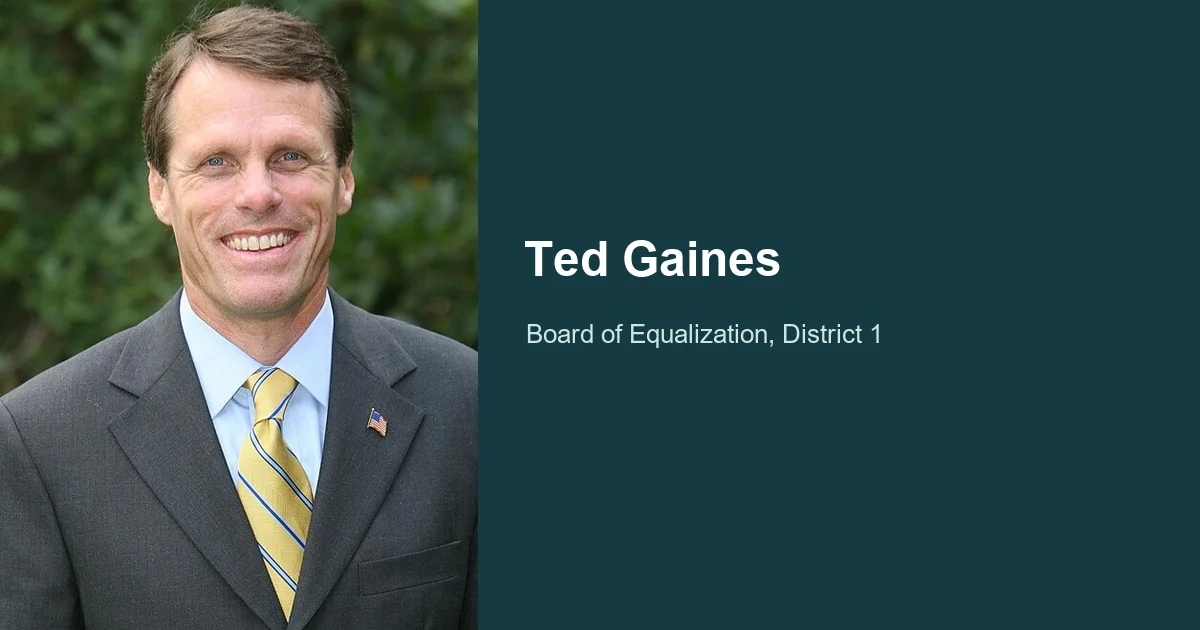
Ted Gaines: Turlock’s State Tax Board Representative

A California State Senate photograph of Ted Gaines beside his name and current Board of Equalization District 1 office.
Ted Gaines in a California State Senate portrait; the original photograph’s date is not recorded. Photo: California State Senate; Public domain in the United States. Resized and paired with a name panel.

Ted Gaines represents Stanislaus County on the California State Board of Equalization. For Turlock homeowners, the board’s rules affect inherited homes, moves and property assessments. County offices apply those statewide rules to individual properties. Who He Represents and How He Reached the Board Gaines is a Republican serving his second elected term as the First District member of the California State Board of Equalization, or BOE. He won the seat in 2018 and was reelected… Keep Reading

Shirley Weber: California’s Secretary of State

Official photograph of Shirley Weber beside her name and California Secretary of State title.
Shirley Weber’s official portrait, circa 2021. Photo: California Secretary of State’s Office; Public domain in the United States. Resized and paired with a name panel.

California Secretary of State Shirley Weber certifies statewide election results, maintains the voter-registration system and oversees election rules. Her office also handles business filings and keeps the state’s historical archives. A Family History Shaped by the Right to Vote Shirley Nash Weber became California’s 32nd secretary of state on January 29, 2021, following Gov. Gavin Newsom’s nomination. She was the first Black Californian to hold the office. Voters elected her to a full term in… Keep Reading

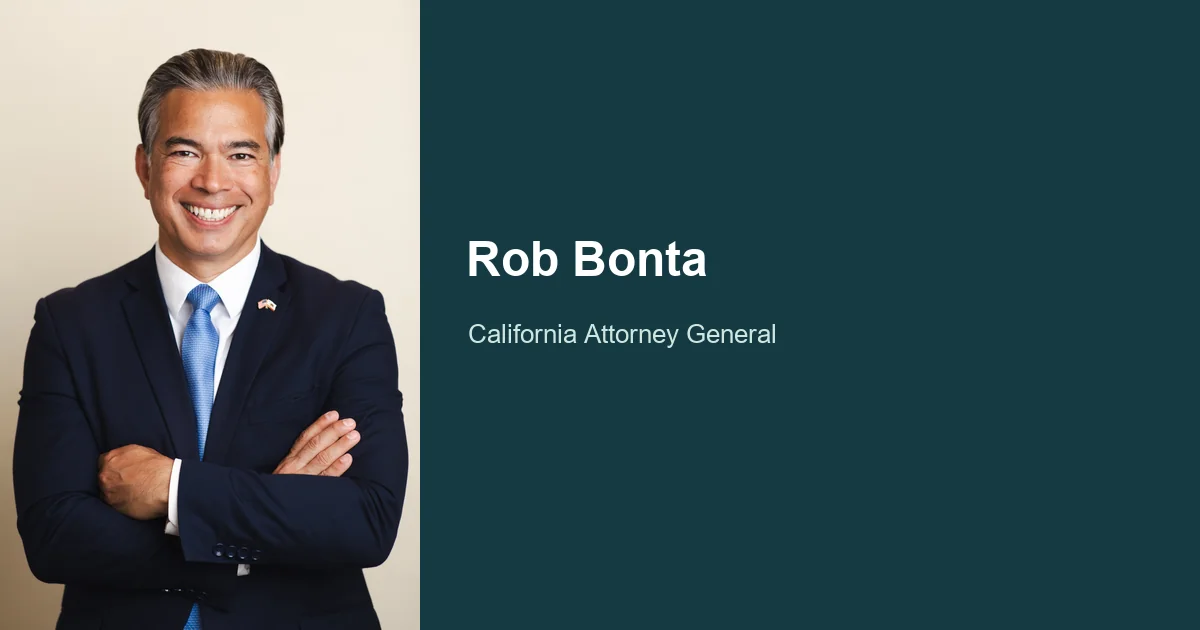
Rob Bonta: California’s Attorney General

Official photograph of Rob Bonta beside his name and California Attorney General title.
Rob Bonta’s official portrait, July 2023. Photo: Douglas Despres / California Attorney General’s Office; Public domain in the United States. Resized and paired with a name panel.

In February 2026, state agents helped dismantle a methamphetamine lab in Turlock. The following month, Attorney General Rob Bonta announced the seizure of 280 pounds of crystal meth and eight firearms. His office also challenges federal policies, reviews local housing plans and takes complaints from customers who think a business has cheated them. From an Immigrant Family to California’s Chief Law Officer Bonta became California’s 34th attorney general on April 23, 2021, after Gov. Gavin… Keep Reading

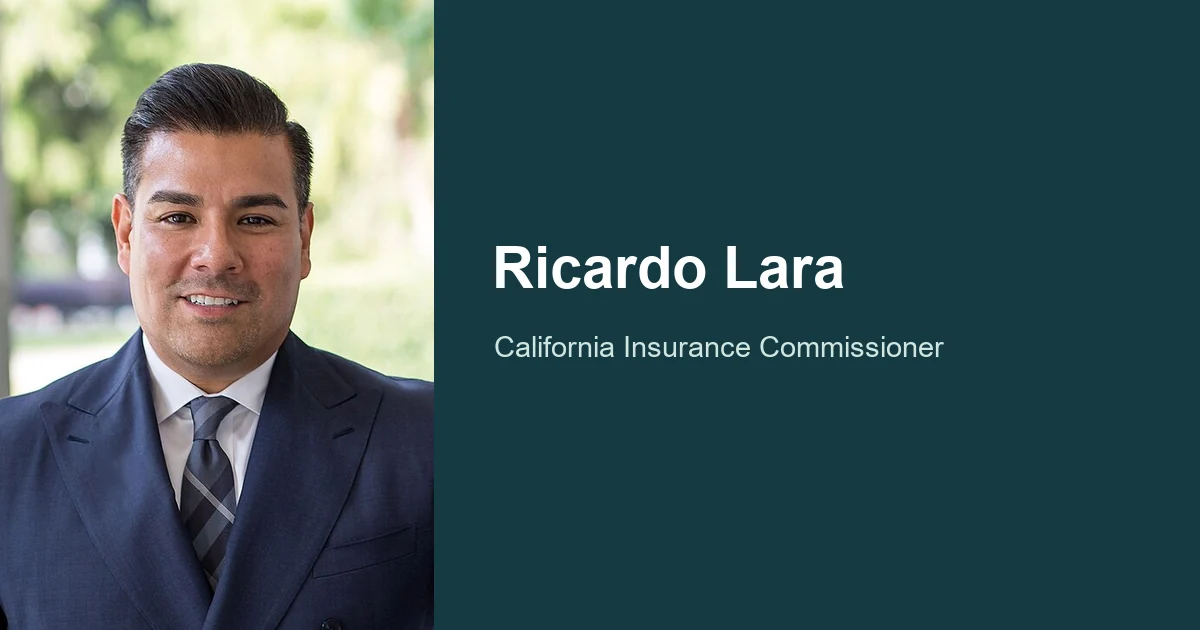
Ricardo Lara: California’s Insurance Commissioner

Ricardo Lara in his official Insurance Commissioner photograph, beside his name and office title.
Ricardo Lara’s official Insurance Commissioner portrait, January 2019. Photo: State of California / Department of Insurance · public domain. Resized; name panel added.

Ricardo Lara, California’s insurance commissioner, oversees the industry behind homeowners’ renewal notices. His final year in office has centered on a difficult tradeoff: giving insurers more flexibility in pricing risk while trying to make policies available to people who have been turned away. The Path from East Los Angeles to Statewide Office Lara took office in January 2019 and won reelection in 2022. He became California’s first openly gay person elected to statewide office. He… Keep Reading

1 2 3 … 22
Go to Top