Category archive

Education

Schools, childcare, students, enrollment and higher education.

Turlock eCademy Changes: What Families Can Ask on Nov. 10

in Education
Turlock Unified eCademy information night: Tuesday, Nov. 10 at 6 p.m., 1100 Cahill Avenue, Turlock.

For a Turlock family deciding how to handle seventh grade next year, the school day could look different depending on one choice: teach at home with help from eCademy, or ask about independent study through a district middle school.

Turlock Unified will explain those plans and take questions Tuesday, Nov. 10, at 6 p.m. at eCademy Charter at Crane School, 1100 Cahill Avenue, Turlock. In its Nov. 3 district update, Superintendent David Lattig said the school’s charter expires June 30, 2027 and invited families to weigh in on the changes.

What Would Change at Crane?

The district says it plans to expand the home-school program at Crane from transitional kindergarten through sixth grade to transitional kindergarten through eighth grade. It also plans to move the separate independent-study program for grades 7–12 to its comprehensive schools.
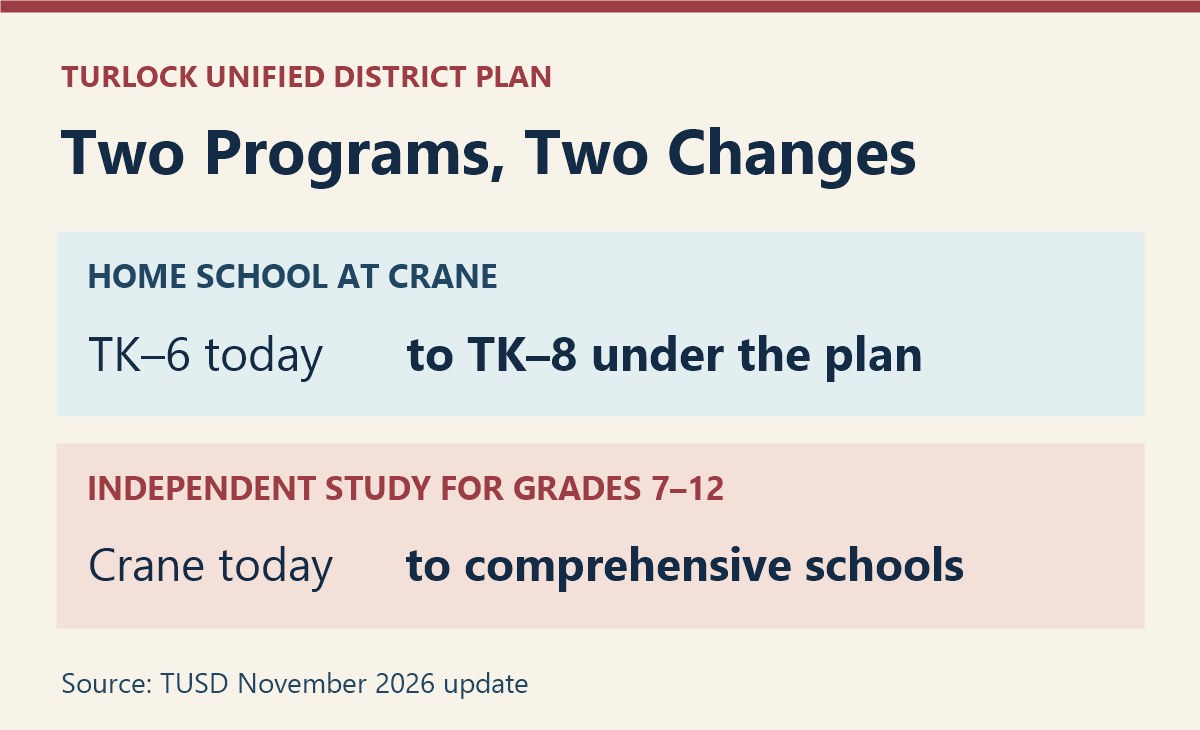
District plan: Crane home school expands from TK through sixth to TK through eighth. Independent study for grades seven through twelve moves to comprehensive schools.
Turlock Unified describes two changes in its November update.

What a School Week Looks Like Today

In Crane’s current home-school program, the parent teaches at home using district curriculum. The school lists weekly appointments with a credentialed teacher and weekly science labs. Families considering the expanded option can ask what that support would look like for seventh- and eighth-graders.

Crane’s current middle-grade independent study and high-school independent study list online and in-person options. Both list weekly appointments for traditional independent study. The high-school page also describes concurrent enrollment at Turlock High or Pitman High, subject to school approval. Those pages describe the current offerings. Families can ask which options would carry over and where.

David told the Turlock Journal that moving independent study would help students stay connected to the schools they would otherwise attend, with access to resources such as counseling and sports. The state school directory lists Crane as an active public school that opened in August 2011.

What to Ask at the Meeting

Bring the grade your student will enter next year and one detail that would affect your decision. Ask which campus would handle enrollment and who would coordinate weekly check-ins. If your student relies on an in-person class or a particular support service, ask where it would be available. Ask when families can expect instructions for choosing a program.
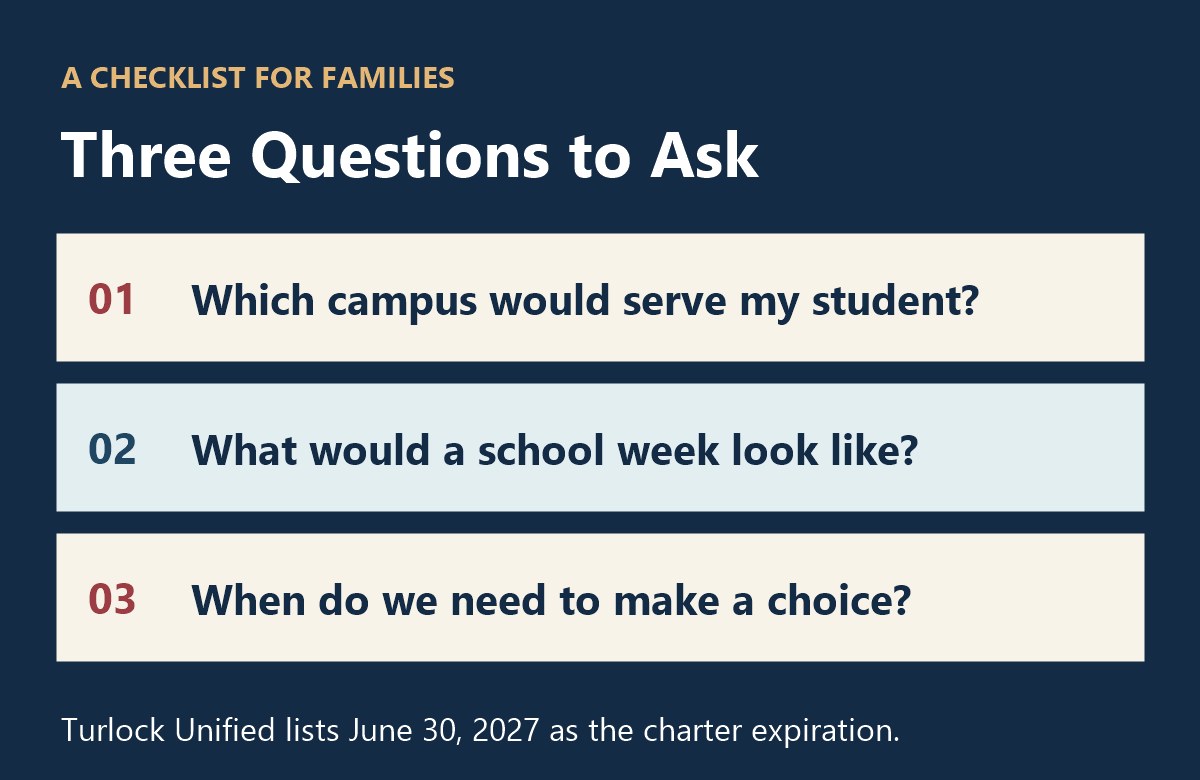
Three questions: Which campus would serve my student, what would a school week look like, and when do we need to make a choice?
Ask the district about placement, the weekly schedule and enrollment deadlines.

If you cannot attend, David invited questions at dlattig@turlock.k12.ca.us. The district Board of Trustees page is where Turlock Unified posts agendas and minutes. For school boundaries and general registration, see our Turlock schools and childcare guide.

What Would You Ask Turlock Unified?

If your family has used home school or independent study in Turlock, what would you want the district to keep available next year?
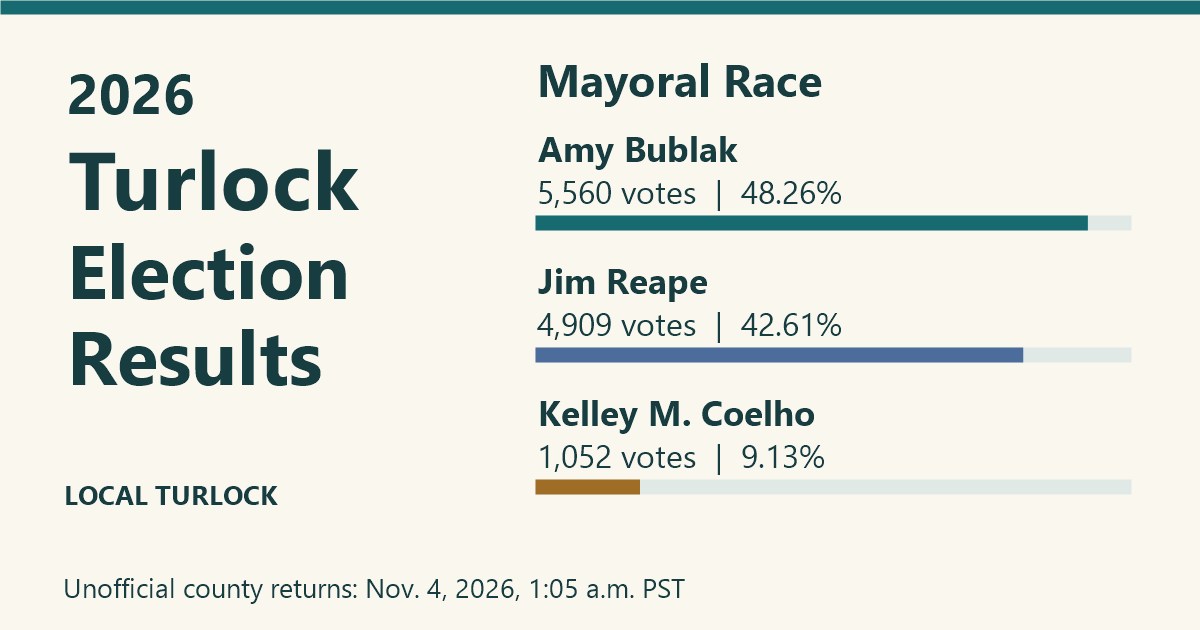
Turlock Election Results: Amy Bublak Leads by 651 Votes

in Government & Elections/Education
Unofficial Turlock mayoral vote: Amy Bublak 5,560; Jim Reape 4,909; Kelley M. Coelho 1,052.
Unofficial mayoral returns in the county's November 4, 1:05 a.m. report. Graphic by Local Turlock.

Turlock woke up Wednesday with Amy Bublak leading the mayoral race by 651 votes and a City Council contest separated by just 31 votes. The overnight returns favor three City Hall incumbents, but the local races remain unofficial as more ballots are processed.

The figures below use the Stanislaus County report issued November 4 at 1:05 a.m. for local contests and the California Secretary of State’s 6:27 a.m. statewide and districtwide returns for the larger races. A news organization’s race call is identified separately from an official certification.

Amy Bublak Leads Jim Reape in the Mayoral Count

CandidateVotesShare
Amy Bublak5,56048.26%
Jim Reape4,90942.61%
Kelley M. Coelho1,0529.13%

The county has recorded 11,521 votes for the three listed mayoral candidates. Amy leads Jim by 651 votes, or 5.65 percentage points. Kelley is third. These are the numbers in the overnight report, rather than a declaration that the contest has been decided.

The two methods of voting tell slightly different parts of the story. Among counted vote-by-mail ballots, Amy has 4,748 votes to Jim’s 4,297, a 451-vote advantage. At vote centers, Amy has 812 to Jim’s 612, adding another 200 votes to her lead. Kelley has 814 mail votes and 238 vote-center votes.

Those categories describe ballots already included in this report. They do not tell us how the uncounted ballots will break, and they do not establish why a particular neighborhood or group supported a candidate.

For Amy Bublak, the campaign is a bid for a third term. She became Turlock’s first woman mayor in 2018 after serving on the council. Her campaign emphasized public safety, city finances, street reconstruction and continuing projects begun during her tenure.

Jim Reape, a Planning Commission member since 2017 and longtime local healthcare professional, argued for steadier staffing, collaboration at City Hall and long-term road maintenance. Kelley Coelho, an investigator and Army veteran, emphasized accountability, responsiveness and school safety. Those were campaign priorities, rather than explanations the vote totals themselves can prove.

The Turlock Journal’s election-night report pictured Amy meeting supporters at Jura’s Pizza while holding an earlier lead. The county’s later report is the source for this article’s vote totals. For the candidates’ positions before Election Day, see our local representatives directory and the individual profiles linked above.

Cassandra Abram and Ryan Taylor Are Just 31 Votes Apart

District 3 is the closest of Turlock’s three contested City Hall races in this report. Incumbent Cassandra Abram has 1,670 votes, or 50.47%, against Ryan Taylor’s 1,639, or 49.53%. The difference is less than one percentage point.

Here, the voting-method breakdown makes the narrow margin especially clear. Cassandra leads the counted mail ballots 1,490 to 1,390. Ryan leads vote-center ballots 249 to 180. Subtracting Ryan’s 69-vote vote-center advantage from Cassandra’s 100-vote mail advantage leaves 31 votes.

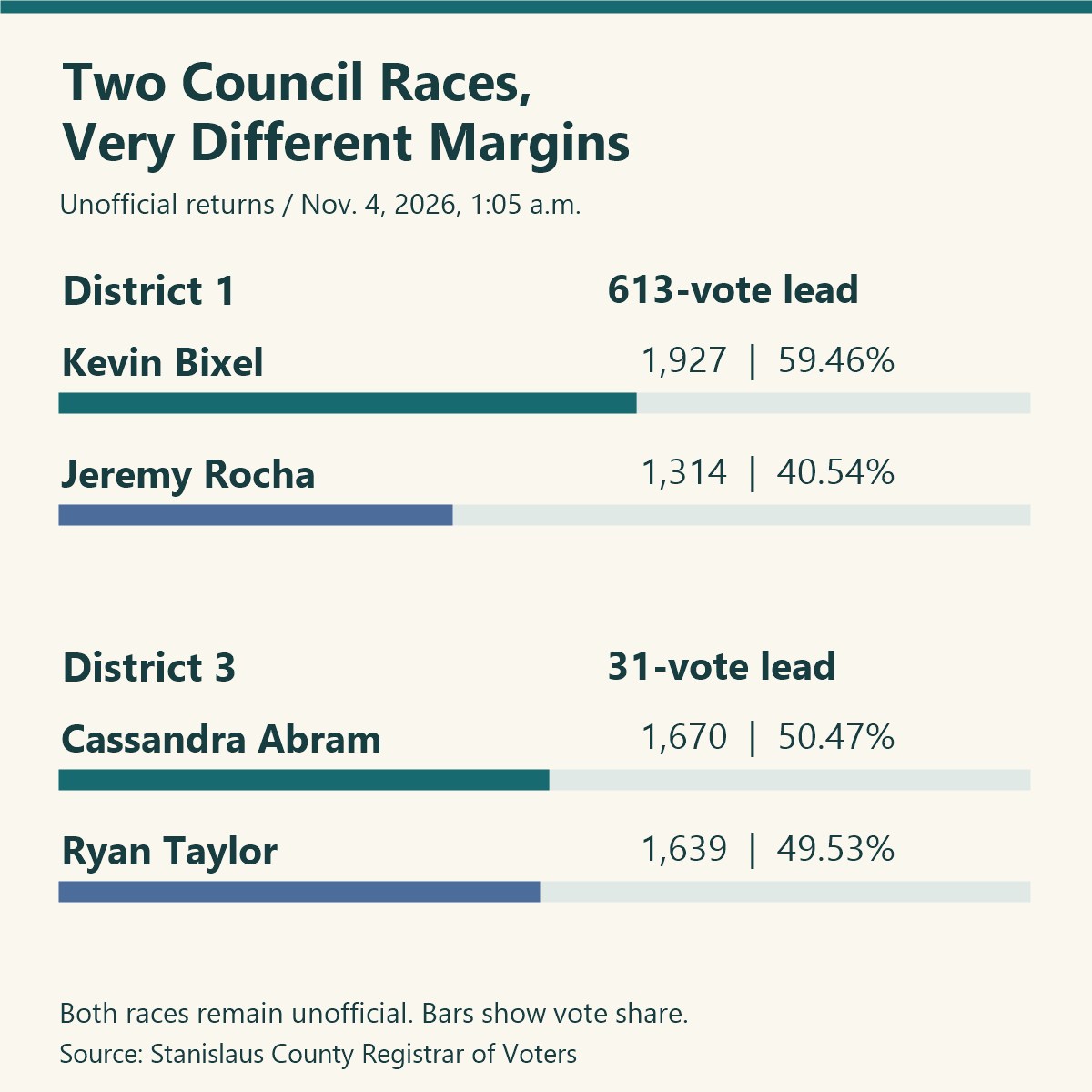
In District 1, incumbent Kevin Bixel leads Jeremy Rocha 1,927 to 1,314. Kevin has 59.46% of the counted candidate vote, compared with Jeremy’s 40.54%, a 613-vote margin. The two district races should not be treated as equally close simply because both incumbents are ahead.

Kevin Bixel leads Jeremy Rocha by 613 votes. Cassandra Abram leads Ryan Taylor by 31 votes.
Unofficial council returns from the November 4, 1:05 a.m. county report. Graphic by Local Turlock.

If the current leaders ultimately prevail, voters will have retained Amy, Kevin and Cassandra in the offices on this year’s ballot. That is a conditional description of the present count. Turlock’s council still makes decisions collectively; an individual mayor or councilmember cannot approve a city budget or contract alone.

Mary Jackson Leads for Turlock Unified Area 4

In Turlock Unified School District Area 4, Mary Jackson has 1,914 votes, or 71.82%, against Jayden Betbabanta’s 751 votes, or 28.18%. The recorded margin is 1,163 votes. School-board boundaries are separate from City Council districts, so an Area 4 school result is not a District 4 council result.

Denair Unified voters were choosing up to two board members. Mike Baker has 769 votes and Kathi Dunham-Filson has 595, followed by Gaby Cortes with 483 and Billy Ray Myers with 434. Mike and Kathi occupy the two leading positions in this report. Because voters could select two candidates, those totals should not be read as if everyone cast one vote in a two-person race.

Congress and the Legislature: Use the Entire District

The county report includes only the Stanislaus County portion of congressional and state legislative contests. The full district can have a different margin, and sometimes a different leader. The Secretary of State combines the participating counties.

RaceFull-District CountStatus
U.S. House District 5Tom McClintock: 102,646 (56.2%)
Michael Masuda: 79,957 (43.8%)
AP race call for Tom McClintock
U.S. House District 13Adam Gray: 58,217 (61.3%)
Kevin Lincoln: 36,724 (38.7%)
Adam leads in the official tally
State Senate District 4Alexandra Duarte: 123,606 (52.2%)
Jaron Brandon: 113,160 (47.8%)
Alexandra leads districtwide
State Assembly District 22Juan Alanis: 45,013 (100%)Juan was the only listed candidate

Sources: official House District 5, House District 13, Senate District 4 and Assembly District 22 returns, all carrying the 6:27 a.m. report time. Fox News lists the AP call for Tom McClintock. A race call precedes certification.

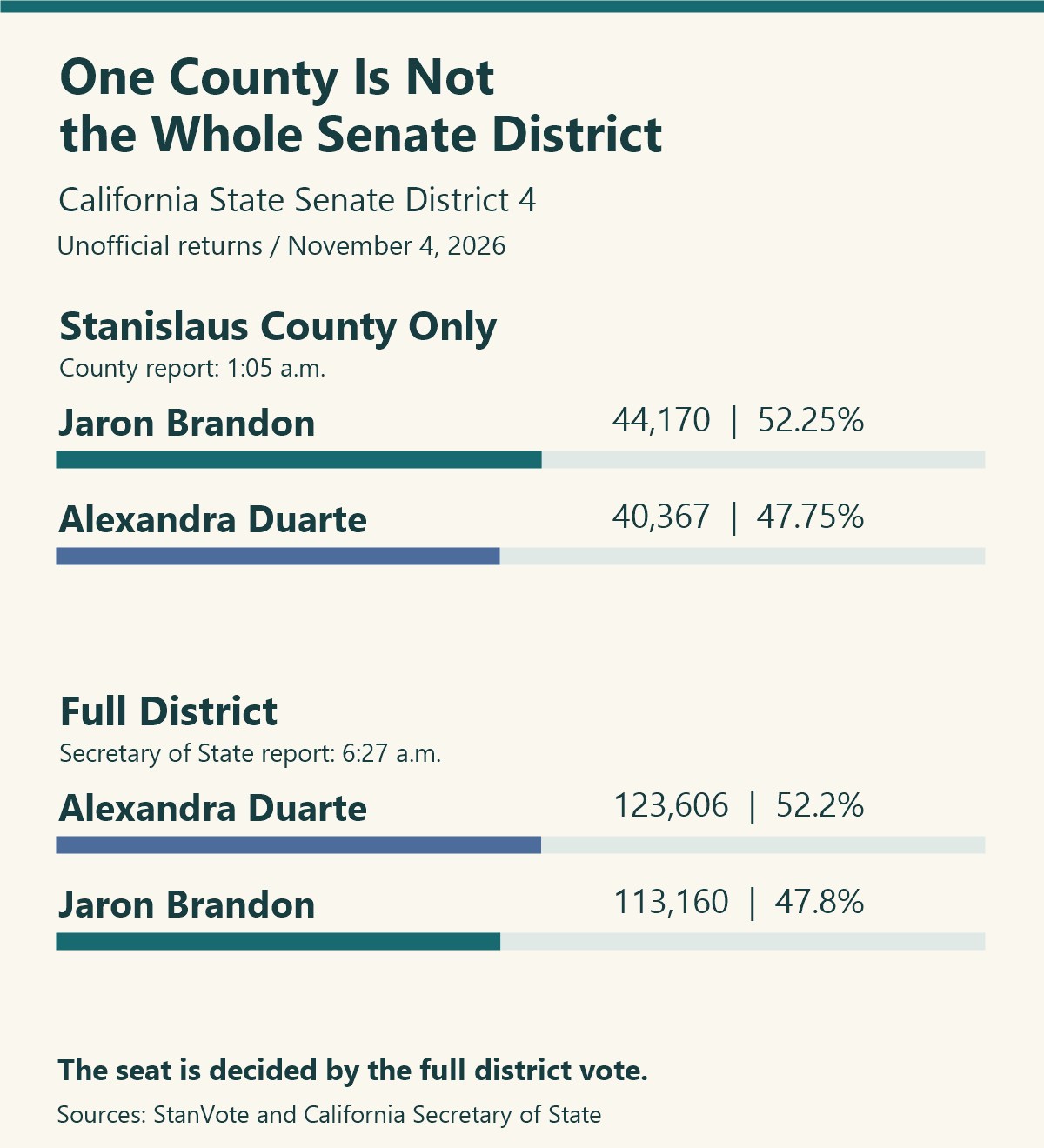
Senate District 4 is the clearest example of the county-versus-district difference. Jaron leads in Stanislaus County with 44,170 votes, or 52.25%, to Alexandra’s 40,367, or 47.75%. Across the whole district, Alexandra leads by 10,446 votes. The county-only numbers would give readers the wrong impression of who is ahead for the seat.

For Juan, the 100% figure refers to the counted votes for the single candidate listed in that Assembly contest. It does not mean every registered voter voted for him.

Xavier Becerra Wins the Governor’s Race in the AP Call

KQED’s AP-powered results page identifies Xavier Becerra as the winner of the governor’s race against Steve Hilton. The official statewide tally at 6:27 a.m. has Xavier at 4,991,891 votes, or 63.9%, and Steve at 2,814,373, or 36.1%. The vote count continues after the news call.

Stanislaus County is considerably closer in that contest: Xavier has 52.92% here and Steve has 47.08%. The statewide electorate, rather than the county electorate, chooses the governor.

The same AP results page calls five other statewide offices. The percentages below come from the Secretary of State’s 6:27 a.m. returns; remaining contests are labeled as leads.

OfficeStatewide ReturnsStatus
Lieutenant GovernorFiona Ma 63.8%; Gloria Romero 36.2%AP called for Fiona
Secretary of StateShirley N. Weber 64.7%; Donald P. (Don) Wagner 35.3%AP called for Shirley
ControllerMalia M. Cohen 63.8%; Herb W. Morgan 36.2%AP called for Malia
TreasurerEleni Kounalakis 64.0%; Jennifer Hawks 36.0%AP called for Eleni
Attorney GeneralRob Bonta 63.8%; Michael E. Gates 36.2%AP called for Rob
Insurance CommissionerJane Kim 52.0%; Ben Allen 48.0%Jane leads
Superintendent of Public InstructionRichard Barrera 57.1%; Sonja Shaw 42.9%Richard leads
Board of Equalization, District 1Nelson Esparza 53.9%; Shannon Grove 46.1%Nelson leads districtwide

Use the official statewide results menu for the continuing count in each office. The Board of Equalization result covers its full district, rather than all of California.

Jaron Brandon leads Stanislaus County, while Alexandra Duarte leads across the full Senate District 4.
County returns at 1:05 a.m. and full-district returns at 6:27 a.m. on November 4 show different leaders. Graphic by Local Turlock.

Where the State Propositions Stand

California’s propositions are also decided statewide. This table summarizes the Secretary of State’s 6:27 a.m. statewide returns. “Leading side” describes the current count; it is not a certified outcome.

Prop.SubjectLeading Side
1Housing affordability bondsYes, 59.4%
2Larger state rainy-day fundYes, 59.6%
3Extending the high-income tax for schools and healthcareYes, 58.7%
4Allowing public funding of election campaignsNo, 52.0%
5Changing statewide recall electionsYes, 50.3%
37Loans for middle-income buyers of qualifying new homesYes, 61.0%
38Immunology research bondsYes, 55.7%
39Government-issued identification requirement for votingNo, 58.6%
40One-time tax on certain taxpayersNo, 55.6%
41Spending-limit and audit rules for new state taxesNo, 52.4%
42Restrictions on new personal-property and certain retroactive taxesYes, 54.3%
43Limits on raising revenue for local government servicesNo, 54.9%
44Community health-clinic spending requirementsNo, 81.8%
45Environmental-review changes for certain projectsNo, 54.1%

Proposition 5 is especially close in the morning report: 3,706,564 yes votes to 3,657,452 no votes, a 49,112-vote difference. Its 50.3% yes share deserves a different description from a measure with a large margin. The official results page links the full legal title and voter-guide explanation for each proposal.

Why 100% of Precincts Does Not Mean Every Ballot

The county report lists all 206 precincts as reporting. It also labels the results unofficial. Those statements can both be true: precinct reporting is not a guarantee that every eligible mail, provisional or conditional-registration ballot has finished verification and counting.

The Secretary of State explains the ballots processed after Election Day, including mail ballots postmarked by Election Day and received within seven days, provisional ballots and ballots needing additional processing. Signature and registration checks take place before eligible ballots enter the count.

The county’s report shows 86,913 ballots against 301,333 registered voters, or 28.84%, countywide. For the citywide Turlock contest it shows 12,306 ballots against 40,481 registered voters, or 30.40%. Those are reported turnout figures at this stage, not final turnout and not the same thing as the number of votes cast for mayor.

For the next numbers, return to StanVote’s election-results page and check the report’s run date and time before comparing totals. Voters can also use California’s My Voter Status to check their own ballot status. The count still matters most in the close local races, especially the 31-vote District 3 contest.

What Should the Next Council Tackle First?

Road repairs, public safety, city services or another local priority? Tell us which project you want the next Turlock council to address.

20,000-Pound Donation Supports Three Turlock Food Programs

in Community/Education
Illustrated groceries, a reusable bag and a bowl beside the words Food Help in Turlock.
Editorial illustration by Local Turlock.

Twelve pallets of food arrived in Turlock on Thursday, ready to support meals, household groceries and students trying to get through the semester. The shipment from The Church of Jesus Christ of Latter-day Saints weighed approximately 20,000 pounds, according to Christopher Correa’s October 31 report in the Turlock Journal.

United Samaritans Foundation received the delivery. The food will be shared with Turlock Gospel Mission and Stanislaus State’s Warrior Food Pantry. The Journal reports that volunteers from all three organizations joined church members to unload and sort canned and dried foods.

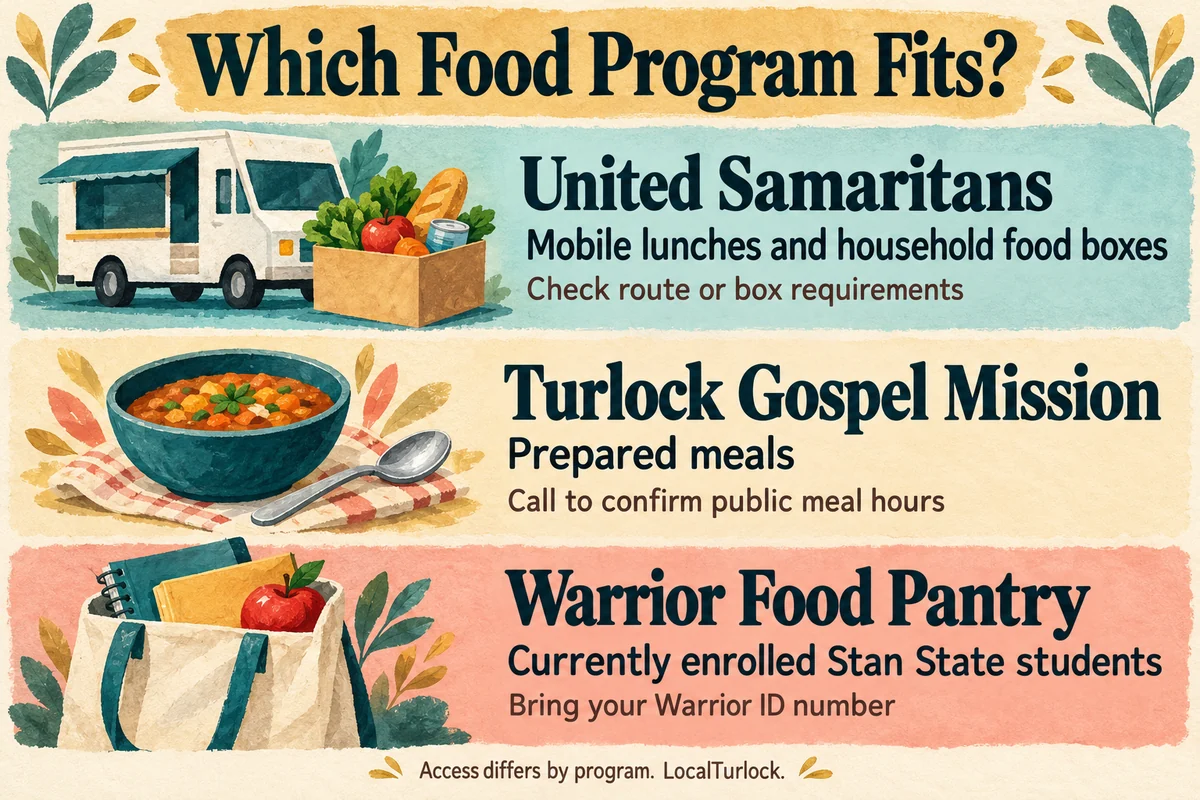
For food this week, start with the service you need: a prepared meal, household groceries or student support. The access rules differ.

United Samaritans: Lunch Trucks and Food Boxes

United Samaritans’ Daily Bread program takes prepared meals to scheduled stops. Its program description explains that meals for Turlock, Keyes/Ceres and Westside routes are cooked in its Turlock kitchen, then loaded onto mobile feeding trucks. Use the Mobile Lunch Truck Schedule on the foundation’s homepage to find a stop and its time.

The Emergency Food Box program is a separate option. The foundation’s current requirements sheet asks for:

  • A picture ID.
  • An ID or Medi-Cal card for each household member.
  • Proof of address from within the last six months.
  • Proof of income from the last six months for each household member age 18 or older.

Call 209-668-4853 for the next distribution date and pickup instructions. Gathering the documents first can save a second trip. The food-box checklist applies to that program; ask separately about the lunch-truck service.

United Samaritans mobile lunches and food boxes, Turlock Gospel Mission prepared meals, and the Warrior Food Pantry for current Stan State students.
The programs have different access rules. Explanatory illustration by Local Turlock.

Turlock Gospel Mission: Ask About Public Meals

Turlock Gospel Mission serves people experiencing homelessness or food insecurity, including people on fixed incomes who need supplemental meals. Its meal-service description says some meals are for shelter guests or Restoration Program participants and others are open to the public.

The shelter and day center are at 437 S. Broadway, Turlock. Call 209-656-1033 to confirm the public meal time before going: the service page and website footer currently list different hours.

Ask which entrance to use and whether the meal you plan to attend is open to walk-in visitors. The mission also lists clothing, hygiene assistance and case management among its services.

Stan State: A Pantry Visit and a Food Box Are Separate

The Warrior Food Pantry offers food and toiletries at no cost to currently enrolled Stanislaus State students. Students can collect up to 10 items per week and need their Warrior ID number. In Turlock, the pantry is in the Student Services Building, Room 128, Building 116, on the campus at One University Circle, Turlock.

Fall 2026 drop-in hours are Monday, Wednesday, Thursday and Friday from 9 a.m. to 4 p.m., and Tuesday from 10 a.m. to 6 p.m. Basic Needs lists November 11 as a closure. Students who cannot visit during those hours can ask about an appointment. Contact 209-667-3132 or basicneeds@csustan.edu.

The university also holds separate food-box distributions for current students. November’s dates are Thursday, November 5, and Wednesday, November 18, from 10 a.m. to noon at University Circle, while supplies last. Students can walk up or drive up, provide their Warrior ID number and complete a brief check-in form.

Food distribution for current Stan State students on Thursday, November 5 and Wednesday, November 18, 2026, from 10 a.m. to noon at University Circle. Warrior ID number needed; while supplies last.
November distribution dates listed by Stan State. Calendar illustration by Local Turlock.

Food-distribution items do not count against the pantry’s weekly allowance. Students may attend each available distribution.

Want to Help? Start with the Organization’s Needs

A food drive works better when the receiving organization helps plan it. Before buying cases of groceries, ask what is needed, what can be accepted and when someone will be available to receive it. That gives a school, workplace or neighborhood group a specific shopping list and delivery plan.

Turlock Gospel Mission’s volunteer page lists meal service, clothes-closet assistance, cleaning, reception and other roles. Groups can request a dinner-service opportunity through its sign-up link; staff coordinate the arrangements. Choose a role and shift with the organization rather than arriving with an unannounced group.

Our Get Involved guide has more local volunteer options. If transportation is the obstacle, the Turlock Transit guide explains a first bus trip. Confirm the pickup location and service hours, then plan the ride home as well.

Organizing a Local Food Drive?

What is one practical tip you would give someone organizing their first food drive? Add your suggestion to our Facebook discussion.

November Stargazing From Turlock: Meteors, the Moon and a Museum Night

in Places & Recreation/Education
Astronomical photograph of the Pleiades star cluster with bright blue stars and surrounding reflection nebulae.
The Pleiades in an astronomical photograph. NASA, ESA, AURA/Caltech and Palomar Observatory / Wikimedia Commons; public domain. Cropped and resized.

You can start November stargazing in Turlock with a chair and a clear patch of sky. The month offers two Taurid meteor windows, a compact star cluster worth finding with binoculars, and a full Moon on November 24. For help getting oriented, MJC’s Great Valley Museum has a Science Night on November 6.

The Journal’s November sky calendar by Jim Brugger and Fred Yerzy highlights Saturn and the star clusters in Taurus. Here are a few manageable targets and dates to put on the calendar, with the equipment matched to what you want to see.

Find the Pleiades

The Pleiades, also called the Seven Sisters, look like a small, close-packed group of stars. They make a useful beginner target because the grouping is recognizable without learning an entire constellation. The blue clouds in the header photograph come from astronomical imaging; that is not the view to expect with your eyes.

NASA’s binocular guide recommends ordinary binoculars in the 7×35 to 10×50 range for targets including the Moon and Pleiades. If you already have a pair for birdwatching, try those before buying astronomy equipment. Higher magnification can make a handheld view harder to steady.

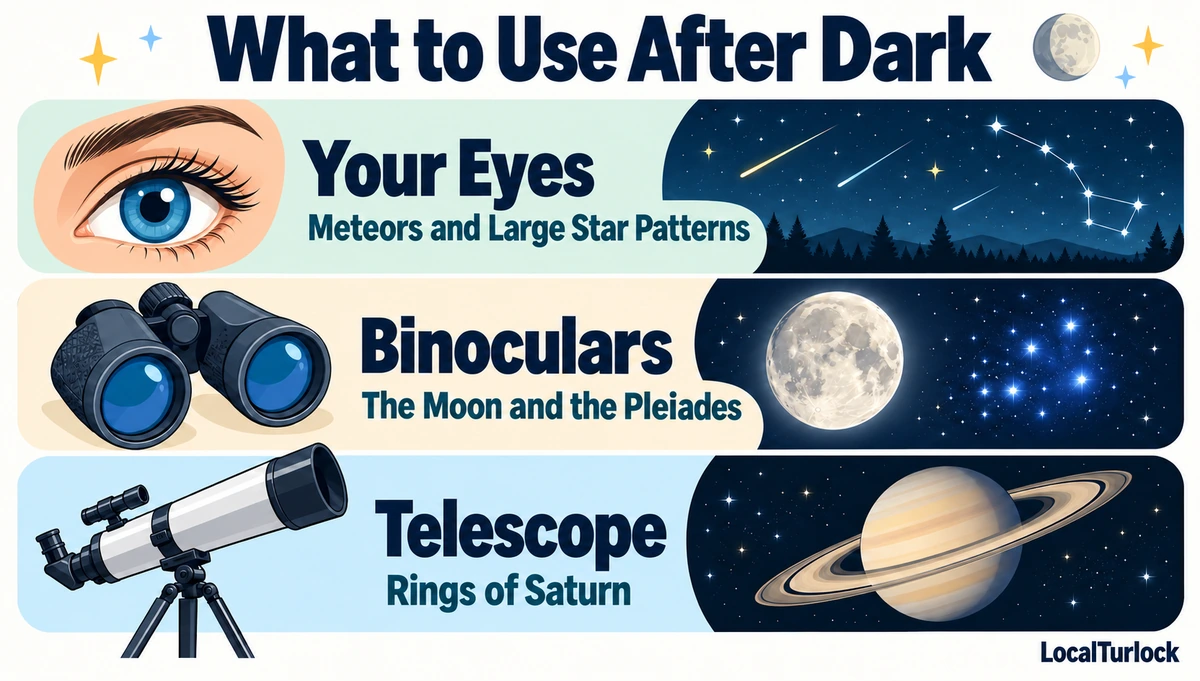
  • Your eyes: use them for meteor watching and getting familiar with broad star patterns.
  • Binoculars: bring out more stars in the Pleiades and more detail on the Moon.
  • A telescope: is the next step for resolving Saturn’s rings. Do not expect ordinary handheld binoculars to deliver that view.
Use your eyes for meteors and large star patterns, binoculars for the Moon and Pleiades, and a telescope for the rings of Saturn.
Match the equipment to the target. Explanatory illustration; sky patterns and objects are not shown to scale.

Two Taurid Nights to Put on the Calendar

The American Meteor Society’s 2026 calendar lists November 4-5 for the Southern Taurids and November 11-12 for the Northern Taurids. Those are nights spanning two dates: begin on the first date and continue into the next morning if conditions and your schedule allow.

The Taurids are associated with bright fireballs, but a date on the calendar is not a promise of a busy sky. The society lists relatively limited moonlight for both windows this year, particularly November 11-12. A clear, darker location still matters more than watching from directly beneath a bright porch light.

Leave the binoculars down for meteors so you can watch a broad area. NASA’s meteor-viewing advice is to allow 20-30 minutes for your eyes to adjust and avoid bright lights, including your phone. Read the plan before going outside, bring a comfortable seat and give the sky some uninterrupted time.

November 24 Is the Full Moon

The month’s full Moon falls on November 24, as listed in both the local calendar and timeanddate’s November sky guide. It is an easy date to remember for a simple Moon-watching evening. It serves a different purpose from a dark-sky meteor outing: you are looking at the bright object rather than trying to spot faint streaks beside it.

Try MJC’s November 6 Science Night

If you would rather start with an organized outing, the Great Valley Museum’s official schedule lists Friday, November 6, from 7 to 10 p.m. for Science Night at the Museum. The Journal also lists planetarium shows and a rooftop observatory among the evening’s attractions.

The museum and William R. Luebke Planetarium are in the Science Community Center on MJC’s West Campus, 2201 Blue Gum Avenue, Modesto. Use that destination, rather than the college’s East Campus address.

The museum currently lists $8 general museum admission and $8 general planetarium admission separately. Youth under 18, seniors 55 and older, and military visitors are listed at $5 for each. Do not assume one ticket covers both. Use the official page’s ticket links for the November 6 offerings and any specific showtimes before planning the evening around a particular presentation.

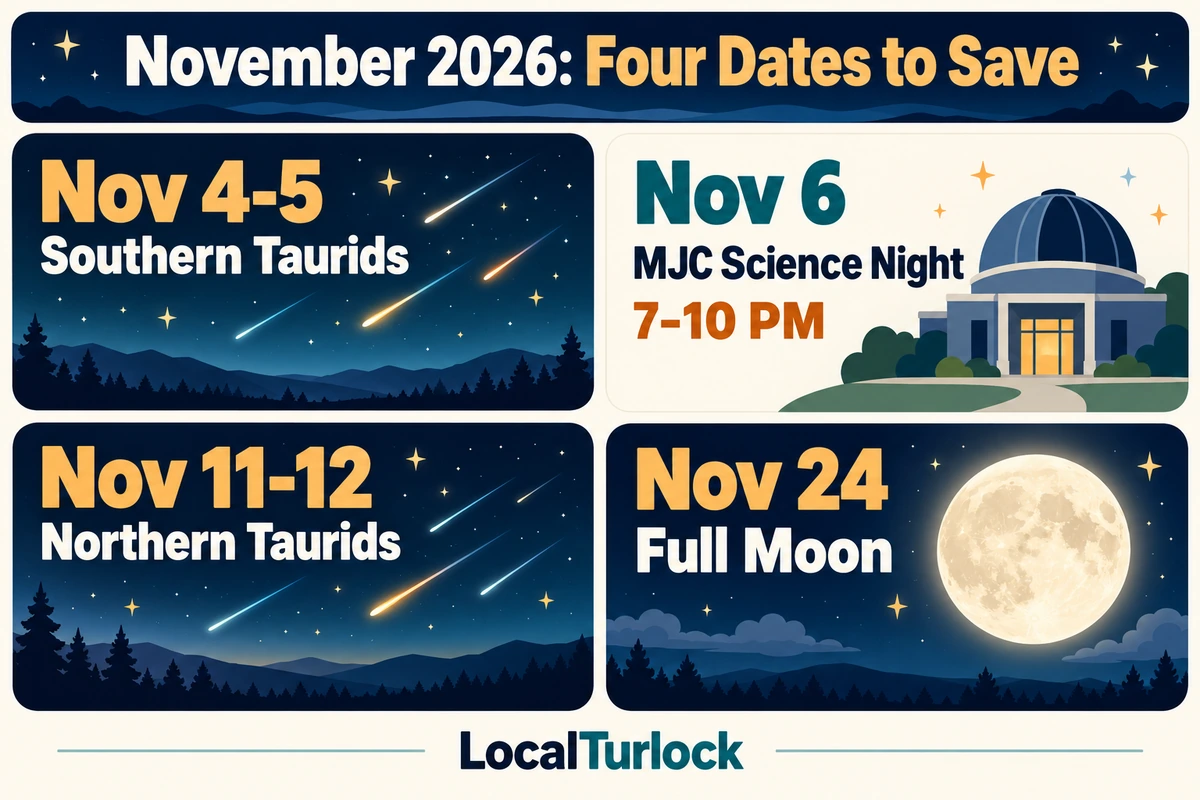
November 4-5 Southern Taurids; November 6 MJC Science Night 7-10 PM; November 11-12 Northern Taurids; November 24 full Moon.
Two meteor windows, MJC Science Night and the full Moon. Calendar illustration, not a weather forecast.

The planetarium’s visitor information says doors do not reopen once a program begins, and food and drinks stay outside. The museum does not recommend planetarium shows for children under five. For a younger child, that distinction may matter more than the length of the drive.

Before Heading Outside

A backyard is a reasonable place to learn a bright target. For darker skies, choose a location with confirmed after-dark access, a clear view and a place to park. Bring a chair and warm layers so you can settle in without cutting the evening short.

Check the National Weather Service forecast for Turlock that afternoon, and choose one target for the first evening. For the museum outing, check the November 6 tickets and presentation times through the official links above.

What Have You Spotted Above Turlock?

What is the most memorable thing you have seen in the night sky around here? Share the story on our Facebook post.

For more nearby outings, browse the Turlock Guide and our community events calendar.

Turlock Library’s November Lineup: Coding, Reading Dogs and Fruit Trees

in Event News/Education
Illustration of a reading dog, coding laptop and fruit tree for Turlock Library programs in November 2026.
An illustrated look at November's reading, coding and gardening programs.

A dog can be a forgiving audience for a new reader. A laptop can turn a Saturday morning into a first coding lesson. And a fruit tree does not have to tower over the backyard to produce a crop. All three turn up on Turlock Library’s November 2026 calendar.

The month’s programs are free, but two worth planning around require registration: Read to a Dog on November 7 and beginner Scratch coding on November 14. Later in the month, Master Gardeners will explain a way to keep newly planted fruit trees small. There are also art projects, a Pokémon afternoon and a mystery book discussion.

Two Saturdays to Reserve Now

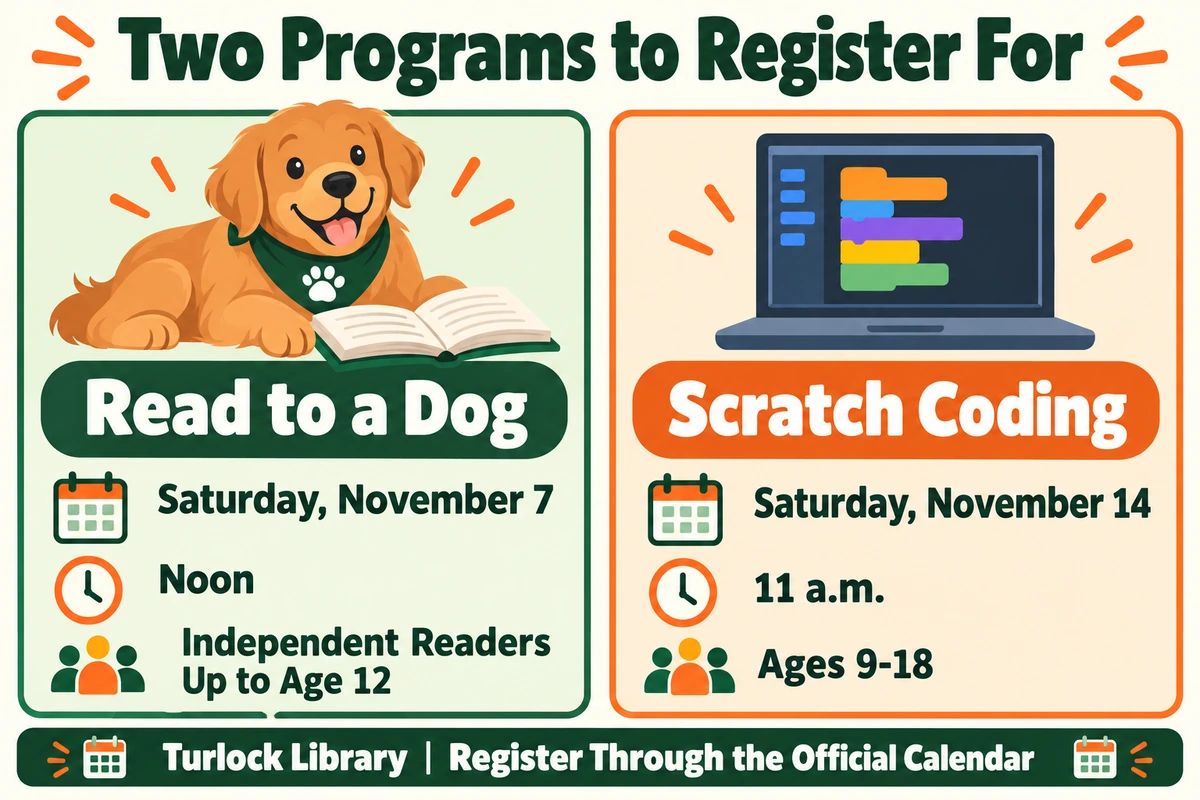
Read to a Dog: Saturday, November 7, at noon. This is for independent readers up to age 12. Children read aloud to certified therapy dogs, giving them a chance to practice with an unusually patient listener. It is a different experience from sitting in a group while an adult reads a story.

Space is limited. Use the library’s Read to a Dog listing to register a reader. The age limit alone does not tell you whether this is the right fit: the program specifically calls for children who already read independently.

Learn Coding With Scratch: Saturday, November 14, at 11 a.m. The beginner-friendly MakerSpace session is for ages 9-18. Scratch uses visual coding blocks, offering a way into programming without starting with a page of typed commands.

Registration is required, and the library asks that each person attending be registered individually. Follow the official Scratch session listing, rather than assuming one reservation covers siblings or a whole group. If the form is full or you have questions about participation, call the library at 209-664-8100.

Read to a Dog is November 7 at noon for independent readers up to age 12. Scratch coding is November 14 at 11 a.m. for ages 9-18. Register through the official calendar.
Both Saturday programs require registration through the library’s official calendar.

Fruit Trees for a Smaller Backyard

Backyard Orchard Fruit Trees: Wednesday, November 18, at 6 p.m. UCCE Master Gardeners of Stanislaus County will introduce the Fruit Bush Method. The class addresses keeping newly planted apple, apricot, peach, plum, cherry and other fruit trees under five feet tall while still producing fruit.

That is a useful subject for anyone who wants fruit without devoting most of a yard to a full-size tree. The important distinction is newly planted: the listing is not a promise that an established, mature tree can simply be cut down to five feet. Questions about choosing a tree, allowing enough room and starting its training would fit the session well.

The Master Gardeners’ class listing gives the program details. Unlike the two Saturday programs above, it does not currently display a registration button.

More November Dates to Put on the Fridge

  • Tuesday, November 3, 4 p.m.: Copper Foil Art. Ages 9 and older can make art with supplied materials.
  • Wednesday, November 4, 2-4 p.m.: Pokémon Party. An all-ages afternoon; children under 4 need direct adult supervision. Trading cards or a Nintendo Switch are optional things to bring.
  • Monday, November 9, 10:30 a.m.: Mystery Lovers Book Club. The selection is The Woman in Cabin 10 by Ruth Ware.
  • Tuesday, November 10, 4 p.m.: Stop-Motion LEGO. Ages 9 and older can experiment with animation.

The county’s November library calendar has the full schedule and individual event details. Choose Turlock when browsing; the calendar also includes programs at other branches. The Turlock Journal’s November roundup is another useful overview.

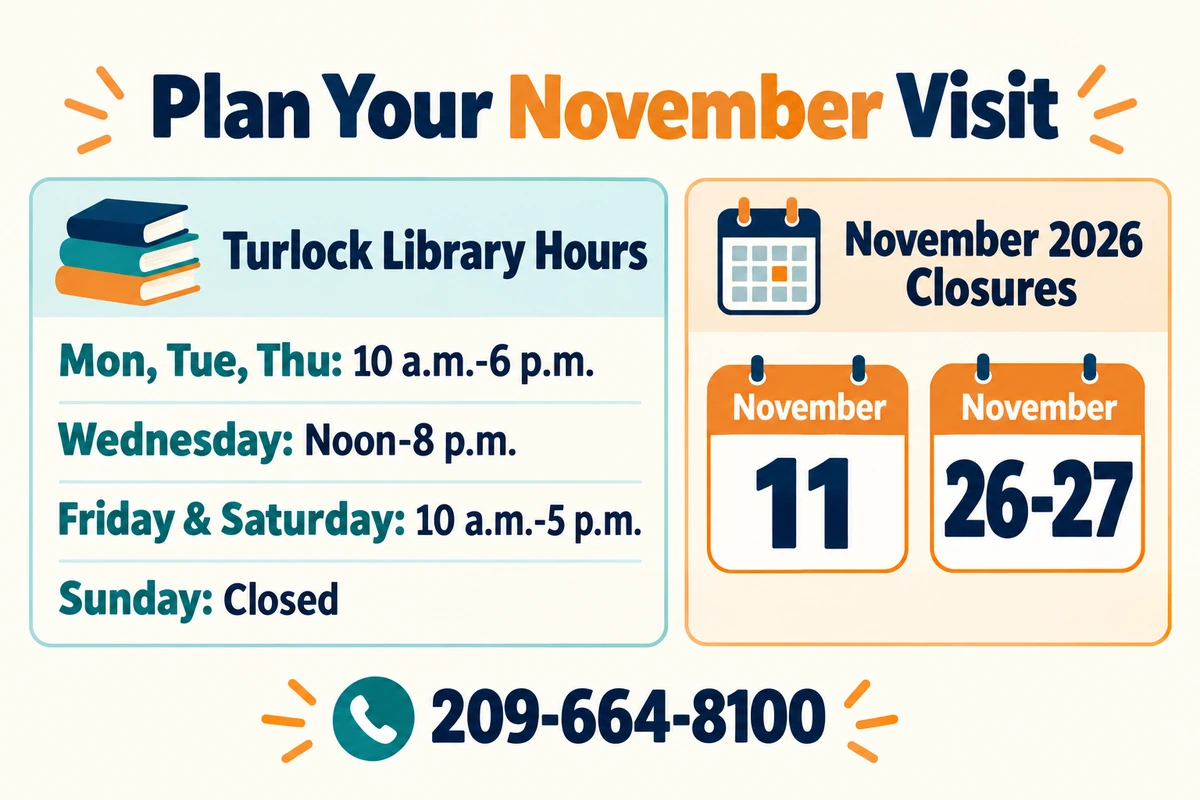
Turlock Library: Monday, Tuesday and Thursday 10 a.m.-6 p.m.; Wednesday noon-8 p.m.; Friday and Saturday 10 a.m.-5 p.m.; Sunday closed. Closed November 11 and 26-27, 2026. Phone 209-664-8100.
Regular branch hours and November 2026 holiday closures. Illustration: LocalTurlock.

Getting There and Avoiding a Closed Door

Turlock Library is at 550 Minaret Avenue, Turlock. Its regular hours are:

  • Monday, Tuesday and Thursday: 10 a.m.-6 p.m.
  • Wednesday: noon-8 p.m.
  • Friday and Saturday: 10 a.m.-5 p.m.
  • Sunday: closed.

All county library facilities close November 11 for Veterans Day and November 26-27 for Thanksgiving. Friday is normally an open day in Turlock, but the Friday after Thanksgiving is an exception. The county’s hours and holiday calendar lists both the regular schedule and those closures.

The branch has a parking lot, Wi-Fi and public computers. If you are considering the bus, our first-time Turlock Transit guide explains routes, fares and boarding. For the story behind the building and its expansion, read our Turlock Library guide.

Which November Library Program Would You Try?

Reading with a therapy dog, learning to code or growing backyard fruit? Join other local readers in the discussion on our Facebook post.

Astronomy Night at Stan State: What to Know Before Friday

in Event News/Education
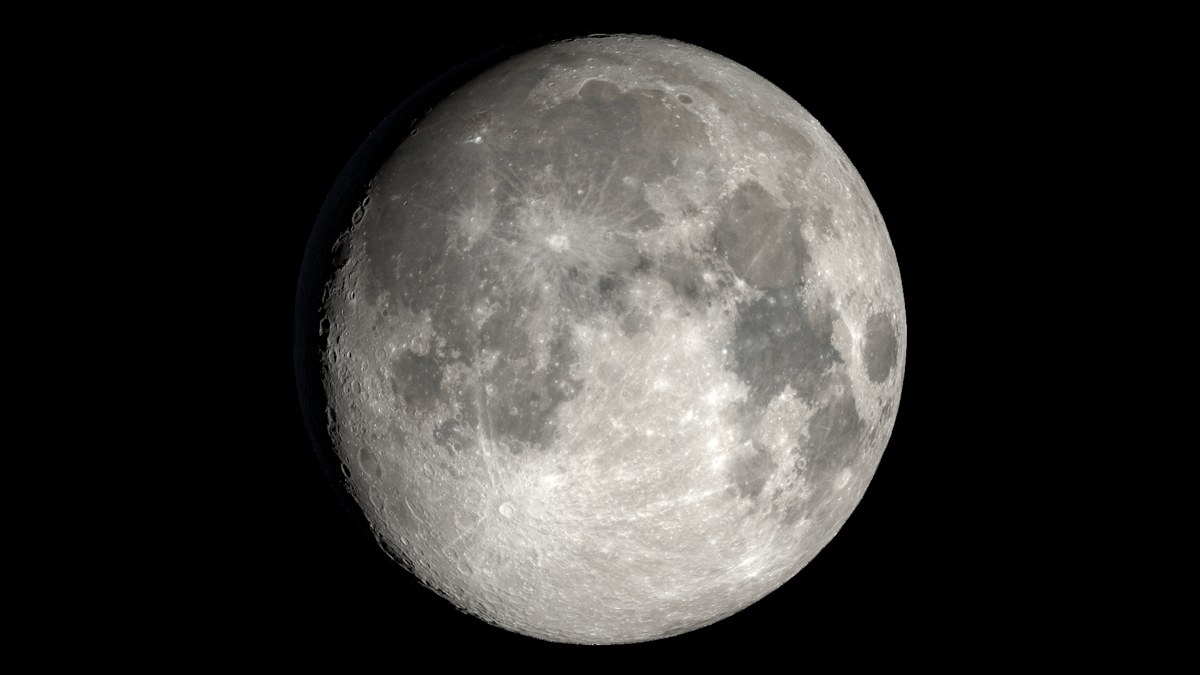
NASA visualization of the nearly full Moon for 8 PM Pacific on October 23, 2026.
Moon phase for October 23 at 8 PM Pacific. Visualization: NASA's Scientific Visualization Studio.

There is a telescope on top of Naraghi Hall, and this Friday Stanislaus State is inviting the public to an evening of astronomy. You can also look through telescopes beside the pond and try space and physics activities without getting a rooftop reservation.

Astronomy Night is Friday, October 23, from 6 to 9 PM. One detail matters before you round up the family: the rooftop sessions and general admission have separate signups. Rooftop reservations currently show full; general admission still has room.

Friday Night at a Glance

Jump to: Registration · What You Can Do · Getting There · Your First Telescope View.

General Admission Is Still an Option

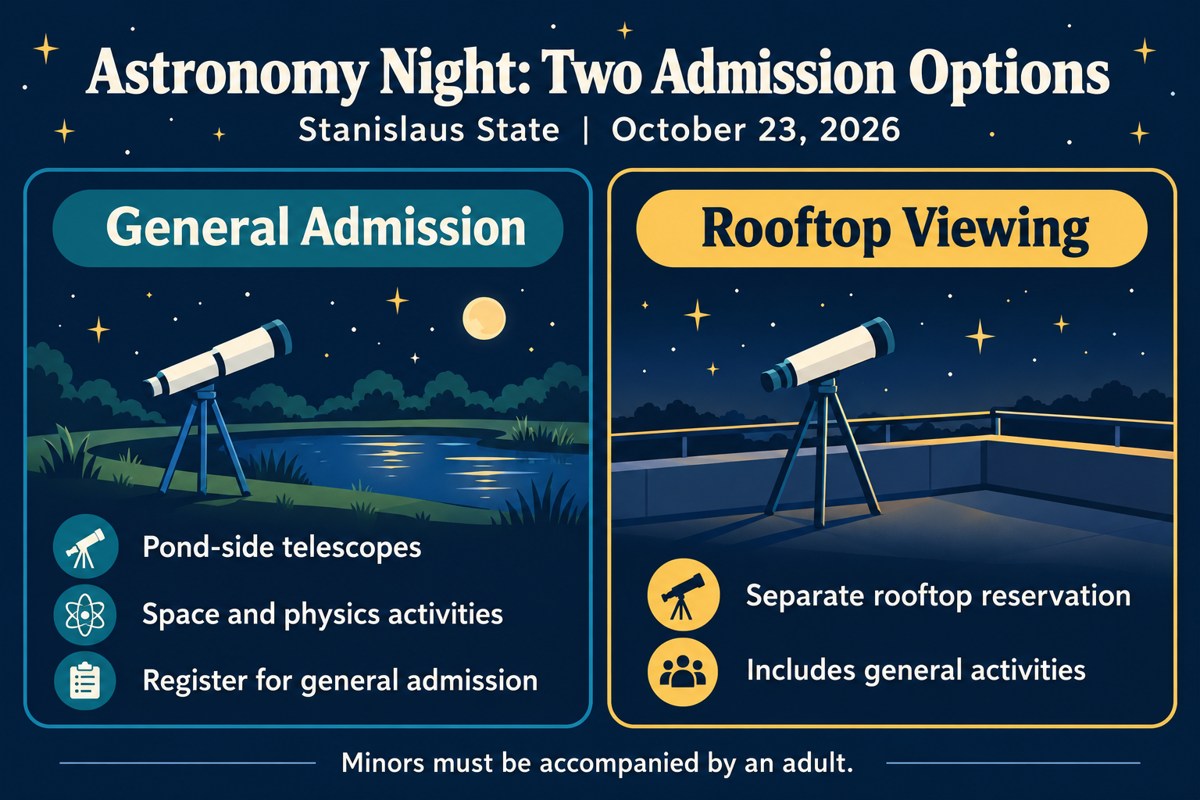
The signup separates the evening into two choices. General Admission covers the telescopes by the pond and astronomy activities. A Rooftop Reservation adds a timed session with the rooftop telescope and also includes the general activities.

As of publication on October 21, the rooftop sessions listed on the signup page are marked full. General admission remains available. A general-admission place does not reserve a rooftop session; check the live signup for openings or changes.

There is a small timing mismatch in the official pages: the main announcement says 6-9 PM, while the general-admission signup row says 6-9:30 PM. Plan around the advertised 6-9 PM window, and contact the organizer if the later finish affects your visit.

General admission includes pond-side telescopes and activities. Rooftop viewing requires a separate reservation. Minors need an adult.
General admission and rooftop viewing have separate signups. Conceptual illustration; check live availability.

More Than a Line for a Telescope

The announced activities include making constellations and exploring Moon phases, alongside hands-on space and physics activities. That gives families something to do between looks through an eyepiece, especially when children want to make or handle something themselves.

Past editions show how this works. In its 2024-25 event report, Stan State describes straw rockets, cookie-based Moon-phase models and shock-wave demonstrations at the November 2024 Astronomy Night. That event drew 144 participants and 49 volunteers. Those are examples from a previous year, rather than a promised activity list for Friday.

For a younger child, a useful starting question is simply, “What am I looking at?” For an older student, try asking why an object looks different through the telescope than it does in a photograph. There is no need to turn the evening into a quiz or rush through every station.

Getting to Naraghi Hall and Parking

Use the university’s Naraghi Hall map and floor-plan page to locate the building before leaving. A driving app can get you to the campus, but the building map is more helpful for the final walk.

The university’s visitor parking page lists daily permits at $6, available near campus entrances. Visitors are generally required to pay for campus parking. The Astronomy Night announcement does not advertise a parking waiver, so budget for a permit and follow the signs where you park. City-street parking along the campus perimeter does not require a university permit, although posted street restrictions still apply.

Bring a layer for standing outside and wear shoes you are comfortable walking in. If stairs, rooftop access or another part of the setup could be difficult, contact Robert Bell before Friday to discuss an accessible way to participate. The event listing specifically invites accommodation and access questions.

What to Ask During Your First Telescope View

Start by asking the operator which object is in view and what detail to look for. If the view seems blank or blurry, say so. Ask for help positioning your eye before moving the equipment or turning a knob. An eyepiece can take a moment to get used to.

The Moon is a good subject to learn on. NASA’s Moon-viewing guide explains that binoculars reveal terrain and that a telescope brings out mountain ridges, crater chains and other features. Look near the boundary between light and darkness, called the terminator, where shadows help the relief stand out.

A lunar impact crater and its bright rays, seen from orbit by NASA's Lunar Reconnaissance Orbiter.
This 2018 spacecraft image covers a lunar area roughly five miles across. It shows a much closer view than a campus telescope can provide. Credit: NASA/GSFC/Arizona State University; NASA source.

Friday’s Moon will be nearly full. The NASA 2026 Moon-phase dataset puts its illumination near 95 percent at 8 PM Pacific; the header image is NASA’s visualization for that hour. Actual views depend on clouds, viewing conditions and the targets chosen by the telescope operators. The organizer has not published a target-by-target observing schedule.

The Local Program Behind the Evening

Science in Our Community has been opening Stan State’s science activities to local families since 2011. A spring 2026 university profile traces the program to Professor Emeritus Mark Grobner and describes its current director, evolutionary biology professor Jeanette Pirlo. Students, faculty and staff volunteer to bring science beyond their own classrooms.

Jeanette has also added adult programming, including Sip N’ Science at Dust Bowl. Astronomy Night is one way to try the program; the Science in Our Community website carries its other activities. For more campus background, read our Stanislaus State guide.

Before Friday: reserve the right admission option, save your confirmation and check the organizer’s listing again before heading out. If the rooftop sessions stay full, the pond-side telescopes and activities are still part of general admission.

What Would You Like to See?

What would you most like to see through a telescope? Join the Astronomy Night discussion on our Facebook post.

More Local Outings

Find other options in our guide to activities for kids and upcoming events calendar.

Turlock’s November 4 Job Fair: Employers and What to Bring

in Jobs & Employment/Education
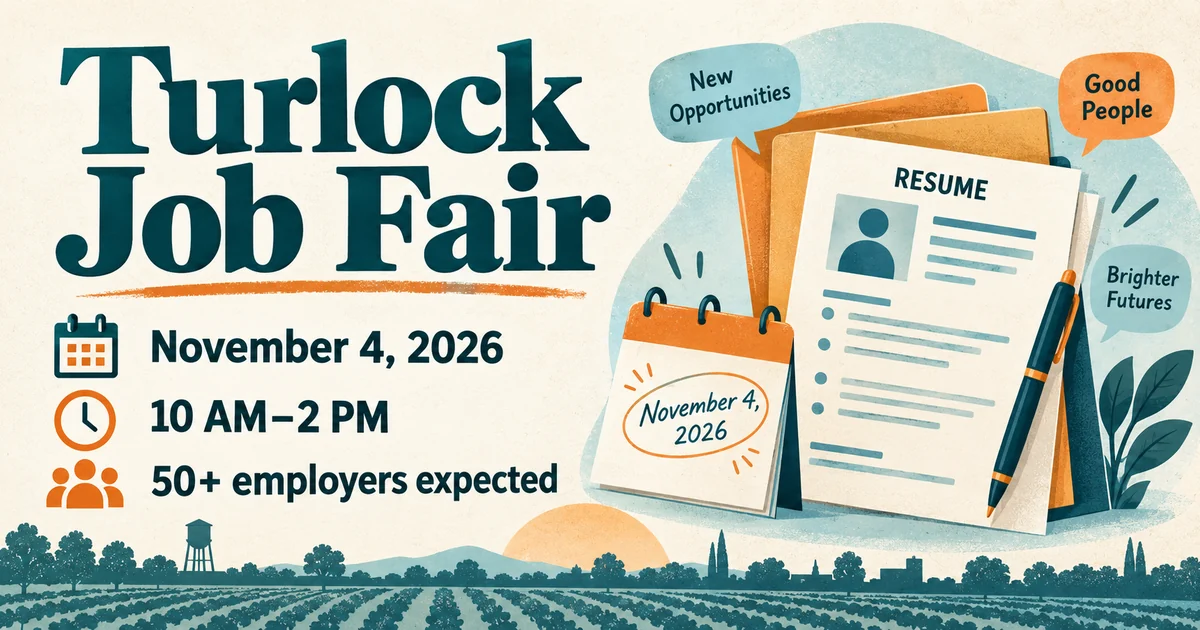
Turlock Job Fair on November 4, 2026, from 10 a.m. to 2 p.m., with more than 50 employers expected.
The November 4 fair brings employers and job seekers together in Turlock. Editorial illustration by Local Turlock.

Turlock’s November 4 job fair gives you a chance to speak with employers in person, with interviews and resume help on the program. There is time this weekend to look up openings, put a resume together and decide which employers you want to meet.

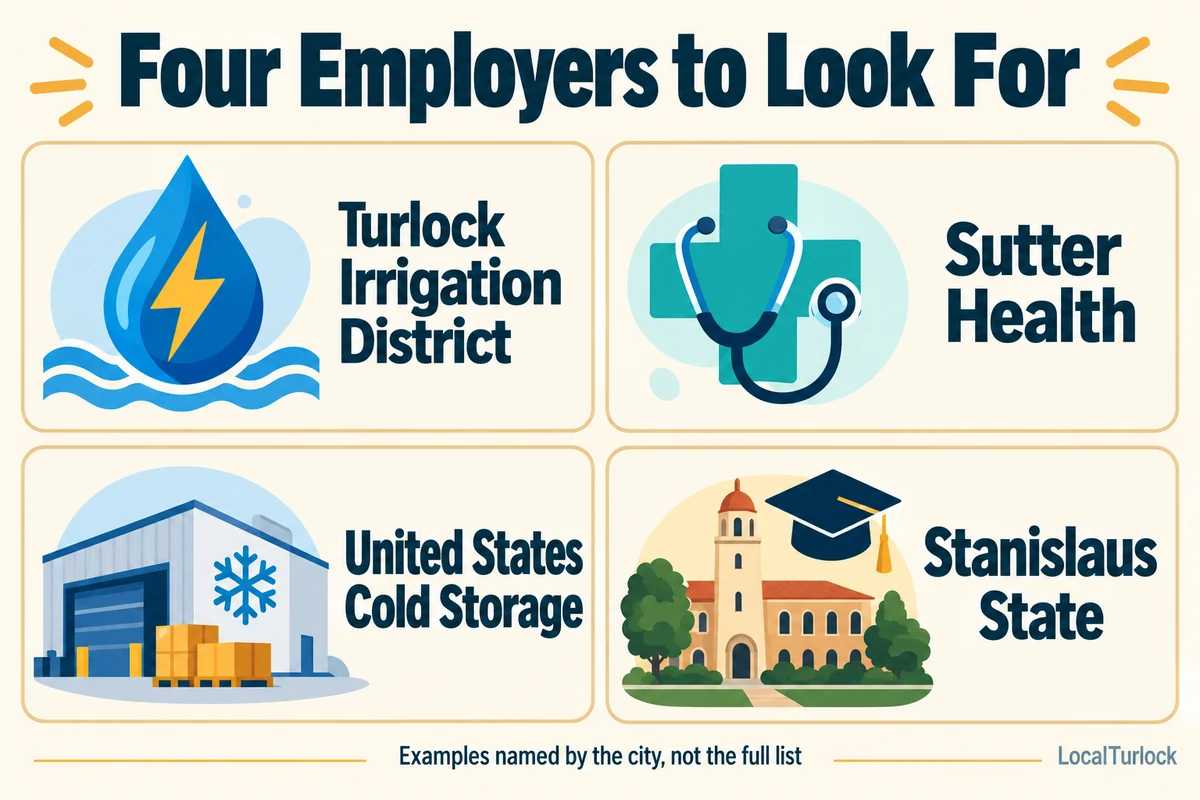
The city’s October 30 announcement names Turlock Irrigation District, Sutter Health, United States Cold Storage and Stanislaus State among the participants. The city and Chamber expect more than 50 employers; EDD’s listing says 40-plus. Both list the same date, hours and venue.

The Date, Place and Registration Details

Four Employers to Look Up Before Wednesday

The four names in the city’s announcement span several kinds of work. Browse their own employment pages before the fair and save the title of any position that interests you. Ask at the event which openings the representatives are recruiting for.

Turlock Irrigation District, Sutter Health, United States Cold Storage and Stanislaus State, four employers named in the city announcement.
Four employers named by the city. Conceptual illustration by Local Turlock.
  • Turlock Irrigation District: Its careers page links current openings, salary schedules and career-spotlight videos. TID accepts employment applications online and requires a separate application for each posted position. An employer conversation at the fair does not replace that application.
  • Sutter Health: The job search includes clinical and nonclinical categories, with filters for location, schedule and shift. Check the worksite on the actual listing, especially if your search includes Modesto or other nearby communities.
  • United States Cold Storage: The company’s careers page links external opportunities separately from openings for existing employees. Use the external listings if you do not already work there, and check the facility location.
  • Stanislaus State: The university separates staff, faculty and student opportunities. Choose the appropriate section rather than assuming every campus opening has the same application process.

Bring a Resume and a Short Introduction

Bring several printed copies of your resume and check your phone number and email address before printing. Keep a copy on your phone too, so you can refer to it or send it if an employer asks.

The Connecticut Department of Labor’s job fair preparation guide recommends practicing a 20-second introduction focused on your skills and experience. Say what kind of work you want and give one example of something you have done well. A concrete responsibility, such as training a coworker, keeping records or solving a customer problem, gives a recruiter something to ask you about.

Before you go, write down the hours you can reliably work and how far you can travel. If you are changing fields, identify which parts of your previous work could transfer. You do not need to recite your entire work history at every table.

Ask About the Worksite and the Next Step

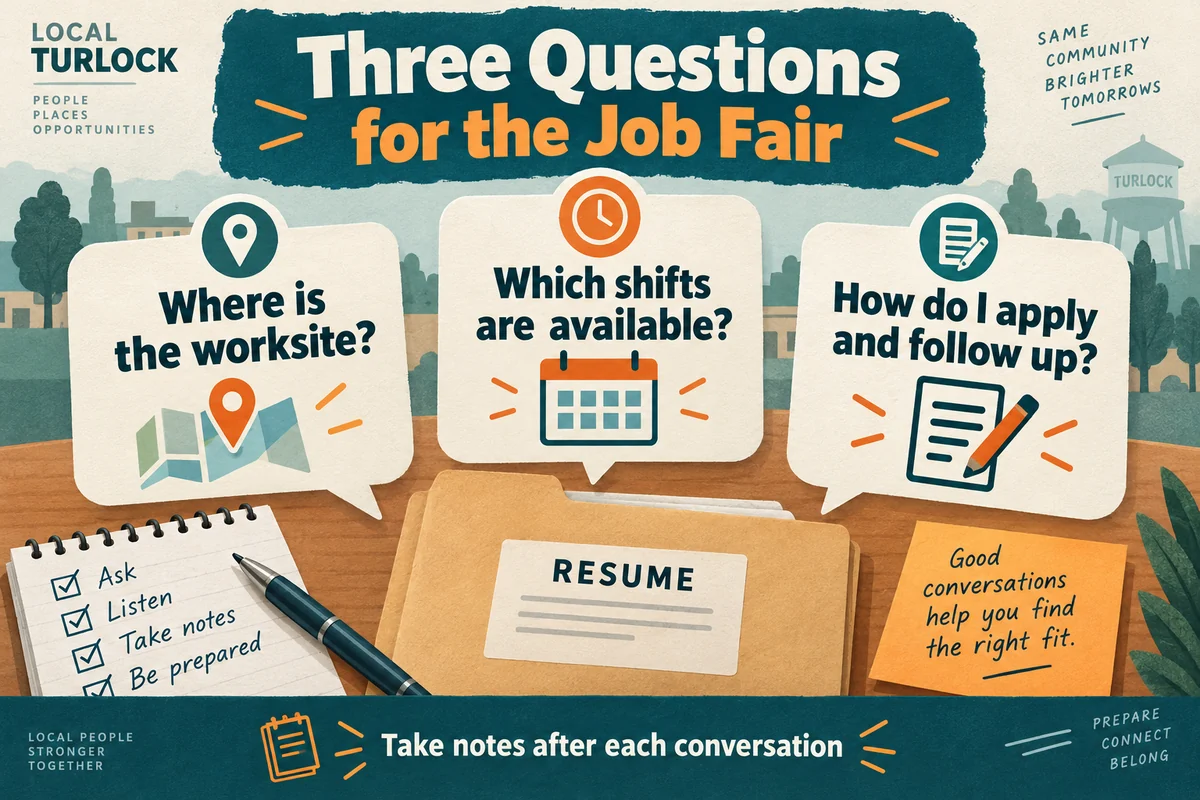
Start with three practical questions: Where would I work? Which shifts are available? How do I apply and follow up? The answers can help you decide where to spend more time.

Ask whether an opening is permanent, seasonal or temporary, and what training or credentials it requires. If you have already applied online, bring the job title or reference number so the representative knows which position you mean. If the fit looks promising, ask what happens after the fair and who should receive a follow-up.

Ask employers where the worksite is, which shifts are available, and how to apply and follow up. Take notes after each conversation.
Ask about the location, hours and application process while you have an employer in front of you. Editorial illustration by Local Turlock.

Make Time to Follow Up

Take a note after each conversation: the position, application link, contact person and any deadline mentioned. Follow the instructions the employer gives you. A short follow-up that names the position and refers to your conversation is easier to act on than a general request for any available job.

More Help With Skills and Applications

EDD’s workshops calendar lists local and virtual sessions on resumes, interviews and CalJOBS. Check each session’s registration instructions; the fair’s walk-in arrangement does not apply to every workshop.

Fresno State RISE, formerly Parent University, offers professional development and digital-literacy courses for high school students and adults. Subjects include resume development, interviewing, basic device use and Google Workspace. For the next available class session, call 559-278-0719 or text 559-554-2532.

Which Interview Question Is Worth Asking?

What is one question you always ask at a job interview? Share it on our Facebook post.

Taking the bus? Our Turlock Transit guide explains routes, fares and a first ride. Check both the trip to the fair and the trip home. For more local employment and commuting resources, see the Turlock FAQ.

Schools & Childcare in Turlock

The brick facade and entrance of the historic Turlock High School building on Canal Drive.
Historic Turlock High School building on Canal Drive, September 2012. Photo: Saeid Banankhah (Saeidb) / Wikimedia Commons · CC BY-SA 3.0. Cropped.

Your nearest school may not be your assigned school. Start with your home address, then arrange enrollment and the hours before and after class. Turlock families have district programs, cooperative preschools, private centers and licensed home-based care to choose from. Find What You Need District boundaries and assigned schools Enrollment, TK and kindergarten Preschool, infants and childcare assistance Before-school, after-school and holiday care Transportation and learning support Turlock’s school histories Which District and School Serve… Keep Reading

Summer Is Time for Reading and Fun at the Library

in Education

The annual Summer Reading Challenge is underway at the Turlock Public Library.

For the remainder of the summer school break, young readers — 17 and younger — can download the Beanstack mobile app and log their reading activity. If students read for at least 30 minutes a day, they are awarded a virtual ticket, which can be used to win prizes.

Continue reading on Turlock Journal

Local Ballplayers Selected to 32nd Rotary All-Star Game at Stan State

in Education/Sports

Warrior Field on the campus of Stanislaus State will once again play host to some of the top prep baseball players in the county on Saturday with the return of the Modesto Sunrise Rotary All-Star Game.

The 32nd edition of the annual all-star showcase will feature 45 ballplayers from 22 schools in Stanislaus County, including a handful from Turlock-area teams. 

Continue reading on Turlock Journal

1 2 3 … 24
Go to Top