Tag archive

Turlock Transit

Roger K. Fall Transit Center: Turlock Buses, Amtrak & Beyond
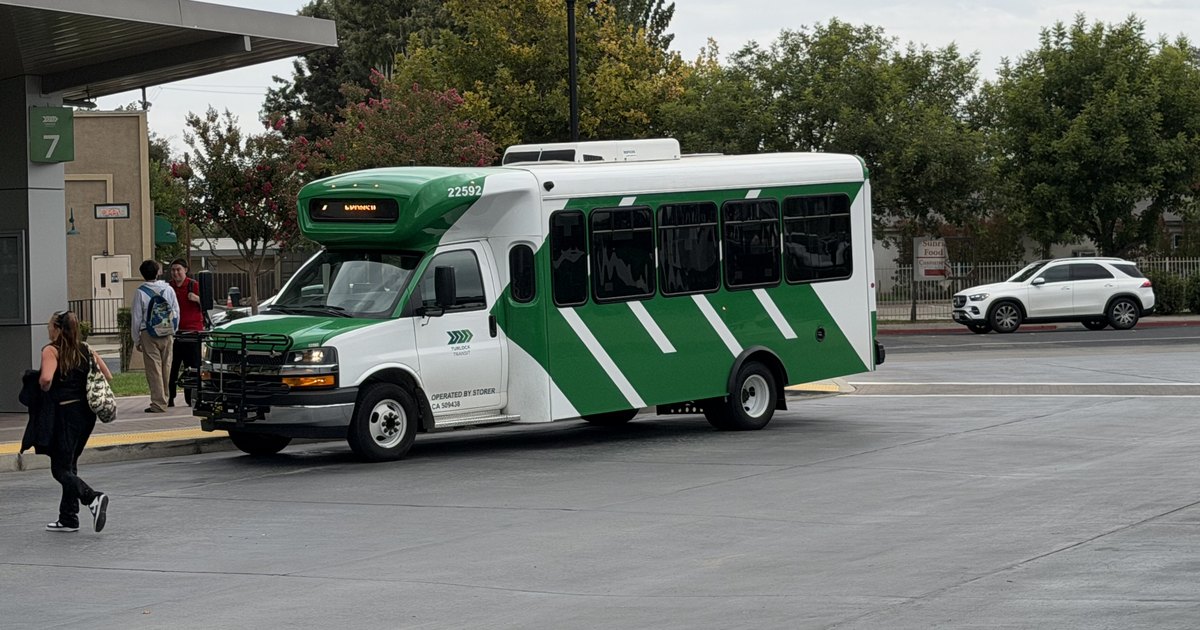
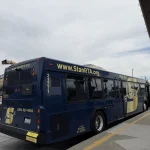
Turlock Transit bus at bay 7 of the Roger K. Fall Transit Center.
A Turlock Transit bus at bay 7 in August 2026. Photo: Evan0512 / Wikimedia Commons, CC BY-SA 4.0; cropped.

You can get from Turlock to Sacramento, the Bay Area or Yosemite without driving the whole way. The trick is knowing which bus to take, where the train actually stops and how to get home. Roger K. Fall Transit Center is the starting point for many of those trips—and a useful place to ask someone to help you plan one. Start with the Right Place The Roger K. Fall Transit Center is at 1418 N.… Keep Reading

Turlock Transit Guide: Routes, Fares and Your First Bus Ride

in Transportation
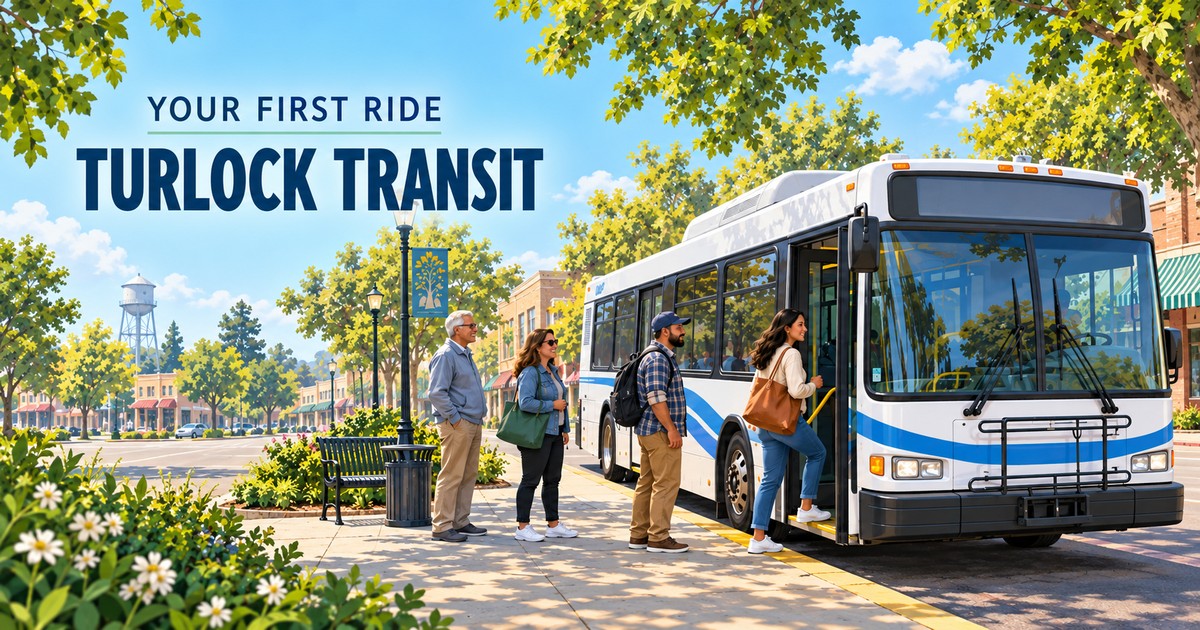
Editorial illustration of a city bus and passengers at a sunny bus stop for a Turlock Transit first-ride guide
Editorial illustration.

You have driven past the bus stops for years. Then your car is in the shop, someone needs a ride across town, or you start wondering whether every small errand really needs a car. Suddenly the questions get very practical: Which bus do I take? How do I pay? And how do I make sure I can get home?

This Turlock Transit guide walks through that first ride, from finding a stop to getting off at your destination. You do not need to memorize the whole system. Start with one trip, one route and a return plan.

The Essentials Before You Leave Home

  • Seven local routes: numbered 1 through 7, with maps and individual schedules.
  • A regular $2 all-day pass: it covers unlimited fixed-route rides that day, including changes between local buses.
  • The main hub: Roger K. Fall Transit Center, 1418 N. Golden State Boulevard. All seven routes serve it.
  • Service days: Monday through Saturday. There is no regular Sunday service.

Keep the official system map and downloadable rider guide handy. The guide is available in English and Spanish. Maps explain where a bus travels; the timetable tells you when it gets there.

Where Do Turlock Transit’s Seven Routes Go?

The following is an orientation to the network, rather than a list of every stop. A destination shown along a route can still involve a walk from the stop to its entrance. Open the linked route map and check the exact stop before heading out.

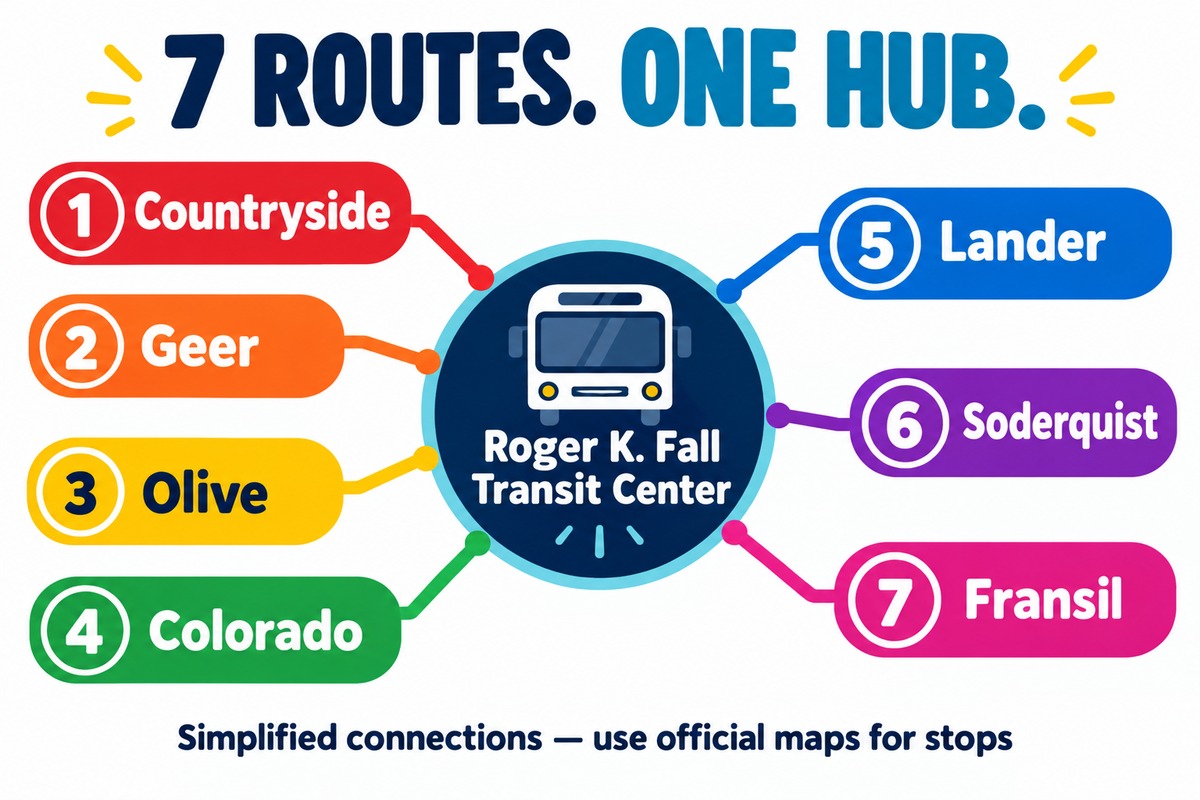
  • Route 1 — Countryside: a north-side loop connecting the Transit Center with the Countryside/Monte Vista shopping area, Monte Vista and Dels near Stanislaus State, and Geer and Minnesota. It is a starting point for planning trips toward Monte Vista Crossings and the university.
  • Route 2 — Geer: connects Geer and Tuolumne, Monte Vista and Dels, and Countryside at Monte Vista Crossings. Routes 1 and 2 circulate in opposite directions around the north-side area, so compare them for both legs of a shopping or campus trip.
  • Route 3 — Olive: reaches the Christoffersen corridor near Pitman High School and Turlock Junior High, the north side of the university area, and Delbon at Emanuel Medical Center. Check the walk from the stop if you have a medical appointment.
  • Route 4 — Colorado: serves east-side corridors including Colorado and Lyons, Alpha and Cottonwood, and Minaret and Cahill. The map includes the Turlock High School, Dutcher Middle School and Turlock Library areas.
  • Route 5 — Lander: connects the hub with Central Park and downtown, continues toward Lander and Linwood, and returns through the Golden State and Minerva area. It is useful to investigate for downtown errands and south-side destinations.
  • Route 6 — Soderquist: covers west and southwest neighborhoods, with scheduled points at Tully and Main, West and South, and Soderquist and Canal.
  • Route 7 — Fransil: serves west-side destinations through West Main and Kilroy, Fransil at Amazon, and Fulkerth and Dianne. Its map helps with trips toward the movie theater and the Fransil employment area.

Follow the arrows on the map. These routes run as loops. Your ride home may continue around the loop or use a different route. Crossing the street and waiting for the same number to travel back the other way is not a reliable return plan.

Colorful conceptual diagram connecting Turlock Transit routes 1 Countryside, 2 Geer, 3 Olive, 4 Colorado, 5 Lander, 6 Soderquist and 7 Fransil to Roger K. Fall Transit Center.
Conceptual route diagram. Colors are illustrative; lines show shared access to the Transit Center, not geographic paths.

How to Plan a Trip Without Getting Overwhelmed

  1. Choose an exact destination. Use the address or entrance you need, rather than just “downtown” or “the university.”
  2. Find the closest useful stops at both ends. Compare the route path, its direction and the walking distance. The closest stop to your home is only helpful if it connects with where you want to go.
  3. Read across one timetable row. A row represents a scheduled trip. Match the departure at your boarding point with the later arrival near your destination. The tables list selected timing points, so an intermediate stop may need the live lookup.
  4. Plan the return before leaving. Save the stop location, route number and last usable departure. Include time for a connection if your trip needs two buses.

The official live bus information page lets you select a route and stop to see arrival predictions. Treat a prediction as an estimate; traffic and loading can affect it. For a first trip, our suggestion is to arrive five to ten minutes early and allow an extra cushion before an appointment.

Hours, Frequency and the Last Bus

Turlock Transit lists service hours of 6 a.m. to 9 p.m. Monday through Friday and 9 a.m. to 7 p.m. Saturday. Those are overall operating hours, not a promise that a bus departs your particular stop at closing time.

The route schedules show the first weekday departures from the Transit Center at 6 a.m. and the last at 8:30 p.m. Saturday departures begin at 9:10 a.m. and end at 6:25 p.m. Gaps between scheduled hub departures vary, commonly around 35 to 40 minutes during much of the day. Check the actual row instead of assuming a bus comes every half hour. See the published departure schedule and your own route’s page.

Holiday service can differ. The official FAQ lists closures including New Year’s Day, Presidents Day, Memorial Day, Independence Day, Labor Day, Thanksgiving and Christmas. Check the agency’s current notices around holidays.

What Does It Cost, and How Do You Pay?

The current fixed-route fare page lists:

  • Regular: $2 for an all-day pass or $30 for a 31-day pass.
  • Discount: $1 for an all-day pass or $15 for 31 days for riders 55 and older, people with disabilities and Medicare cardholders.
  • Free eligible groups: youth 18 and younger; college students and faculty; public education students, faculty and staff; active military and honorably discharged veterans. Bring the identification or eligibility proof applicable to your group.

A 31-day pass begins with its first use. Local transfer slips are unnecessary because the period pass allows unlimited local rides during its validity.

You can buy a day pass aboard the bus. The Transit Center sells passes and stored-value cards; its ticket window is cash only, according to the rider guide. Bringing the correct cash amount keeps a first ride simple. Electronic fareboxes can issue a Change Card for future use rather than cash back, according to the agency’s farebox information.

For phone payment, Token Transit sells mobile passes. Set up the app before your trip, activate the pass just before boarding, and follow the farebox validator instructions. Buying and activating require a data connection; an activated pass can be used without one. Keep your phone charged.

Your First Ride, Step by Step

  1. Wait at the marked stop. Stay visible and safely back from the curb. Check the route number when the bus approaches.
  2. Let exiting passengers finish, then board. Before paying, ask the driver whether this bus serves your intended stop. A short explanation that this is your first ride helps make the question clear.
  3. Pay or present your pass. Have cash, your active mobile pass or eligibility identification ready. Keep your day pass for subsequent rides.
  4. Find out how to request your stop. Ask the driver to point out the stop-request control and which door to use when leaving. That is easier to do at boarding than when your destination is already passing the window.
  5. Sit or hold a handrail. Keep your belongings out of the aisle and watch your progress against the route map.
  6. Request the stop before you reach it. Give the driver time to stop safely. Wait until the bus has stopped before stepping off, then use a safe crossing to reach your destination.

If you miss your stop, tell the driver and ask about the next safe place to get off. For your first outing, choose an errand with a flexible arrival time. You can learn the routine without also racing a clock.

A Simple Downtown Practice Trip

Here is a scheduled example to make the timetable less abstract: Route 5 leaves the Transit Center at 9:10 a.m. and lists Central Park at 9:14 a.m. A later bus is listed at Central Park at 9:49 a.m., then back at the Transit Center at 10:06 a.m. after continuing around the loop.

Those times illustrate how to read a trip, rather than guarantee a particular day’s arrival. Check live information and stop notices before using the example. Notice the return takes longer than the short outward leg: that is why the route’s direction matters.

Changing Buses and Traveling Beyond Turlock

If one route does not connect both ends of your trip, the Transit Center is the common hub for switching between the seven routes. Use your valid local day or 31-day pass on the next Turlock Transit bus. Leave a buffer between the scheduled arrival and departure; a connection is not guaranteed simply because both times appear close together.

Trips toward other communities involve a separate regional system. Turlock Transit’s connection information points riders to Stanislaus Regional Transit Authority, The S, and Merced County’s The Bus. The current rider guide says to request a free transfer to The S when boarding your first bus. Check the connecting operator’s route, fare and last return trip separately, and confirm the transfer with your driver.

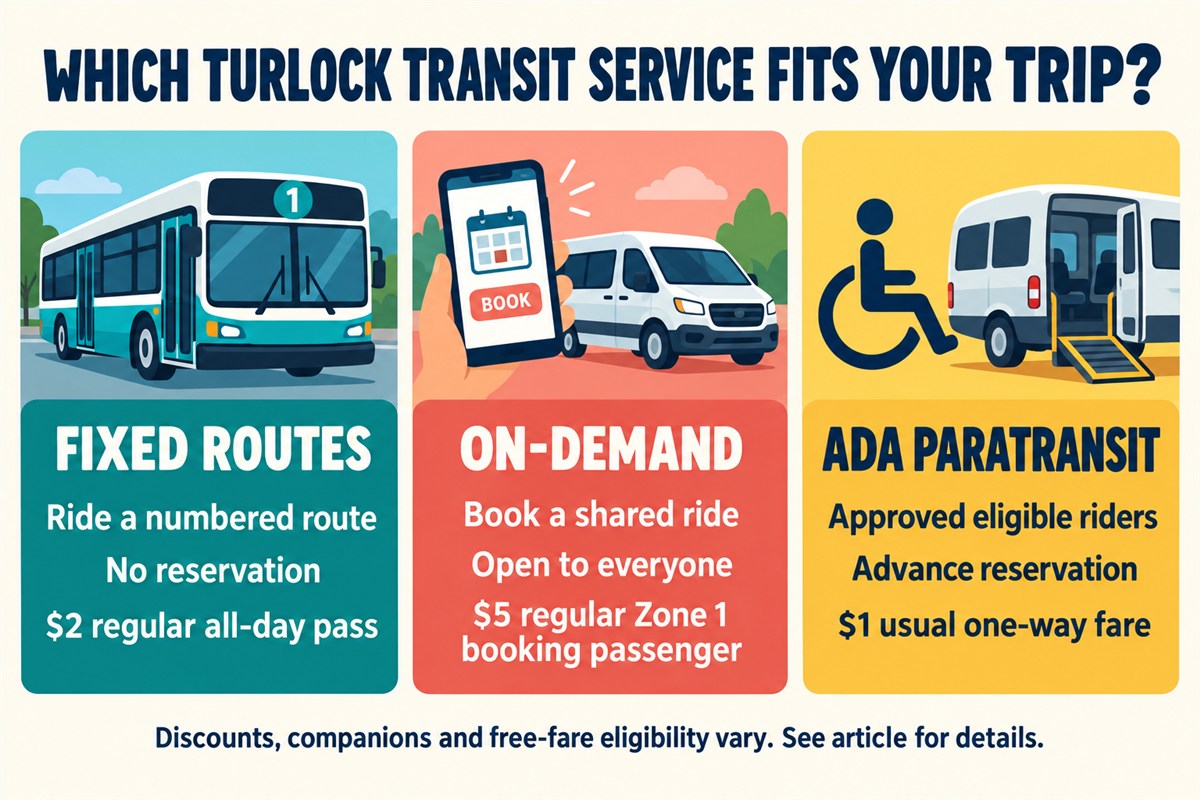
Three colorful cards compare Turlock Transit fixed routes, on-demand rides and ADA paratransit, with regular fares and reservation requirements.
Turlock Transit service options. Regular fares shown; eligibility and discounts vary.

Accessibility, on-Demand and Getting Extra Help

Turlock Transit’s buses accommodate wheelchairs through ramps or lifts. Ask about boarding assistance and securement when needed. The agency’s accessibility information also links to reasonable-modification resources and free travel training.

On-Demand is a different service from the numbered routes: a reserved, shared, curb-to-curb ride open to the public in Turlock and Denair, including the Amtrak station. Book through the Turlock Transit app or call (209) 668-5600. Availability and separate fares apply. The usual in-town Zone 1 fare is $5 for the booking passenger, with $3 companions; qualifying discount riders and trips involving Zone 2 pay $2.50 per passenger. Denair trips have shorter hours: 7 a.m. to 8 p.m. weekdays and 10 a.m. to 6 p.m. Saturday. Read the service and zone information before booking.

ADA paratransit serves qualified riders whose disabilities prevent them from using the fixed-route system. Eligibility is based on functional ability. Reserve by 5 p.m. on the preceding business day; the usual eligible adult fare is $1 one way. The current paratransit page directs applicants to ADARide at (209) 284-4577. A disability discount on a regular bus and paratransit eligibility are separate matters.

There are also different apps with similar names. Transit provides fixed-route trip planning, live information and mobile tickets; Token Transit handles mobile fares; the agency’s Turlock Transit app is used to book and manage reserved trips. You do not need to reserve a seat on an ordinary numbered fixed-route bus.

A Few Habits That Make Riding Easier

Bringing a bicycle can extend the distance you can travel from a stop. The agency says its buses have bike racks. For your first trip with a bike, ask about loading, rack space and whether your bicycle fits before traveling.

The agency’s rider rules prohibit eating and drinking aboard; keep food and beverages sealed. Use headphones, keep the aisle clear, and remember that children under nine must ride with an adult. Pets that fit in a carrier on your lap are permitted, with service animals treated separately.

Leave priority seating available for seniors and people with disabilities, and ask the driver questions while the bus is parked.

Before each outing, check the official website and live map for service changes. Construction can move a stop even when the route itself is still running. Save (209) 668-5600 for Turlock Transit questions. For arrival information without the map, the rider guide lists calling or texting your stop ID to (209) 222-2154.

Try one manageable trip this week. Pick a familiar destination, plan both directions and give yourself time. If you would like someone to help you learn the system, ask about MOVE’s free travel training at (209) 672-1143. Knowing how to use the bus gives you one more way to get around Turlock when you need it.

For more local updates, browse Local Turlock’s transportation coverage.

Service information checked October 11, 2026, against Turlock Transit’s official route pages, fare information and currently linked rider guide. Schedules, fares and individual stops can change; confirm your trip with the agency before traveling.

Turlock Transit Now Offering Rides to Amtrak Station

in Transportation

Turlock Transit began offering on-demand shuttles to the Amtrak station in Denair this week as part of a new service meant to improve residents’ connectivity to rail services.

The new, demand-response service for travelers arriving at and departing from the Turlock-Denair Amtrak Station began running on Monday, transporting riders to or from any location in Turlock or Denair for $2.50 each way. Riders can call and request a pick-up from their location in either town; the Turlock Transit bus will then pick riders up from their home and transport them to the station on Santa Fe Avenue. 

“We are very pleased to have Turlock Transit as a partner in connecting passengers to and from Turlock, Denair and CSU Stanislaus,” said Vito Chiesa, Stanislaus County Supervisor District 2 and former Chairperson for the San Joaquin Joint Powers Authority. “Local transit operators provide critical first and last mile connections. Turlock Transit’s doorstep to station service will serve as a great model for local providers throughout the state.”

The latest addition to Turlock Transit’s offerings comes as the City takes steps to make public transit easier for residents. In September, the City Council voted to reduce transit fares ahead of a scheduled rate increase, benefitting a wide range of bus riders from students to seniors. 

Continue Reading on Turlock Journal

Turlock Transit Installs Air Purification System on Buses

in Transportation

Active air purification technology has been installed on all Turlock Transit buses. 

The equipment generates and distributes safe levels of naturally occurring hydroperoxides to actively and continually treat the air and surfaces. The system has been lab-tested and proven to eliminate nearly 99 percent of germs, microbes, viruses and bacteria from the air and on surfaces, including the SARS-CoV-2 virus. 

Continue Reading on Mass Transit.

Go to Top