
Last updated
Almonds do more than grow around Turlock. At Blue Diamond’s Washington Road plant, they become flour, sliced and roasted ingredients, and the base for Almond Breeze almondmilk. The name on the supermarket shelf belongs to a cooperative owned by growers—a business that started in 1910, more than a century before its factory opened here.
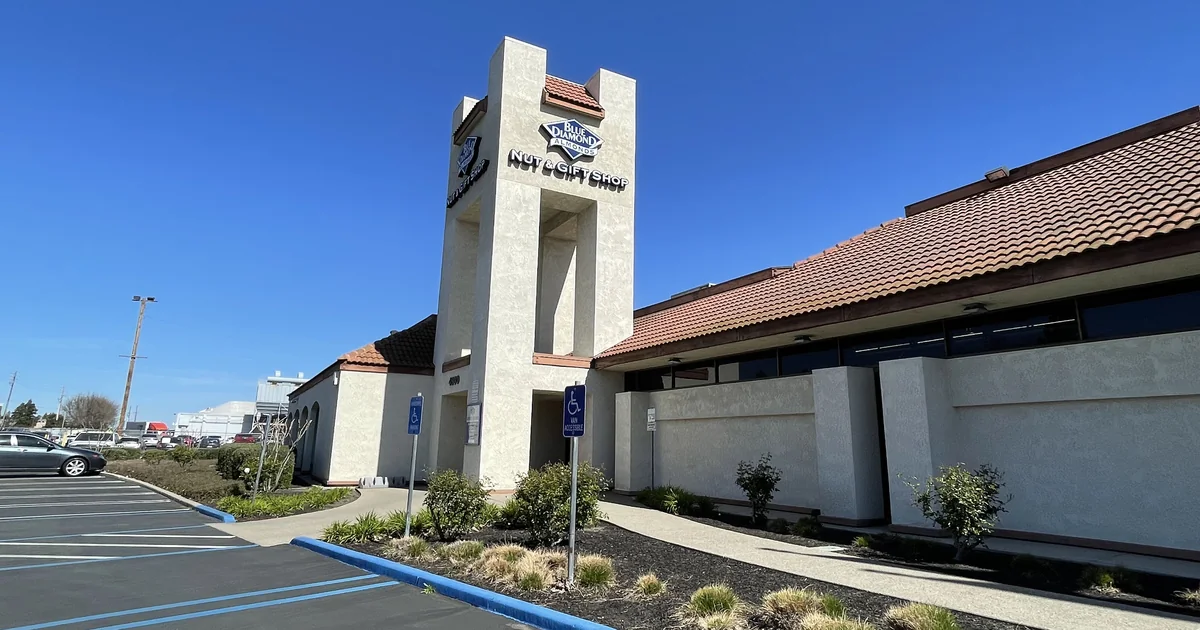
The shop pictured above is Blue Diamond’s Salida location. Turlock’s plant is a manufacturing workplace at 1300 N. Washington Road, Turlock. Both are part of a regional operation that connects orchards, receiving stations, food production and grocery brands. The differences between those places explain why Blue Diamond has become such an important part of west Turlock’s industrial district.
Jump to Inside the Turlock operation · How growers own it · The familiar cans and cartons · Why Turlock · The 2026 changes · The shop and local jobs.
What happens to almonds on Washington Road?
The company’s July 2025 description of the Turlock site lists blanching, roasting, slicing, dicing and slivering. Those ingredients go into cereals, snack bars, yogurt toppings, baked goods and candy. The plant also produces almond flour and prepares the beverage base for Almond Breeze. That last distinction matters: preparing a concentrated almond ingredient is different from bottling every carton of finished almondmilk sold around the world.
Food Engineering’s 2014 report on the new plant describes how the work was arranged. Natural almonds kept their skins. On the blanching lines, hot water softened the skins before rollers removed them. Almonds could remain whole or be cut into different sizes and shapes. Receiving, processing and finished packaging followed a linear route across a single floor. The magazine named Turlock its 2014 Plant of the Year.
One building detail is particularly revealing. The plant used 35-foot concrete wall panels designed to be removed and relocated when more space was needed. Utilities and ventilation equipment sat above the processing rooms instead of on the roof. Expansion was built into the design, rather than left for someone to solve after the first production line ran out of room.
The beverage line made that need more visible. At the 2019 groundbreaking, the Journal described an integrated almond base line that would blanch, split, roast and grind almonds into a buttery paste. The base could then travel elsewhere to be mixed with water for almondmilk. A carton in another country could therefore have a Turlock connection without its final filling and packaging happening here.
These are different markets for the same crop. A snack almond must work as something you eat by itself; a baker needs a consistent flour or cut ingredient; a beverage maker needs a usable base. The equipment, specifications and packaging change with the customer. That helps explain why an almond processor needs maintenance technicians, quality staff and logistics teams as well as people working directly on a production line.
Farmers formed the business because selling alone was harder
On May 6, 1910, 230 California almond growers formed the California Almond Growers Exchange. Representative Dennis Cardoza recorded those details in a Congressional centennial tribute. Blue Diamond was the later name of that organization. Turlock’s factory is a much more recent part of its story.
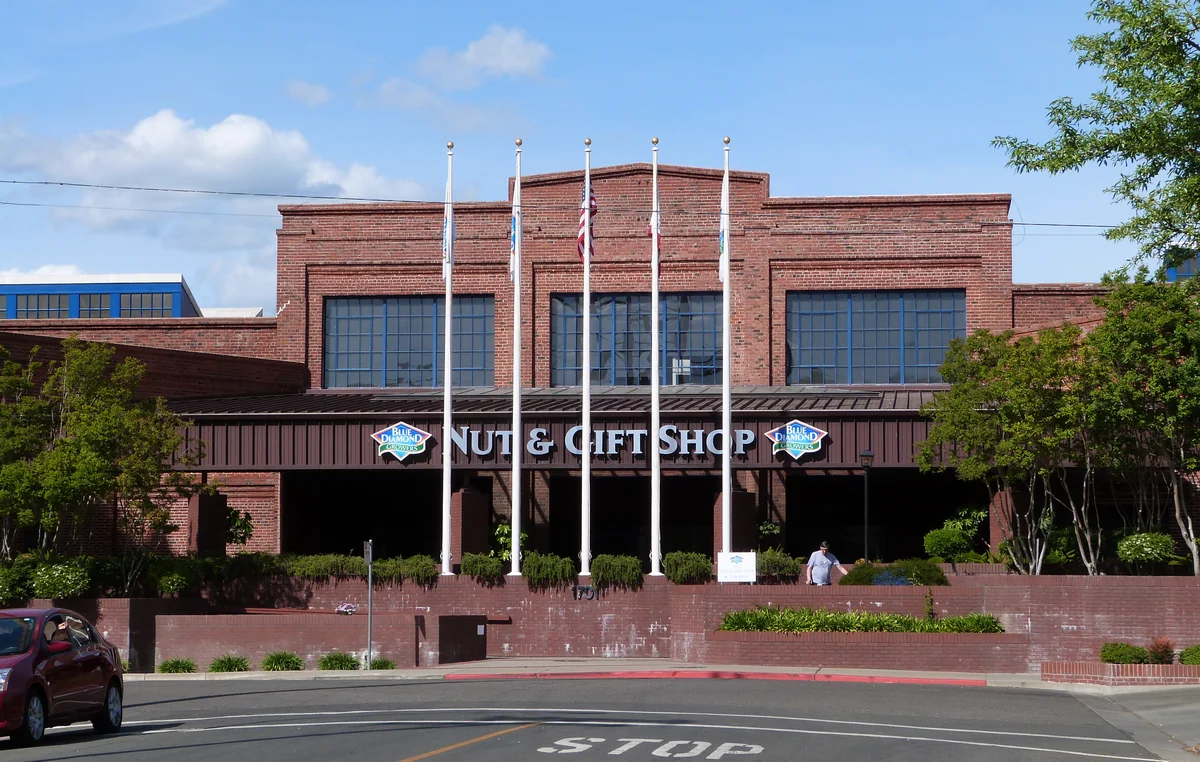
The Sacramento operation shown here was photographed in 2015. The cooperative had already spent decades finding customers for California almonds before building its Turlock plant. Its early problem was bargaining power: small local associations competed for a limited number of buyers, who could press prices down.
A USDA centennial history credits Acampo grower J. P. Dargitz with organizing nine local cooperatives into the statewide Exchange. Market research helped him resist demands for lower prices. T. C. Tucker traveled east to find brokers and customers. Building a common sales organization gave growers a way to reach buyers they could not easily find on their own.
By the late 1920s, the cooperative was supplying almond ingredients for chocolate, baking and ice cream. Its member magazine began in 1922 as The Minute Book, later becoming Almond Facts. The magazine continues to connect the business side of almonds with the work in the orchard: crop conditions, pests, markets and decisions affecting growers.
Blue Diamond’s cooperative information explains the ownership structure. Members elect nine district directors to three-year terms; those directors may appoint up to two directors at large. Management does not sit on the board. The growers supplying the crop therefore have an elected role in overseeing the organization that processes and markets it.
The current chairman, Steve Van Duyn, is a Ripon grower whose family farms almonds and walnuts from Modesto to Galt. He has represented District 5 since 2005 and served as chair since 2023. President and CEO Kai Bockmann took that role in January 2023. The chief executive manages the business; the grower-elected board provides oversight.
That ownership model gives this company a different purpose from simply increasing the value of outside investors’ shares. Its leaders describe their task as improving growers’ returns while paying for processing, marketing and the next round of investment. Our Foster Farms and Gallo articles follow two other large Valley employers, each with a different ownership history.
From Smokehouse cans to Almond Breeze
Several milestones in the company timeline will be more familiar than the Exchange’s original name. The six-ounce Smokehouse can dates to 1949. The cooperative adopted Blue Diamond Growers as its official name in 1980. Its 1986 advertising campaign put actual growers behind the memorable request, “A can a week, that’s all we ask.” Almond Breeze arrived in 1998; a logo refresh followed in 2025.
Those changes opened more ways to sell an almond. A salty snack competes for a place beside chips and crackers. Flour belongs in a baking aisle. Almondmilk has its own refrigerator or shelf space. The brand can reach someone who rarely buys a bag of plain almonds, while ingredient sales reach people eating a breakfast cereal or bakery product without seeing Blue Diamond on the package.
The range expanded again in February 2026 with Blue Diamond Almondmilk, a separately named line in 48-ounce bottles. The announced varieties included Unsweetened Simple, Sweetened Simple, Signature Creamy and Chocolate Protein. This is a newer retail line alongside Almond Breeze; its launch announcement does not establish that the finished bottles are filled in Turlock.
Product development has its own location. The Almond Innovation Center opened at Sacramento headquarters in 2013. That was the same year as the Turlock plant opening. They were separate facilities: one developed products, while the other provided new manufacturing capacity.
Why Blue Diamond chose Turlock
The Journal’s 2013 year-in-review describes an 18-month search for a plant location. Turlock offered proximity to growers, access to Highway 99 and an industrial park with infrastructure ready for construction. Roads, water, sewer and electrical connections were as important to the choice as open land. The site near North Washington and Fulkerth roads gave the cooperative room to expand.
The plant opened June 18, 2013, with a roughly 200,000-square-foot first phase on an 88-acre property. It was a phased development, so the larger complex envisioned in early announcements should not be confused with the building completed that day.
- 2013: Turlock’s first production phase opened.
- 2015: An almond-flour expansion and an operating integrated beverage base line added to the plant’s capabilities.
- 2020: A completed 52,000-square-foot addition provided more automated handling, processing and packaging space.
The 2023 tenth-anniversary release records growth from 35 employees at opening to 162 in June 2023. Those are historical counts, rather than a current staffing figure. It also identifies the 2015 flour and beverage-base milestones. The 2020 completion announcement confirms the later addition.
Salida has a different role in the same network. Its almond receiving station opened in 1969, according to the 2020 announcement. Receiving and storage provide a place for harvested product to enter the cooperative’s system; Turlock’s ingredient lines give that crop additional forms and customers. The newer factory builds on an older regional operation.
A small Turlock connection reached a much larger audience on January 1, 2019. Pat Romero of Turlock was one of the growers featured on Blue Diamond’s first Rose Parade float. The cooperative’s account of the parade names growers and farm families from several Valley towns. It was a public appearance by people behind the brand, alongside the Almond Breeze name.
What the Sacramento changes mean for Turlock
In June 2025, Blue Diamond announced plans to move most Sacramento manufacturing to Turlock and Salida. It cited the expense and inefficiency of the historic Sacramento buildings and set out an 18-to-24-month transition. For the Valley plants, that meant a larger role in the cooperative’s manufacturing. For Sacramento employees, it meant job changes and losses.
The plan changed in an important way. In April 2026 reporting, executives said Sacramento would retain its in-shell almond processing and storage. Most other manufacturing was still expected to move south. The cooperative worked with the Sacramento Employment and Training Agency on job fairs and training; some workers transferred to Turlock or Salida, while others retired or found different jobs.
A May 2026 company announcement put more detail on the revised plan. About 35 acres of the Sacramento campus were proposed for redevelopment, while roughly 19 acres would remain for in-shell processing. Headquarters would stay in Sacramento, with a campus leaseback through at least April 2030. Blue Diamond’s growing Turlock role therefore does not mean the entire company relocated here.
Where to shop—and where to look for work
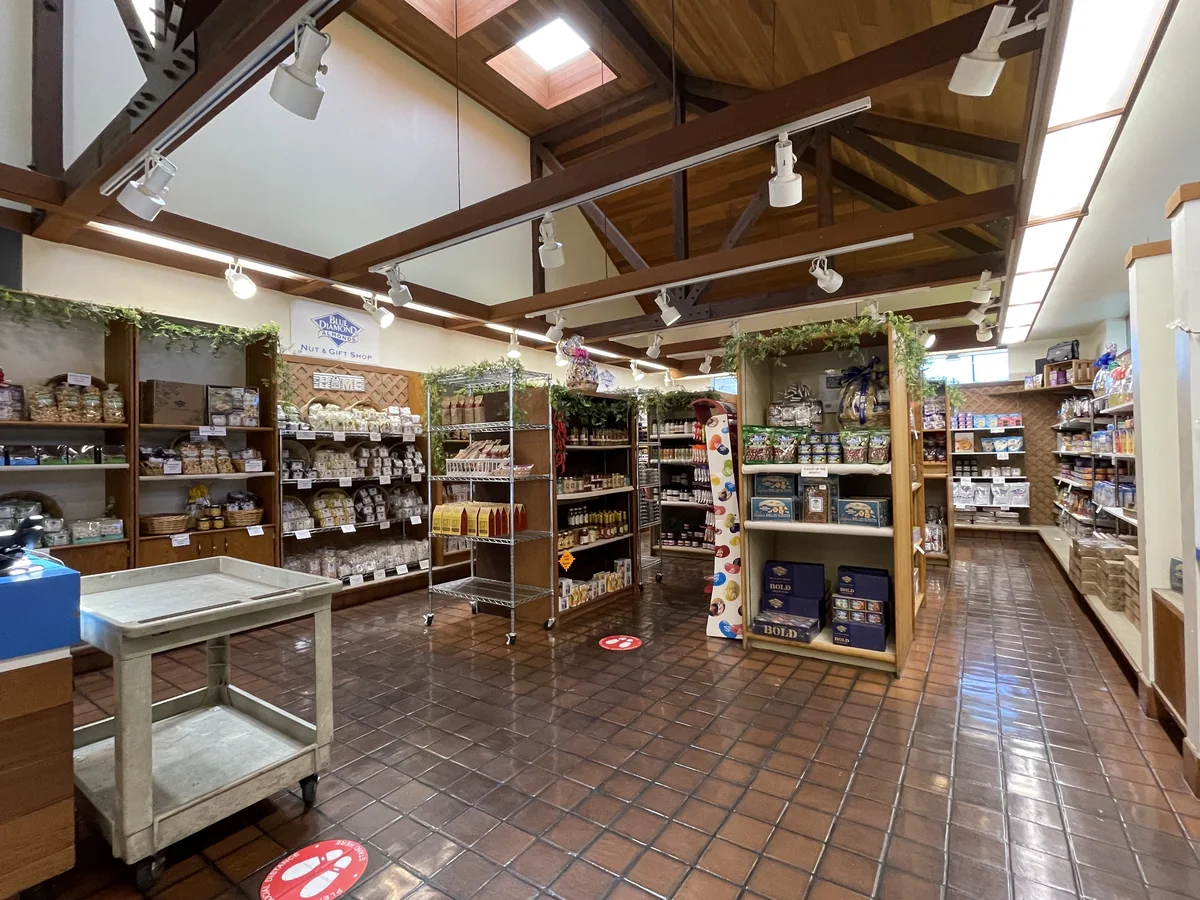
For a public visit, use the Salida Nut & Gift Shop at 4800 Sisk Road, Modesto, on the Salida campus. The UC Agriculture and Natural Resources directory lists flavored almonds and gift packs. This is the retail shop shown in the photographs, rather than a tour entrance to the Turlock production floor.
Blue Diamond’s current FAQ gives the shop number as 209-545-3222. Call for current retail hours or a particular gift item before making the trip. Our Modesto guide covers other stops farther north, while the farms and farm stands guide focuses on places closer to the orchards.
For employment, start at Blue Diamond’s careers page and its official jobs portal. Search by Turlock and read the actual location and shift. Production, maintenance, quality, engineering and supply-chain work involve different qualifications. Some corporate positions are in Sacramento, and a listing elsewhere in the cooperative is not automatically a job at the Washington Road plant.
An application deserves more attention than a headline saying the plant is hiring. Check whether the role is regular or seasonal, what hours it requires, and which experience or certifications it asks for. Compare the commute with the beginning and end of the shift, especially for early mornings or overnight work. The Turlock Transit guide explains how the local bus system works; use its linked trip-planning tools for your particular workplace and schedule.
Students and graduates can also use Stanislaus State’s career resources alongside the employer’s application portal. For a wider comparison of local industries and everyday living costs, the Turlock FAQ covers food manufacturing, transportation and other employers. For almond gifts, call the Salida shop; for a Washington Road job, use the current posting and its stated shift.
