
The university that helps define Turlock started in fairground buildings. Today, Stanislaus State offers a very different first impression: water, mature trees, paths between classrooms and a calendar of music, theatre, art and college sports. You can get to know an important part of town without applying for a degree.
Updated 2026.
Where it is, and how to arrive
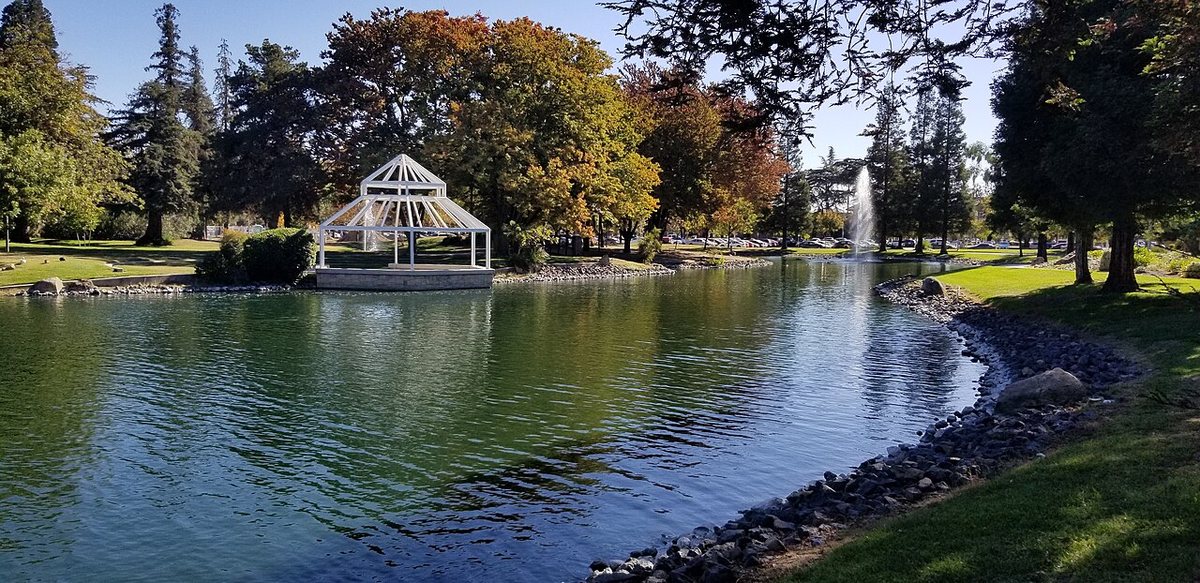
The main campus is at One University Circle, Turlock, along Monte Vista Avenue. From Highway 99, the university’s directions lead east on Monte Vista to University Circle and the reflecting pond. Open the campus map before choosing a parking lot: a gallery, an arena and a concert hall can put you on different sides of the grounds.
The Parking Gateway currently lists daily permits at $6, with hourly permits at $2 an hour in Lot 1 near the library. Organized admissions tours send complimentary parking details after confirmation. For performances and games, use the parking information supplied with that event. A free exhibition and free parking are separate questions.
From the county fairgrounds to a permanent campus
The state established Stanislaus State College in 1957. Instruction began on September 19, 1960, at the Stanislaus County Fairgrounds, and the first commencement awarded 25 degrees at Turlock High School in 1961. The college moved to its permanent 228-acre campus in 1965, initially with a library, classroom building and essential service facilities. It gained university status and its California State University, Stanislaus name in 1985. The university’s official history follows that progression.
Turlock’s college story also belongs to the city around it. A Congressional tribute to Mayor Enoch Christoffersen credits his work on the committee that secured the college for Turlock. Our mayor history traces that civic connection. The move changed the town’s possibilities: a local university became a place to prepare teachers, pursue a new profession and bring visiting performers and ideas into the community.
The lakes have a job to do
The water features are more than a pleasant backdrop. In its 2026 remembrance of President Emerita Marvalene Hughes, the university describes four lakes and the reflecting pond as a 12-million-gallon landscape water-management system. Hughes led the university from 1994 to 2005 as its first woman and first African American president. The entrance pond was dedicated in her honor in 2017.
That is a useful detail to carry on a campus walk: the scenery is also infrastructure. Read our Marvalene Hughes profile for the leadership story behind it. For another way to look more closely, the Campus Tree Story Map introduces species including blue oak, coast redwood and giant sequoia. Pick a few to recognize rather than treating every tree as anonymous shade.
Art on campus, and art downtown
The University Art Gallery is in the campus Theatre Building. Its events are free and open to the public, and the gallery is wheelchair accessible. Exhibition dates give you a more useful plan than simply arriving at the building: displays change, and a reception can offer a chance to hear an artist explain the work.
The university also operates Stan State Art Space downtown at 226 N. First Street, Turlock. Its Main Gallery presents contemporary artists; a separate BFA Gallery shows current student work. The listed regular hours are Wednesday through Friday, noon to 5 p.m., with extended reception hours. That makes it a natural addition to a downtown afternoon, even when you are nowhere near the main campus.
Hear a concert, see a play or follow the Warriors
The School of the Arts supplies separate music and theatre ticket links. Use the performance listing for its venue and audience information; a recital and a mainstage production are different outings. The campus history records the Performing Arts Complex opening in 1970 and the Bernell and Flora Snider Music Recital Hall in 2003. Those buildings help explain why the university is also one of Turlock’s cultural destinations.
For sports, the Warriors’ composite calendar brings the teams’ schedules together, including soccer, basketball, baseball, softball, volleyball and track. Choose a home event and follow its venue and ticket link. The calendar also includes away contests, so the opponent’s name alone does not tell you where to go. A home game can be an easy way to join campus life without knowing anyone on a team.
A campus voice on the dial
You can hear another side of Stan State on KCSS 91.9 FM. The university’s noncommercial, student-run station is a laboratory for radio production courses and a place for student and community voices. It connects the campus to people who may never enter a classroom here. Listen on the radio or through its online stream; our local radio and television guide puts it alongside the other stations serving Turlock.
A place to research the town itself
The Vasché Library’s Special Collections and University Archives hold local photographs, oral histories, manuscripts and newspapers. A full archive of the Turlock Journal and its predecessor titles is available on microfilm in the library’s periodicals stacks. Rare and local-history materials can be requested for the Special Collections Reading Room by appointment.
For a demolished school, an old family business or a street that changed beyond recognition, these collections can provide something a general web search misses. Start with the online archive catalogue and contact the library with a specific name, place or date. Our Turlock history pages offer starting points for that kind of investigation.
If you are considering studying here
Book an individual, family or group campus tour to hear about academics and student life from a current student. The usual guided walk lasts about an hour; housing tours are arranged separately. For a first visit as a resident, the university event calendar is the best next step. Find a public event that interests you, then add time to see the campus that grew from those fairground classrooms.
