
A bronze peach picker stands outside a former bank in downtown Hughson. Together, the statue and the building introduce the city unusually well: farming made the town, and residents have kept the records of that work close at hand.
Updated 2026.
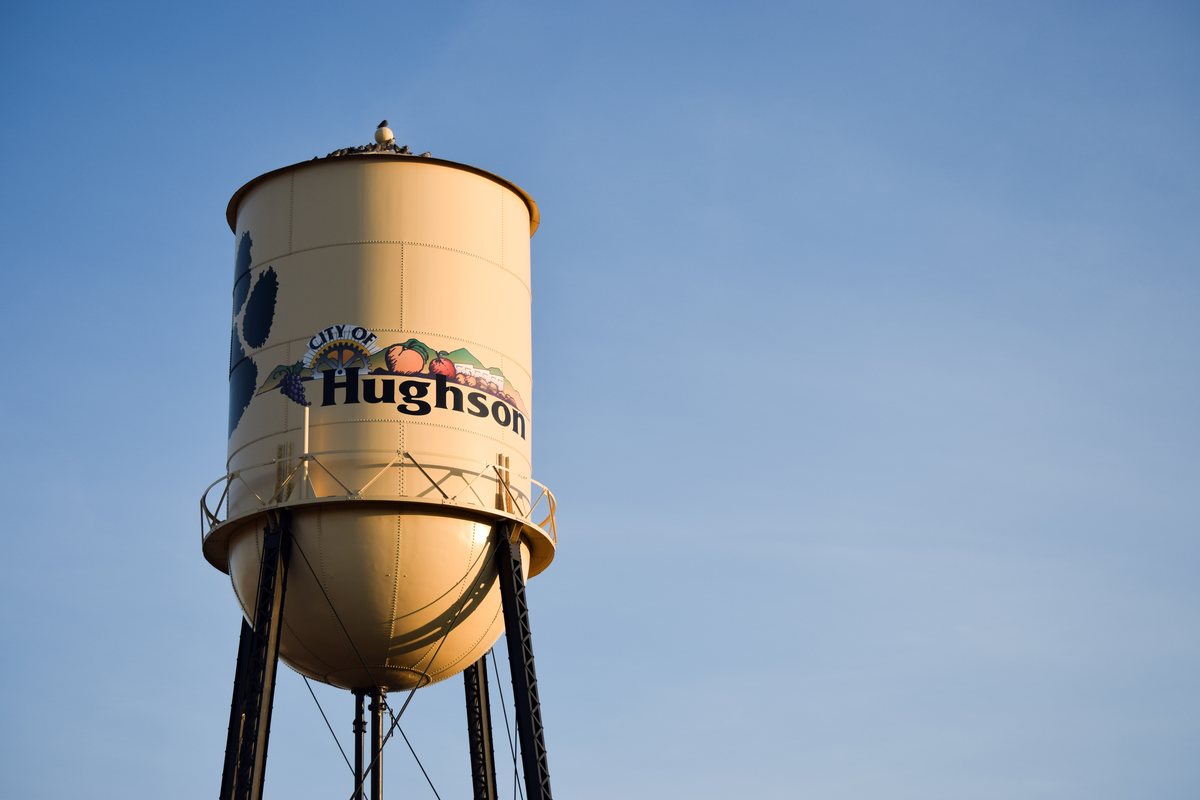
From grain shipments to peach country
Hughson’s agricultural history reaches back well before its incorporation as a city in 1972. The Hughson Historical Society traces nineteenth-century farming families along the south bank of the Tuolumne River. Grain initially dominated. Irrigation later supported alfalfa, livestock, fruit and vegetables, with peaches becoming a major crop around 1920.
Those peaches linked Hughson directly to its neighbors. Some went fresh to market; others were dried or hauled to the Pratt-Low cannery in Modesto and the Hume cannery in Turlock. The society records a period when Hughson was called the “Peach Capital of the World,” with receiving docks beside the Santa Fe railroad.
The depot took Hiram Hughson’s name. In 1907, Hughson sold land to Charles Flack and C. W. Minnear, whose Hughson Town Company laid out streets and sold lots. A less expected detail in the society’s history: oil salvaged from overturned railroad tank cars was used to oil the streets in 1935. Agriculture, transportation and town-building repeatedly overlap in Hughson’s story.
Start at the museum on Hughson Avenue
The Hughson Historical Museum occupies the original Bank of Hughson building at 6944 Hughson Avenue. Check the society’s calendar for an open house before making a special trip; this is a volunteer-run museum.
The Turlock Journal’s museum feature describes school yearbooks, football memorabilia, 4-H and FFA jackets, military uniforms and household objects. That range gives farming history a human scale: the children, clubs and families who lived around the orchards. The museum has been in this building since 2004.
Hughson Avenue remains the downtown’s main commercial street. A museum open house makes a natural anchor for a walk through the business district. The historical society’s calendar also follows local meetings, homecoming and holiday activities.
Margaret Sturtevant’s living legacy
For a different kind of local history, visit Hughson Arboretum & Gardens at 2490 Euclid Avenue, near Whitmore Avenue. Margaret Sturtevant began planting trees for the future arboretum in 1994, according to a 2025 Stanislaus Connections feature.
Hughson’s General Plan records a 2000 donation of 13 acres and the establishment of the nonprofit organization. What began as a resident’s tree collection became a public place with an educational purpose.
The garden’s mission includes native plants and trees of historic value. Its published visiting hours are sunrise to sunset, with occasional private-event closures. Leashed dogs are welcome. This is the stop to choose for a walk among trees and plants; use its calendar to check access.
Parks and the city’s agricultural celebration
- Rolland C. Starn Memorial Park: 1914 Tully Road. Starn Park includes a ball field and picnic spaces; the city offers park rentals. For organized activities and family events, follow Hughson Parks, Recreation & Entertainment.
- Hughson Fruit & Nut Festival: the spring downtown celebration connects the town’s farming identity with vendors and a classic-car show. The chamber’s 2026 festival page advertised April 25–26. Look to the Hughson Chamber for the next announced edition.
- Hughson Library: 2412 A Third Street. The county directory links current service hours and branch information.
For city business, Hughson City Hall is at 7018 Pine Street. The city website carries meetings, local services and recreation notices.
Pair Hughson with the Denair guide for another railroad-and-farming community, or Waterford for the Tuolumne River and reservoir outings farther east.
