
One of Turlock’s most widely recognized inventions fits on a wrist. MedicAlert began with Marion and Chrissie Collins trying to protect their daughter Linda after a frightening allergic reaction. Its lasting contribution was larger than the metal bracelet: a way to connect a stranger treating an emergency with information that only a patient or family might otherwise know.
The story joins a Turlock medical practice, a teenager’s departure for college, a telephone number engraved in metal and a family’s living room. In 2026, the organization those efforts produced marked its seventieth anniversary.
Updated 2026.
The cut that changed a family’s life
Marion Collins grew up in Turlock and met Chrissie Woolcock in eighth grade. After medical school, he returned to practice alongside his brother James. That family connection makes the episode behind MedicAlert particularly striking. In the summer of 1953, fourteen-year-old Linda cut her finger while her parents were away. Her uncle James treated her and administered a skin test before giving tetanus antitoxin. Even that small exposure caused a severe allergic reaction.
Linda survived. Her parents began attaching written allergy information to her clothing and making paper bracelets for trips away from home. The problem was practical: paper could tear or disappear, and neither parent could accompany her everywhere. MedicAlert’s account of Marion and Linda Collins describes the progression from those improvised warnings to a permanent bracelet as Linda prepared to attend Stanford.
Linda’s idea, a jeweler’s work
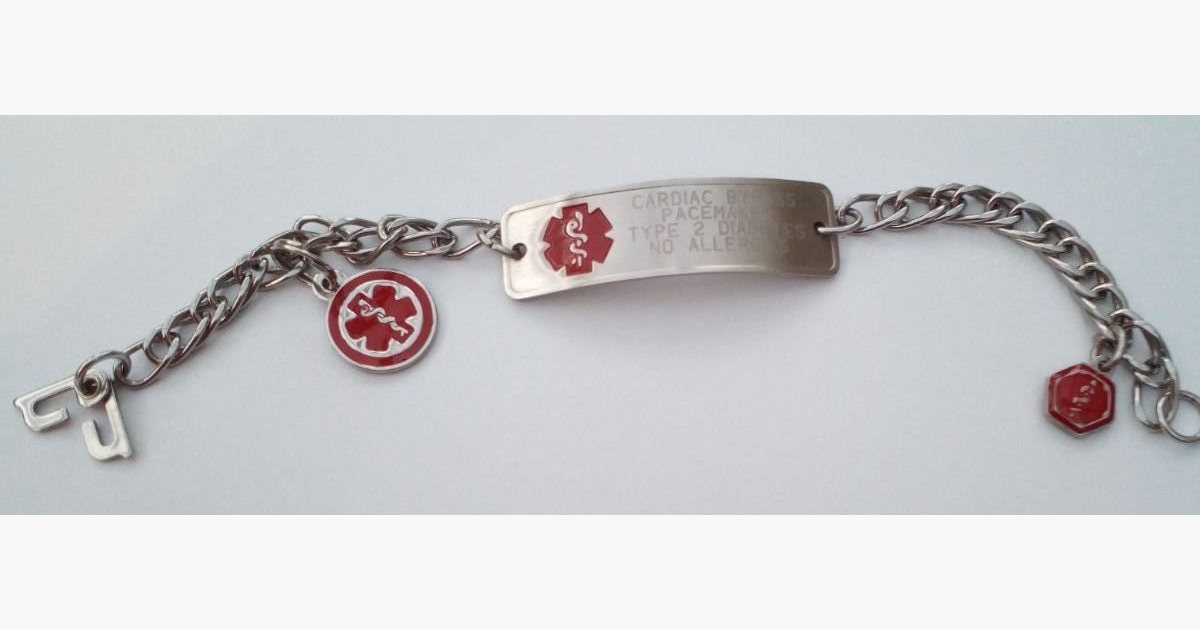
The Smithsonian’s collection record for a MedicAlert bracelet credits Linda herself with suggesting a bracelet. Her father brought a rough design to a jeweler. A medical symbol and conspicuous red lettering identified its purpose; the reverse carried information that an emergency worker could read.
The museum record describes a stainless-steel sample engraved with an allergy warning, a membership number and a Turlock telephone number. It is a useful object to study because the front and back perform different jobs: one attracts attention, while the other supplies the next step. Linda’s original bracelet is also held in the Smithsonian’s collection, according to the foundation’s history.
The Collins family incorporated MedicAlert as a nonprofit in Turlock in 1956. A bracelet could identify a condition, but an identification number could connect its wearer to a much fuller record. That distinction became central to the service.
Why the telephone number mattered
A 1963 report in Time described more than 100,000 Americans wearing the bracelets. At that point, five dollars bought a bracelet and a lifetime medical record kept in Turlock. The engraving directed a responder to call an area-code-209 number, collect, at any hour. A small-town telephone connection was part of a national emergency-information system.
MedicAlert’s milestone history traces the expansion from round-the-clock telephone service in the 1960s to a computerized database in the 1970s. It also records something easily lost in a founder’s biography: Chrissie and Linda continued the work after Marion died. Chrissie later received the American Medical Association’s Citation of Distinguished Service, an unusually high recognition for someone who was not a physician.
The bracelet was the visible part. Maintaining records, answering calls and teaching responders to recognize it were the less visible work that made it useful.
A living room, a bowl of cards and a return downtown
At a 2019 Turlock celebration, the founders’ granddaughter Karry Walker recalled a large bowl on her grandmother’s mantel filled with holiday cards from around the world. Chrissie would open and read them individually. The detail brings the international organization back into a family home.
The Turlock Journal’s reporting on MedicAlert’s homecoming explained that the foundation had moved to Salida in 2015 before returning to Turlock at 101 Lander Avenue in 2019. Its new quarters occupied a building previously used as a bank and a county office.
The same celebration recognized longtime employee Cindy Pacheco with the first Linda Collins Award. Pacheco had spent four decades engraving bracelets. Her work supplies another perspective on the invention: an idea born in one household became a craft and a career for people in its hometown.
What remains of the original idea
MedicAlert’s 2026 anniversary announcement describes QR-enabled IDs, an online member portal and a staffed emergency response center. Those tools differ substantially from the early ledgers and collect calls, but they still address the Collins family’s original problem: getting a person’s medical information to someone who does not know them.
For Turlock, MedicAlert is a story of invention through ordinary circumstances—a local doctor, a daughter with an allergy, a jeweler and a phone. They created a dependable way for information to travel.
Continue with the history of Turlock, the teacher behind Medeiros Elementary, or the Turlock Guide for places and institutions you can explore today.
